Breaking news from the Iran war shook the world this weekend. An F-15E Strike Eagle was shot down over southwestern Iran on Friday, April 3, 2026. Both crew members ejected. One was rescued quickly. The other spent more than 24 hours hiding in a mountain crevice deep inside Iran while Iranian Revolutionary Guard forces hunted him. What happened next became one of the most daring search and rescue operations in US military history. Here is everything you need to know about how Iran brought down two US military aircraft in a single day, and how American special operations forces, the CIA, and dozens of aircraft pulled off a rescue behind enemy lines in the treacherous mountains of Iran.
How Did Iran Shoot Down the F-15E Fighter Jet?
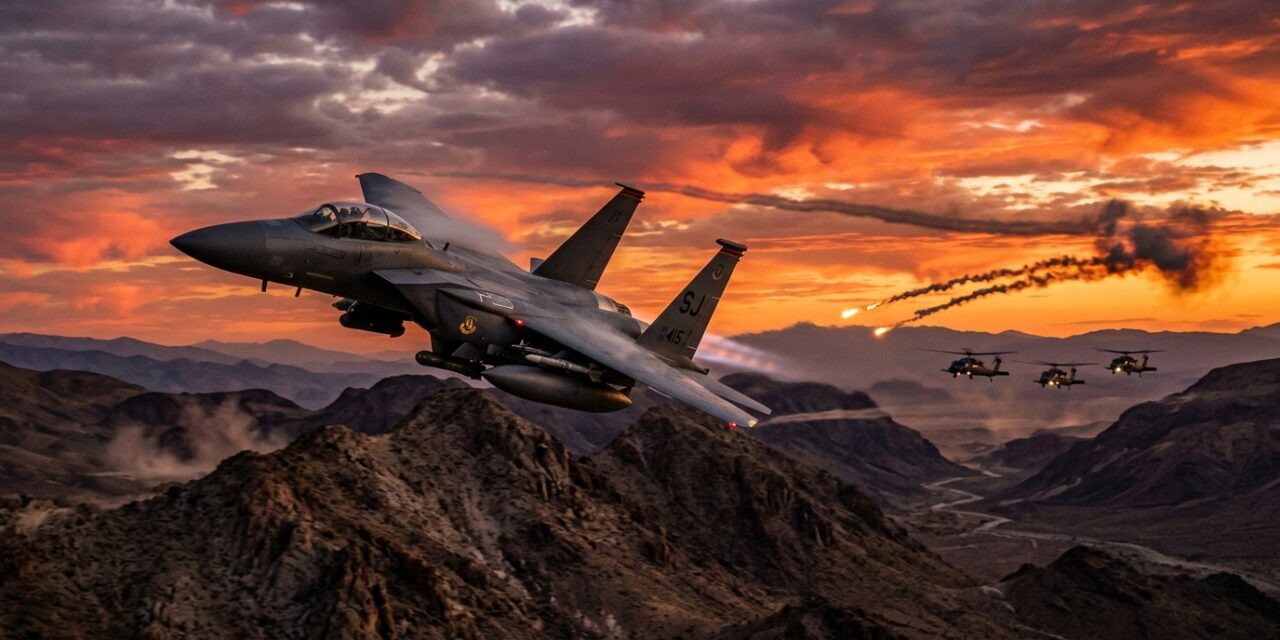
On Friday morning, Iranian air defenses struck an F-15E Strike Eagle flying over southwestern Iran. The F-15E fighter jet is a two-seat aircraft. It carries a pilot and a weapons system officer, commonly called a WSO or “backseater.” When the jet was hit, both crew members were forced to eject over hostile territory.
Iranian state media, specifically the outlet Nour News linked to the Revolutionary Guard, claimed the jet was destroyed by a new advanced air defense system operated by the IRGC Aerospace Force. This was the first US military aircraft shot down over Iran since the war on Iran began on February 28, 2026. It was also the first manned jet shot down in Iran during the conflict. The shootdown punched a hole in weeks of Pentagon claims that Iranian air defenses had been largely destroyed.
An internal Pentagon email obtained by the Associated Press confirmed the military had received notice of “an aircraft being shot down” in the Middle East. Meanwhile, a local affiliate of Iran’s state TV channel began urging residents to find the crew and offered a bounty equivalent to roughly $60,000 for anyone who could capture the enemy pilots alive.
What Happened to the F-15E Crew Members After They Ejected?
The pilot was rescued soon after the crash by US special operations forces who flew into Iranian territory on two rescue helicopters. The two crew members had separated after ejecting. That part of the combat search and rescue mission went relatively fast. But it did not go smoothly. The helicopter carrying the recovered pilot was hit by small arms fire during extraction, wounding crew members on board. The helicopter still landed safely and all personnel received medical treatment.
The F-15 WSO was not so lucky. After ejecting, the colonel landed in a remote area of Iran’s mountainous southwest. He was wounded but could still walk. He hiked up a 7,000-foot mountain ridgeline and hid in a crevice. He activated an emergency beacon. Then he waited. For more than 24 hours, this brave warrior was behind enemy lines in the treacherous mountains of Iran, being hunted by IRGC forces who were getting closer by the hour.
How Did the A-10 Warthog Get Shot Down the Same Day?
The bad news did not stop with the downed F-15. On the same Friday, an A-10 Warthog took fire from Iranian forces while supporting the search and rescue mission for the missing F-15E crew member. The A-10 Thunderbolt II, one of the Air Force’s oldest and most iconic attack jets, was struck near the Strait of Hormuz.
The pilot was able to get the damaged A-10 Warthog out of Iranian airspace and into Kuwaiti airspace before ejecting. The aircraft crashed. The pilot was safely rescued. Iran’s military boasted that its air defense systems had intercepted and struck the American attack jet, calling it the second successful hit on a US military aircraft within 24 hours. US officials disputed some of those claims, with one source telling Fox News the plane caught “enemy fire” during the rescue operation rather than being directly shot down by a dedicated air defense system.
Two US Black Hawk helicopters involved in rescue efforts were also hit by Iranian fire that day. Crew members were injured, but both helicopters remained operational. It was a brutal day for US air operations over Iran.
How Did the CIA Help Locate the Missing Airman Inside a Mountain Crevice?
While rescue crews searched for the missing F-15E crew member, the CIA launched a deception campaign inside Iran. Operatives spread false information that US forces had already found the airman alive and were moving him on the ground for exfiltration. The goal was to confuse Iranian officials who were also racing to capture the American officer.
A senior administration official told NBC News the details. While the Iranians were confused and uncertain, the CIA used what officials called “unique, exquisite capabilities” to search for the missing airman. One official described it as finding a brave American soul inside a mountain crevice, invisible to everyone except the CIA’s technology. The agency immediately shared the WSO’s exact location with the Pentagon, the US military, and the White House.
The CIA also facilitated what is known as an “unconventional assisted recovery.” That process involves the agency contacting civilians willing to aid or shelter US military forces on the ground. Every layer of this rescue operation involved coordination between intelligence and military assets on a scale rarely seen.
What Did the Daring Rescue Mission Look Like?
President Donald Trump ordered an immediate rescue mission once the CIA confirmed the airman’s location. The US military sent dozens of aircraft, armed with advanced weapons, deep into Iranian territory. The rescue team included a specialized commando unit from Air Force Special Warfare, backed by a high volume of air cover. Reports indicate the operation involved landing multiple transport aircraft inside enemy territory to create a makeshift remote airbase within Iran.
US Air Force jets conducted strikes against Iranian forces to prevent them from reaching the area where the airman was hiding. The IRGC had sent its own forces to the region to block a rescue, and a firefight broke out. Two C-130 transport planes were intentionally destroyed by US forces at the temporary airstrip to prevent them from falling into Iranian hands after getting stuck. Three replacement aircraft were flown in to complete the mission.
Trump and senior members of his team, including Joint Chiefs Chairman Gen. Dan Caine and Defense Secretary Pete Hegseth, monitored the entire operation from the White House Situation Room. Trump confirmed the rescue on Truth Social just after midnight on Sunday, writing “WE GOT HIM!” The Air Force officer, a highly respected colonel, was seriously wounded but would recover. US forces rescued the missing crew member after the airman was rescued from his hiding spot by a specialized commando team. Trump said it was one of the most daring search and rescue operations in US military history and called it “an Easter miracle.” This was the first time in military memory that two US pilots have been rescued, separately, deep in enemy territory.
What Is the War Against Iran About?
The Iran war, codenamed Operation Epic Fury by the US, began on February 28, 2026. The US and Israel launched a coordinated surprise attack on Iran while nuclear negotiations were still underway. The opening strikes killed Supreme Leader Ali Khamenei and targeted Iran’s nuclear facilities, missile infrastructure, military bases, and government buildings. President Donald Trump said the operation aimed to defend the American people by eliminating what he called imminent threats from the Iranian regime.
The core issues driving the war involve Iran’s nuclear enrichment program, its ballistic missile arsenal, and its network of proxy forces across the Middle East. The US withdrew from the 2015 Iran nuclear deal (JCPOA) in 2018. Attempts to negotiate a replacement deal failed repeatedly. Iran’s position was weakened by the Twelve-Day War with Israel in June 2025, economic sanctions, and a brutal crackdown on domestic protesters in January 2026 that killed thousands. Washington and Jerusalem calculated that military action had a better chance of achieving their objectives than continued diplomacy.
Why Are Israel and Iran Fighting?
The hostility between Israel and Iran goes back decades. Iran has funded and armed proxy groups opposed to Israel, including Hamas, Hezbollah, and Palestinian Islamic Jihad. After the Hamas attacks on October 7, 2023, the conflict between Israel and Iran’s proxy network escalated sharply. Israel struck Iran directly in 2024 and again during the Twelve-Day War in 2025. Iran retaliated with massive missile and drone strikes against Israeli cities.
Israel’s Prime Minister Benjamin Netanyahu has long viewed Iran as an existential threat. The fall of the Assad regime in Syria, which was a key Iranian ally, and the weakening of Hezbollah gave Israel an opening to strike Iran more aggressively. Netanyahu also faces domestic political pressures with elections looming. For Iran, its hostility toward Israel has been a central pillar of regime ideology since the 1979 Islamic Revolution. The late Supreme Leader Khamenei openly called Israel a “cancerous tumor” and promoted Holocaust denial for years.
Why Does America Have Conflict With Iran?
US-Iran tensions trace back to the 1979 Islamic Revolution and the Iran hostage crisis, when 52 American diplomats were held for 444 days. That event shattered diplomatic relations and set a tone of mutual hostility that has lasted more than four decades. Since then, Iran has supported groups that have attacked American forces and interests across the Middle East, including militia attacks on US bases in Iraq and elsewhere.
More recently, Iran’s nuclear ambitions have been the primary flashpoint. The US fears a nuclear-armed Iran would destabilize the entire region and threaten key allies like Israel and Saudi Arabia. Iran’s closure of the Strait of Hormuz since the war began has also caused global economic pain, driving oil prices sharply higher and disrupting one-fifth of the world’s oil supply. As of early April 2026, thirteen US service members have been killed and 365 have been wounded in the conflict involving Iran.
What Was Iran Called in Bible Times?
Iran was known as Persia throughout most of ancient history and in the Bible. The Persian Empire appears extensively in the Old Testament. King Cyrus the Great, who conquered Babylon around 539 BC, is mentioned by name in the Book of Isaiah and the Book of Ezra. He is credited with freeing the Jewish people from Babylonian captivity and allowing them to return to Jerusalem to rebuild their temple.
The country was officially renamed from Persia to Iran in 1935 by Reza Shah Pahlavi. However, the cultural and historical connection between modern Iran and ancient Persia remains strong. The books of Esther, Daniel, and Nehemiah all feature major events set in the Persian Empire. For readers of PatriotPowerLine who follow biblical history, the connection between the ancient land of Persia and the modern nation of Iran adds a layer of historical weight to current events in the region.
How Many US Aircraft Has Iran Shot Down Since the War Began?
Before the F-15E was shot down on Friday, the US had already lost at least 16 MQ-9 Reaper drones over Iran since the war began. Three US F-15 fighter jets were also destroyed over Kuwait in a friendly fire incident early in the conflict, though there were no casualties. The Friday shootdown of the F-15E jet was the first confirmed loss of a manned US military aircraft over Iranian territory.
Adding to the losses, the A-10 that went down near the Strait of Hormuz and the two damaged Black Hawk helicopters show that Iranian air defenses and ground forces remain a serious threat. After the jet was downed, Iranian forces shot at every US aircraft that entered the area. Iran has also claimed to have shot down American F-35 jets on multiple occasions, though the US military has dismissed those claims. Despite Pentagon assurances that Iranian air defenses have been largely destroyed, the events of Friday painted a different picture. Iran shot down or damaged at least four US aircraft in a single day.
What This Rescue Tells Us About What Comes Next in the Iran War
The successful rescue of both crew members from the downed F-15 is a major moment in the Iran war. It demonstrated the reach of US combat search and rescue capabilities, even deep inside hostile territory. It also showed that Iran’s forces are far from defeated. The IRGC was actively hunting the missing airman and nearly reached him before US forces did. An official told reporters that the Iranian forces were “getting closer and closer by the hour.”
Trump said the war in Iran will likely take another two to three weeks. He has threatened to destroy every power plant and bridge in Iran if Tehran does not reopen the Strait of Hormuz. Iran yesterday launched retaliatory strikes against oil, gas, and water facilities in Gulf nations. The rescue of the missing F-15E crew member from behind enemy lines may be the good news story of the week, but the broader conflict is far from over. The US military pulled off one of its most dramatic rescue operations in decades, but the cost of this war continues to climb on all sides.
Key Takeaways
- An F-15E Strike Eagle was shot down by Iran over southwestern Iran on Friday, April 3, 2026. Both crew members ejected and were rescued separately in two different operations.
- The pilot was rescued soon after the crash. The weapons system officer, a colonel, hid in a mountain crevice for over 24 hours while evading Iranian forces before a massive rescue operation extracted him.
- The CIA ran a deception campaign inside Iran to confuse the IRGC and used advanced capabilities to locate the missing airman.
- An A-10 Warthog was also hit by small arms fire and went down near the Strait of Hormuz on the same day. Its pilot ejected safely and was recovered.
- Two US Black Hawk helicopters were damaged by Iranian fire during the rescue efforts.
- The Iran war began February 28, 2026 with a joint US-Israeli attack that killed Supreme Leader Khamenei. It has so far killed over 3,500 Iranians and 13 US service members.
- President Donald Trump called the F-15E rescue “one of the most daring search and rescue operations in US history” and an “Easter miracle.”