Most people who buy a gun for home defense never think about what happens after they pull the trigger. Not the threat. The aftermath. The investigation, the arrest, the trial, and sometimes the prison sentence. This guide covers the best non-lethal and less-lethal options for home defense and everyday carry, from the Byrna launcher to long-gun platforms built for serious stopping power. But we start with the conversation most home defense articles skip entirely: why reaching for a firearm first may be the most dangerous decision you make.
The Legal Risk Nobody Talks About: Even “Good” Shootings Can Ruin Your Life
Even in states with castle doctrine, stand your ground laws, and open carry rights, a defensive shooting almost always means investigation, potential arrest, grand jury proceedings, and legal fees that routinely run six figures. Put the same set of facts on ten different prosecutors’ desks and you may get ten different outcomes. You can be completely justified and still spend two or three years proving it. Surviving the legal aftermath, as any defense attorney will tell you, can be just as costly as surviving the incident itself.
That’s why serious home defense planning starts well before any CQB scenario unfolds. The framework that security professionals use is Deter, Detect, Deny, Delay, Defend. A reinforced door, a monitored alarm, a safe room (sometimes called a panic room), and a less-lethal launcher covering the hallway gives you options at every stage of that chain. The goal is never to reach the last step. And if you do reach it, a less-lethal response is a much easier conversation to have with a prosecutor than a fatality.
The Firearm in Your Nightstand Is Also Available to Your Kids (and Opportunistic Burglars)
Here’s an uncomfortable truth about home defense firearms: the same features that make them useful in a crisis make them dangerous the rest of the time. Quick access means no gun safe. No gun safe means your curious twelve-year-old or your teenager’s visiting friends can find it. The CDC estimates that nearly 4.6 million American children live in homes with at least one loaded, unlocked firearm. That number has real consequences in emergency rooms every year.
Burglars know this too. Residential break-ins happen most often when nobody’s home. If your firearm isn’t locked up because you want it accessible, a burglar who cases your place and waits for you to leave has just found a gun. That gun then ends up on the street or used in another crime. A CO2-powered launcher sitting on your nightstand doesn’t carry the same downstream risk. It won’t chamber a round for someone who doesn’t know how it works, and it’s not a hot commodity for street resale. Less-lethal tools give you meaningful home defense without turning your bedroom into a liability.
The “Home Protected by Firearms” Sign and the Gray Man Problem
You’ve seen these signs. Maybe at a hardware store, maybe in someone’s front yard. “This home is protected by the Second Amendment.” Or the one with a picture of a revolver and a warning about armed residents. The homeowner thinks they’re scaring off criminals. What they’re actually doing is giving every experienced burglar in the neighborhood a piece of highly useful intelligence.
Opportunistic burglars might be deterred. Professionals aren’t. Someone casing a neighborhood for a daytime break-in now knows exactly which house has guns worth stealing. They wait until you leave for work, and your home defense arsenal becomes their inventory. This is the opposite of the gray man approach, which is the tactical principle of not advertising your capabilities, your preparedness, or your assets to anyone who might want to use that information against you. The gray man blends in. The gray man doesn’t have a bumper sticker announcing his carry weapon. And the gray man definitely doesn’t put a sign in his yard telling smart criminals which house to watch.
Non-lethal security tools are naturally more gray man. A Byrna on your hip doesn’t look different from a standard sidearm to most observers. No signage required. No advertisement needed. Your protection stays private.
EDC vs. Home Defense: Why These Are Different Problems That Need Different Tools
Everyday carry and home defense are not the same scenario. When you’re out in the world, you need something concealable, lightweight, and easy to draw quickly. At home, you have more space, more time to grab a larger weapon, and potentially more threats to manage. Treating both scenarios with the same tool is a compromise that serves neither well.
For EDC and travel, pistol-format launchers are the right category. They ride in a holster, fit in a bag, and don’t draw attention. For home defense, long-gun platforms offer more rounds, better accuracy at distance, and significantly more stopping power. A carbine launcher covering your hallway is a completely different threat deterrent than a compact pistol in a holster. The sections below treat each category separately so you can make the right call for each use case.
Best Less-Lethal Pistols for EDC and Travel
These are your carry options. Concealable, manageable, and effective at the ranges where personal defense situations actually unfold. The Byrna launcher family dominates this category for a reason: strong brand support, wide ammunition availability, and a track record that makes them a top choice for civilians and security professionals alike.
| Model | Caliber | Best For | Approx. Price | Notes |
|---|---|---|---|---|
| Byrna Pistols (SD, CL, LE) | .68 cal | EDC, concealed carry, travel | $400–$500 | Legal in all 50 states. Multiple ammo types. User-friendly. Top pick for everyday carry. HIgher quality, less likely to malfunction. |
| Umarex T4E TR50 | .50 cal | Vehicle carry, close-quarters | ~$100–$170 | Compact revolver format. Good for a glove box or center console. Probably too bulky for on-person carry. Prices vary by generation. Some variants only feature a bottom Picatinny accessory rail. |
| Umarex T4E TR68 / HDR 68 | .68 cal | Vehicle carry, stronger impact | ~$150–$200 | More powerful than the TR50. Hits harder. Better suited for the car than for concealed carry. Gets into home-defense territory. |
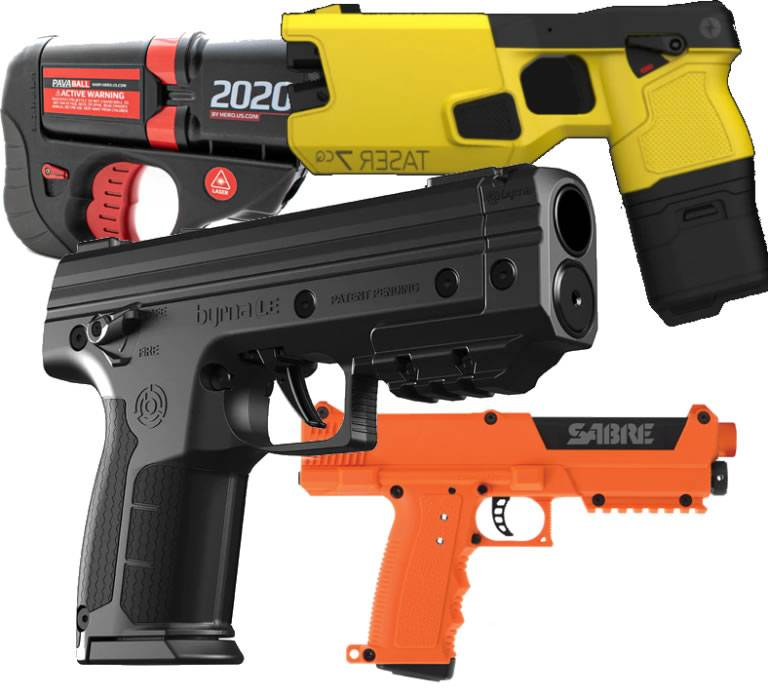
The Byrna SD is the most popular launcher in this category. Powered by CO2 cartridges, it fires .68 caliber chemical or kinetic rounds and operates almost identically to a semi-automatic pistol in terms of draw and trigger pull. The Byrna CL is the more compact variant and is slightly easier to conceal. The Byrna LE is their law enforcement-grade build. All three share the same ammo system and CO2 platform. For most EDC buyers, a standard Byrna pistol with a mixed loadout of kinetic and pepper rounds covers the bases.
The Umarex .50 caliber revolver is worth having in the car, particularly for road trips through unfamiliar areas. It won’t slip into a waistband holster, but it stores easily in a center console and has more punch than pepper spray alone. Step up to the .68 caliber Umarex model if you want more stopping power and don’t need to carry it on your body. Think of it as your vehicle defense option or a bedside backup.
Best Less-Lethal Long Guns for Home Defense
This is where the power equation shifts. Pistol-format launchers are capable tools, but a long-gun platform gives you more velocity, better accuracy at room-length distances, and in some cases higher magazine capacity. If your primary concern is someone coming through your front door at 2 a.m., a carbine or shotgun-format launcher covering your hallway is a meaningful upgrade over a pistol-format device.
The Byrna M4 and Byrna TCR are the standout options in the rifle category. Both fire .68 caliber rounds using the same CO2 system as Byrna’s pistol line, but in a longer barrel format that improves velocity and range. The M4 has the aesthetic profile of an AR-platform rifle, which carries its own deterrent value. The TCR (Tactical Compact Rifle) is slightly more streamlined. Either one gives you a powerful less lethal option that an intruder will take seriously the moment they see it.
| Model | Type | Best For | Approx. Price | Notes |
|---|---|---|---|---|
| Byrna M4 | Carbine launcher | Home defense, intimidation factor | ~$900–$1000 | M4-style profile. .68 cal. CO2-powered. High deterrent value. Best primary home defense launcher. This is the closest thing to having a non-lethal AR-15, except it holds a whopping 38 rounds. |
| Byrna TCR | Tactical carbine launcher | Home defense, precision | ~$700–$800 | Compact, lighter than M4. Same .68 cal system. Easier to maneuver in tight spaces. Unlike it’s larger cousin however, it only holds 19 rounds which is still more than many of its lethal cousins, depending on which state you’re in. |
| Umarex T4E HDS 68 (Paintball) | Shotgun launcher | Close-quarters home defense | ~$120–$00 | Double-barrel .68 cal shotgun format. Fires two rounds per trigger pull. Real stopping power at close range. Can use some pretty creative “projectiles” like darts but keep in mind you’re limited to two rounds before reloading. |
| T4E/HDX .68 Shotgun | Shotgun launcher | Chemical or Steel or Rubber Ball home defense | $250-$400 | There is both an Umarex and a P2P version (the latter has orange, similar to Byrna). These boast 16 rounds. Price mostly varies by amount accessories included and stock attached. |
The Umarex T4E HDS 68 shotgun format is worth serious attention for home defense specifically. It fires two .68 caliber rounds simultaneously, meaning every trigger pull puts two projectiles on target. In a hallway or doorway scenario, that matters. The pepper round variant converts the platform into a chemical delivery system. A burst of OC powder at close range in an enclosed space is extremely effective at ending a threat without permanent injury. These aren’t toys and they aren’t paintball markers. They’re purpose-built less-lethal home defense tools.
One note on selecting the right Umarex shotgun: there are variants in the HDS line that fire only one round and require manual reloading between shots. Skip those for home defense. The double-barrel models that fire two rounds per pull are the ones worth your money. The single-shot versions belong at a target range, not your nightstand.
Tasers and Stun Guns: What the Ads Don’t Tell You
Tasers and stun guns are popular because they’re familiar, widely available, and seem like a clean solution. Point and zap. But there’s a version of the Taser story that rarely makes it into the product listing, and it matters for home defense planning.
The Taser your local officer carries is not the same device you can buy at a sporting goods store. Law enforcement agencies issue models like the Taser X26P or X2, which deliver higher current, have wider probe spread, and are significantly more reliable at penetrating heavy clothing or reaching someone in a physical rage state. Consumer models like the Taser Pulse and Bolt are intentionally limited in both power output and probe deployment. The result is a device that works well under ideal conditions and underperforms when conditions aren’t ideal, which is most real-world defensive scenarios.
Stun guns are even more limited. They require direct skin contact or very thin clothing to be effective. They provide no standoff distance. If an intruder is across your living room, a stun gun is useless until you’re within arm’s reach, which is exactly the position you don’t want to be in. Against someone under the influence of stimulants or in a genuine rage state, a consumer stun gun may produce pain but not reliable incapacitation.
That’s not to say these tools have no value. A Taser on your hip is better than nothing. Stun guns can end a fight at close range and are easy to carry. But when you’re comparing them directly to a Byrna launcher or a less-lethal long gun for home defense, the gap in effective range, reliability, and stopping power is real. For home defense specifically, distance is your friend. Tools that require contact take that advantage away.
What Is the Best Non-Lethal Home Defense?
The best non-lethal home defense is a layered system, not a single product. Strong doors, motion-activated lighting, and a loud alarm handle the perimeter. A less-lethal long gun in an accessible location covers the interior. A CO2 launcher on your nightstand handles close-quarters. Pepper spray in the kitchen gives you a backup. Each layer buys you options and time.
If you’re choosing a single device, the Byrna M4 or TCR for home-stationary use and a Byrna pistol for personal carry gives you the most complete less-lethal self-defense setup available to civilians right now. Trusted by law enforcement and security professionals in professional contexts, both platforms are backed by real-world performance data and broad ammo availability.
What Is the Best Non-Lethal Weapon for Home Defense?
For pure home defense use, the Byrna M4 and the Umarex T4E HDS 68 shotgun are the strongest options on the market. The M4 gives you a rifle profile with Byrna’s proven .68 caliber CO2 system. The Umarex shotgun gives you a double-barrel close-quarters platform that puts two rounds downrange per trigger pull, loaded with either kinetic or pepper rounds depending on your preference.
The best non lethal weapon for your specific situation depends on your home layout. Long hallway? The carbine format gives you range and accuracy. Small apartment? The shotgun format’s close-range punch and chemical effect make more sense. Both deliver serious stopping power without the legal and physical consequences of lethal force.
Are Byrna Guns Worth It?
Yes, for most buyers. The Byrna gun is not a paintball marker and it’s not a novelty. It’s a serious non-lethal self-defense weapon designed to stop a threat and give you time to escape or seek help. For anyone who cannot or will not use a real firearm, the Byrna pistol offers the most credible civilian substitute available. The brand recognition alone carries weight: Byrna has invested heavily in law enforcement and security professional relationships, which gives it a legitimacy that obscure alternatives lack.
Pricing runs $300 to $400 for a complete kit. That’s less than a mid-range firearm plus the ongoing costs of ammunition, a concealed carry permit, and training. For a non-lethal self-defense option that’s user-friendly and backed by broad retailer support, the value holds up well. For buyers who already own a firearm, adding a Byrna less-lethal launcher rounds out a complete defense strategy rather than replacing it.
What Are the Drawbacks of a Byrna Gun?
Byrna launchers have real limitations. CO2 performance degrades below about 40 degrees Fahrenheit, so cold-weather reliability is a genuine concern in northern climates. Magazine capacity is limited, typically 5 to 8 rounds, and reloading under stress is not trivial. These are less-lethal rounds, not non-lethal: kinetic projectiles fired at close range can break skin, cause bruising, or injure vulnerable areas. The term less-lethal is used deliberately by the industry, not as a marketing hedge.
There’s also the CO2 cylinder issue. The launcher only works if a charged, properly installed CO2 cartridge is seated correctly. A dead cylinder or a poor install in a dark bedroom at 2 a.m. is a serious problem. Regular readiness checks are mandatory, not optional. Finally, some municipalities treat CO2 launchers as regulated weapons despite their federal legality. Always check your local laws before purchasing, carrying, or storing one.
Can I Legally Carry a Byrna?
Byrna is legal in all 50 states at the federal level. No background check, no firearm license, no waiting period. That’s a major part of its appeal as an everyday carry option. State and local laws vary, however. Some jurisdictions regulate compressed air launchers or restrict the chemical rounds Byrna fires. New York, New Jersey, and Hawaii have historically been more restrictive. Always verify your local laws before purchasing or carrying.
For most U.S. states, no concealed carry permit is required because the Byrna is not classified as a firearm. A reputable Byrna premier dealer can direct you to current state-level legal guidance. When in doubt, contact local law enforcement or an attorney before carrying in unfamiliar jurisdictions.
Are Rubber Bullets Legal?
Generally yes. Rubber bullets and impact rounds are legal for civilian purchase and use in most U.S. states. They fall under the broader less-lethal ammunition category alongside plastic, foam, and bean bag rounds. Kinetic rounds are the least regulated. Chemical rounds like pepper ball projectiles and tear gas-based ammunition face more varied restrictions at the state and local level. Items may be restricted at the city or county level even when legal statewide, so verify before buying.
What Is the Most Heavily Armed State in America?
Wyoming consistently ranks as the most heavily armed state by firearms per capita, with estimates suggesting more than 200 guns per 100 residents. Montana and Alaska follow closely. Long hunting traditions, minimal restrictions, and rural geography where law enforcement response times can be significant all contribute. Even in these states, less-lethal options serve a real purpose. Not every threat situation justifies deadly force, and a neighbor dispute, an unstable family member, or an unknown person on the property can all be situations where a launcher gives you options that a real firearm does not.
What Race Had Guns First?
Gunpowder was invented in China during the Tang Dynasty, around the 9th century CE. Early fire-based weapons and primitive firearms followed in China before the technology spread west through the Islamic world and into Europe. European nations, particularly Portugal, Spain, and England, developed and militarized firearms most aggressively during the 15th and 16th centuries. So the accurate answer is that Chinese inventors created gunpowder, and European nations industrialized and spread firearms technology globally.
The global diffusion of firearms over the past millennium is a useful reminder that weapons technology never stops evolving. The less-lethal launchers available today represent the latest development in a very long story, and they offer options that previous generations of defenders simply didn’t have.
What You Should Walk Away With
- Even in gun-friendly states like Florida, home defense shootings can result in decades in prison. The Gainesville homeowner sentenced to 22 years in early 2026 is a stark reminder that castle doctrine and stand your ground laws don’t guarantee outcomes.
- Quick-access firearms that protect you from intruders are equally accessible to your children and to burglars who case your home when you’re not there.
- Advertising that you own guns (yard signs, bumper stickers) is the opposite of the gray man approach and can make your home a target for professional thieves looking for firearms to steal.
- EDC and home defense are different problems. Byrna pistols are the top choice for everyday carry and travel. Byrna carbines (M4, TCR) and Umarex T4E shotguns are the stronger option for home-stationary defense.
- Consumer Tasers are significantly less powerful than law enforcement models. Stun guns require close contact. Neither provides the standoff distance or stopping power of a less-lethal launcher.
- The Byrna SD, Byrna CL, and Byrna LE are the leading less-lethal pistol options. Byrna products are legal in all 50 states at the federal level, though local laws vary.
- The Umarex T4E HDS 68 shotgun in double-barrel format is the standout close-quarters home defense launcher. Avoid the single-shot variant.
- Kinetic rounds are legal almost everywhere. Chemical pepper ball rounds face more restrictions. Always verify local laws before buying or carrying.
- A layered approach (alarm, lighting, launcher, pepper spray) beats any single device for comprehensive non-lethal security.