
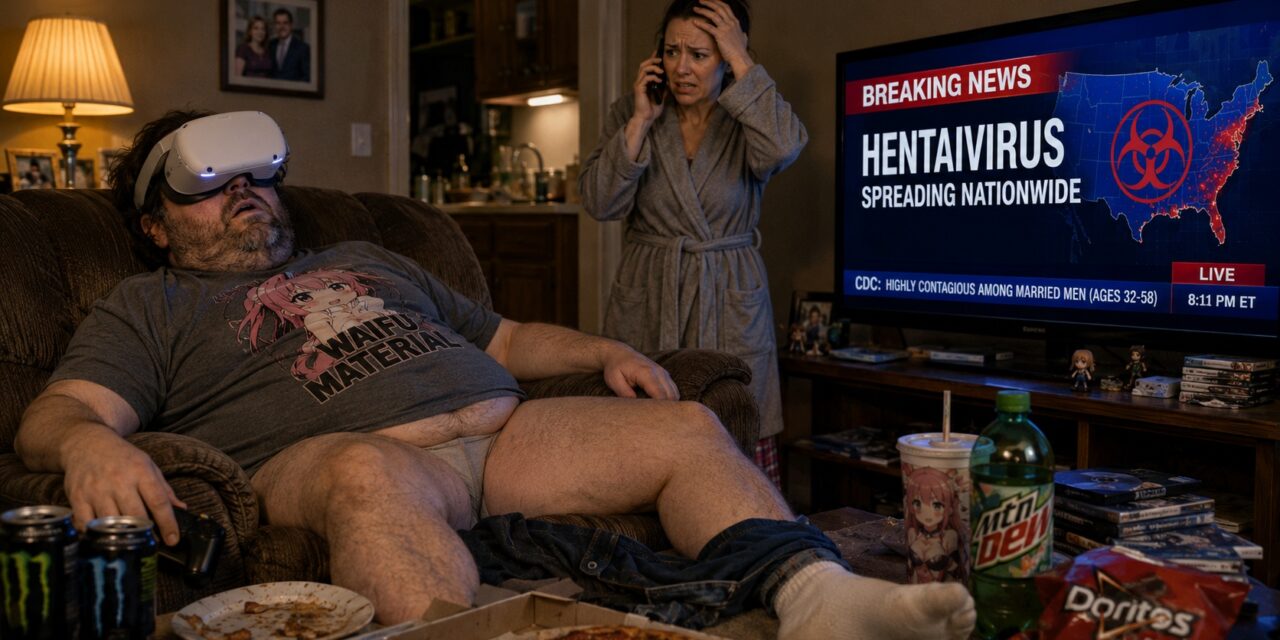
ATLANTA — Federal health officials and a coalition of unusually concerned wives are sounding the alarm this week over HentaiVirus, a rapidly spreading digital-biological hybrid pathogen that experts say is silently incapacitating married men across the heartland at rates not seen since the Great Fantasy Football Outbreak of 2014.
The Centers for Disease Control and Prevention, working in coordination with the newly-stood-up Bureau of Suspicious Browser History (BSBH), confirmed Tuesday that confirmed cases have now been documented in all 50 states, three time zones, and at least one Bass Pro Shops parking lot.
“This is the most aggressive pathogen we’ve tracked since the Marvel Cinematic Universe,” said Dr. Howard Pemberton, lead epidemiologist at the BSBH, speaking from a podium that he asked us not to describe. “Patient Zero is believed to be a 43-year-old HVAC technician from Toledo who told his wife he was ‘just checking the score.’ He has not been seen since.”
What Is HentaiVirus?
HentaiVirus (scientific name: Hentaius Virusiloti maritalus) is a novel pathogen that combines the worst elements of malware, midlife crisis, and the autoplay function on a popular Japanese animation aggregator site. Once contracted, the virus embeds itself in the victim’s WiFi router, browser cache, and ability to make eye contact during dinner.
Unlike traditional viruses, HentaiVirus does not spread through sneezing, coughing, or shared surfaces. Instead, it propagates through:
- A single tab opened “by accident”
- Reddit recommendations from a user named xXShogun_DaddyXx
- Telegram groups labeled “Investigation Material”
- Discord servers your wife definitely should not look at
- That one Twitter thread you swore you closed before bed
Who Is Most At Risk?
While the virus is non-discriminatory in its eventual reach, the BSBH reports that married men between the ages of 32 and 58 are showing infection rates approximately 847% higher than the general population.
“We’re seeing it especially in men whose wives have recently started book club, or whose youngest just left for college,” explained Dr. Pemberton. “There’s a vulnerability window that opens around 9:47 PM and closes only when the bedroom light comes back on. We call it the Hentai Hour. The science is still developing.”
Other high-risk groups include:
- Men who own more than one La-Z-Boy
- Anyone who has ever said “I just like the story of these shows”
- IT professionals (occupational exposure)
- Anyone with a desktop computer in a room with a door that locks
- Veterans of long-haul trucking
- Husbands who suddenly volunteered to take the dog out at midnight
Identified Superspreader Event: Anime Expo
Initial reports incorrectly identified San Diego Comic-Con as the primary vector event, but BSBH epidemiologists have since clarified that SDCC has been “demographically diluted by Marvel dads” to the point of statistical irrelevance.
The actual ground zero, researchers now confirm, is Anime Expo, the annual Los Angeles convention drawing more than 110,000 attendees to the LA Convention Center each summer.
According to internal CDC data, married men aged 35 to 54 who attended Anime Expo within the past 24 months show infection rates approximately 2,300% higher than the general married male population — a figure Dr. Pemberton described, with audible exhaustion, as “the single largest risk multiplier we have ever recorded for any condition since the introduction of the smartphone.”
In response, the CDC has issued a Level 3 Travel Health Notice for the Los Angeles Convention Center, advising married men to:
- Reconsider non-essential attendance
- Avoid prolonged contact with body pillows
- Limit dealer’s hall exposure to no more than two hours per day
- Absolutely, under no circumstances, enter the dealer’s hall after 4:00 PM Saturday
The BSBH has additionally established mobile screening stations at the convention perimeter, where attendees are offered free testing, marriage counseling referrals, and a discreet rear exit through a loading dock for those who request it without making eye contact.
Anime Expo organizers have issued a defiant joint statement calling the federal advisory “an overreaction,” “frankly kind of judgmental,” and “honestly bad for ticket sales.” A spokesperson who declined to give their full name told reporters: “Look, if anything, this is going to be our biggest year yet.”
Smaller but statistically significant secondary outbreaks have been traced to Otakon (Washington, D.C.), Anime NYC, Crunchyroll Expo, and any Barnes & Noble with a manga section taller than the customer browsing it.
Which Devices Are Affected?
The BSBH has released a preliminary platform breakdown, and the data tracks closely with existing malware distribution patterns. Approximately 67% of confirmed cases trace back to Windows PCs, with Android phones accounting for another 23%.
“That’s the same story we see with every threat,” said Dr. Pemberton. “Larger attack surface, more permissive ecosystems, more sideloaded software, and — frankly — that’s where the husbands are.”
macOS and iOS infections remain comparatively rare, accounting for roughly 4% combined, though officials caution this may simply reflect underreporting among Apple users, who tend to assume they cannot get viruses and therefore rarely check. Linux infections are statistically negligible, though the few documented patients reportedly will not stop talking about it.
But the real anomaly, researchers say, is the Meta Quest line of VR headsets.
Despite representing less than half of one percent of household compute devices in the United States, the Quest 2, Quest 3, and Quest Pro are showing infection rates roughly 412% higher than baseline expectations — what epidemiologists call extreme overindexing and what statisticians call we honestly cannot explain this.
“We’re at a loss,” admitted Dr. Pemberton, visibly fatigued. “There is no structural reason a strap-on face computer should be a primary infection vector. And yet. Every single Quest household we’ve surveyed has reported at least one symptomatic individual. The men say they’re ‘just exploring the metaverse.’ We have no further questions at this time.”
The CDC has issued a non-binding advisory recommending that men in possession of a Meta Quest be observed by a trusted family member for a minimum of 30 days, with particular attention paid to any VRChat session lasting longer than four hours, any newly-installed avatar with cat ears, and any sentence beginning with the words “so there’s this Japanese world…”
Recognizing The Symptoms
The CDC has released the following diagnostic criteria. If you or a loved one exhibits three or more of the following, immediate intervention may be warranted:
- Slamming the laptop shut at the sound of approaching footsteps
- Suddenly clearing browser history “for performance reasons”
- A new and unexplained interest in Japanese culture
- Saying “I was researching for work” when you do not work in research
- Inexplicable familiarity with phrases like “subbed vs. dubbed”
- Glassy, sleep-deprived expression typically reserved for new fathers
- Defensive posture when handed a phone to “look at this real quick”
- Sudden purchase of a second monitor “for productivity”
“My husband used to talk to me,” said one Ohio woman who asked to remain anonymous. “Now he just says he’s ‘checking emails’ and disappears for four hours. He doesn’t even have a job.”
The Hidden Economic Cost
A recent study from the Heritage Institute For American Productivity estimates that HentaiVirus costs the U.S. economy $74.3 billion annually in lost productivity, untouched honey-do lists, and unmown lawns. The Department of Labor has classified it as the third-leading cause of “I’ll get to it this weekend.”
How To Protect Yourself And Your Family
This is the part where, federal officials stress, the joke ends and you actually pay attention. Whether or not you’re worried about HentaiVirus specifically, every American with a router should be running basic digital hygiene. The same habits that protect you from the metaphorical virus protect you from the real ones — keyloggers, ransomware, banking trojans, and the quiet kind that just sit there harvesting your data.
Here is the actual, non-parody guidance:
1. Install a real antivirus and keep it on. Bitdefender, ESET, and Malwarebytes are widely recommended for home use. Windows Defender is genuinely solid if you keep it updated. Run full system scans at least monthly.
2. Update your operating system and software. A shocking percentage of malware infections exploit vulnerabilities that were patched months or years ago. Enable automatic updates on Windows, macOS, your browser, and your router firmware.
3. Use a password manager. Bitwarden (free), 1Password, or Dashlane. Stop reusing the same password across sites. When one gets breached — and one will — every other account you own becomes vulnerable.
4. Turn on two-factor authentication everywhere. Email, banking, social media, anywhere it’s offered. Use an authenticator app (Authy, Google Authenticator) rather than SMS when possible — SIM swapping is real.
5. Don’t click sketchy links. Most malware still arrives via phishing — fake shipping notifications, fake bank alerts, fake password reset requests. Hover over links before clicking. Verify the actual URL. When in doubt, navigate to the site directly.
6. Be cautious with browser extensions. Every extension you install can read everything you do in your browser. Audit what you have installed and remove anything you don’t actively use.
7. Use a VPN on public WiFi. Coffee shops, hotels, and airports are happy hunting grounds for credential thieves. ProtonVPN, Mullvad, and NordVPN are reputable options.
8. Back up your data. A 3-2-1 backup strategy (3 copies, 2 different media, 1 offsite) protects you against ransomware, hardware failure, and your own mistakes. External drives plus a cloud backup like Backblaze covers most households.
9. Lock down your router. Change the default admin password. Update its firmware. Use WPA3 encryption if available. Set up a guest network for visitors and IoT devices.
10. Don’t pirate software. Cracked installers are one of the most common malware delivery mechanisms in existence. The “free” version of that $200 program is rarely actually free.
What Comes Next
There is no vaccine for HentaiVirus. There is no cure. There is only vigilance, communication with your spouse, and the discipline to keep your software patched and your browser history empty for legitimate reasons.
Stay safe out there, patriots. Update your systems. Hug your wife. And for the love of country — close the tab.