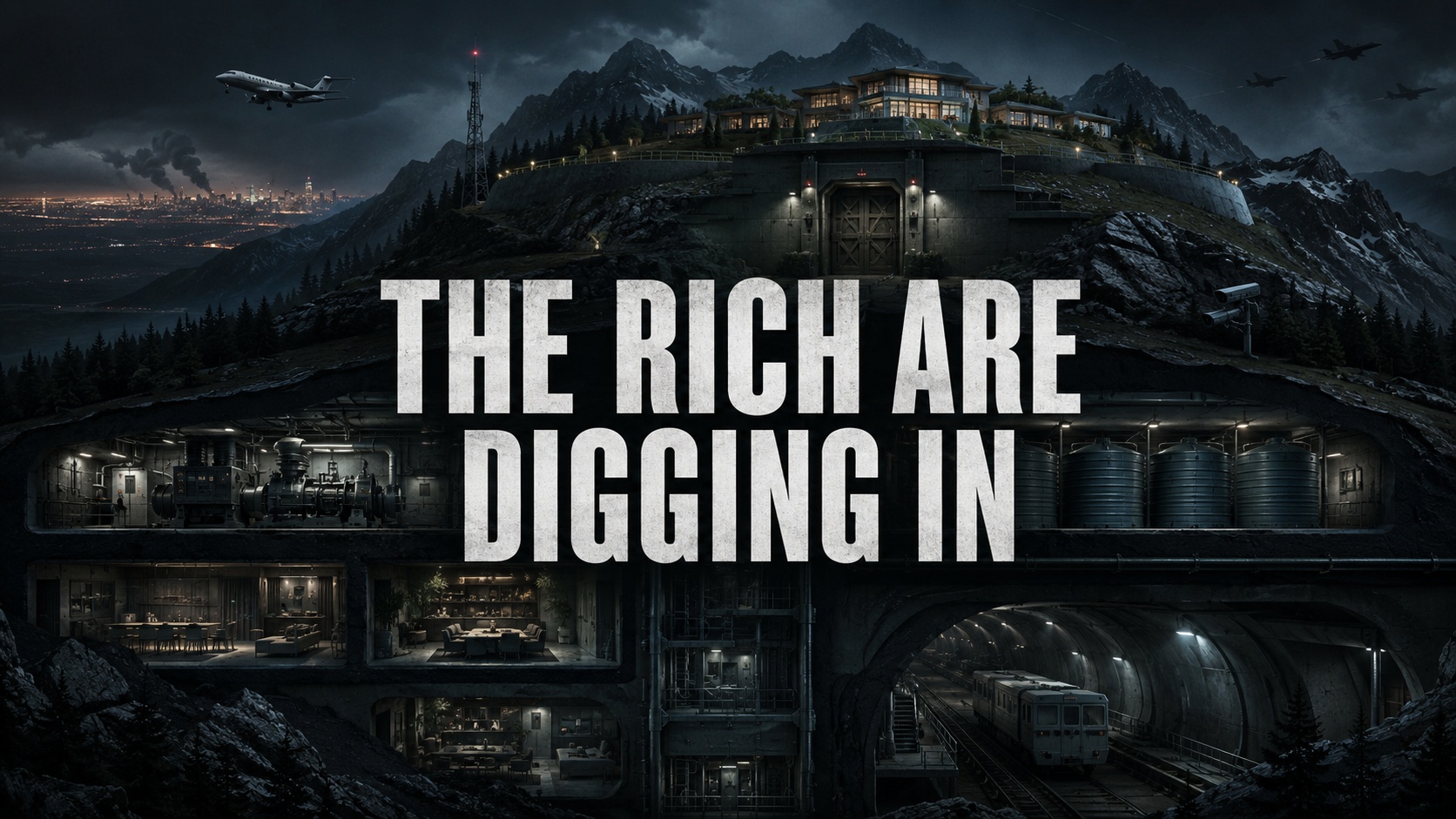
Billionaire Bunkers and the Question Nobody Wants to Ask
Here is something genuinely strange.
Some of the wealthiest people on Earth made their fortunes telling us that the future would be open, connected, efficient, and frictionless. Everything would run through the cloud. Borders would matter less. Technology would solve problems faster than governments could create them.
That was the pitch.
But now, a surprising number of those same people are buying remote farmland, private airstrips, diesel storage, independent water systems, hardened security, steel doors, and underground shelters.
So what happened?
Did the people building the future suddenly lose confidence in it?
And the question that keeps coming back is simple:
What do they know?
To be clear, there is no reliable master list of billionaire bunkers. These projects are private for obvious reasons. They can be hidden behind shell companies, nondisclosure agreements, remote land purchases, and harmless descriptions such as a basement, wine cellar, agricultural facility, or security renovation.
So the stories get exaggerated.
A reinforced basement becomes an apocalypse fortress. A remote vacation property becomes an escape compound. A billionaire buys a farm and suddenly everyone thinks he has received a classified warning about the end of civilization.
Some of that is mythology.
But not all of it.
The bunker boom is real. The exact numbers are not.
LinkedIn co-founder Reid Hoffman once estimated that more than half of Silicon Valley’s billionaires had acquired some form of apocalypse insurance. That did not necessarily mean a buried command center with machine guns and a five-year supply of freeze-dried elk meat. It could mean a remote property, a reinforced shelter, or a second home in a country such as New Zealand.
Still, stop and think about that.
These are people with access to heads of state, intelligence contractors, military technology, financial data, artificial intelligence laboratories, epidemiologists, and some of the most influential private networks in the world.
When people like that start purchasing distance from civilization, it is reasonable to ask why.
Not because it proves a conspiracy.
Because it reveals a loss of confidence.
Zuckerberg’s Very Expensive “Basement”
Mark Zuckerberg’s compound on Kauai is probably the most famous example.
Public reporting based on property records, construction documents, interviews, and sources familiar with the project describes Koolau Ranch as a roughly 1,400-acre estate. The total investment, including the land, has been estimated at more than $270 million.
That is not a house.
That is a territory.
The development reportedly includes two mansions connected by a tunnel and an underground shelter measuring approximately 5,000 square feet. Plans have described independent food and energy capabilities, extensive surveillance, soundproof doors, and an escape hatch.
Zuckerberg has pushed back against the doomsday language. He has described the underground structure as a small shelter, something more comparable to a basement.
Okay.
Technically, that might be true.
It is just a basement underneath an enormous, highly controlled private compound with farmland, water, power, communications, surveillance, physical security, and significant distance from dense population centers.
That is one hell of a basement.
The important issue is not what Zuckerberg calls it. The issue is how the entire property functions.
- It has land.
- It has food potential.
- It has water.
- It has shelter.
- It has security.
- It has energy.
- It has layers.
That last part matters.
A bunker is not simply a steel door in the ground. A real survival system is made of overlapping layers. Food backs up stored food. Solar backs up the grid. Fuel backs up solar. Wells back up municipal water. Security protects the equipment. Distance protects the security.
That is called depth.
One reinforced room is a product.
A remote, self-supporting estate is a system.
And when one of the most powerful technology executives in the world builds a system like that, people are naturally going to ask whether he is worried about something the average person is not seeing.
Maybe he just values privacy.
Maybe it is insurance.
Maybe it is a status symbol.
Or maybe people who spend their lives studying global systems understand how fragile those systems really are.
Peter Thiel and the Southern Escape Plan
Peter Thiel has been connected to New Zealand for years in reporting about elite survival planning.
He obtained New Zealand citizenship in 2011 and purchased property there. A company associated with him later proposed a large lodge near Wānaka on the South Island. The structure would have been partially embedded into the hillside and capable of accommodating the owner and a substantial number of guests.
Local authorities rejected the plan in 2022 because of its visual impact on the landscape.
So the proposed project was bunker-like.
It was also never built.
That distinction is important because the internet has a way of turning architectural plans into completed underground kingdoms.
But Thiel’s interest in New Zealand is not imaginary.
In a widely discussed 2016 interview, OpenAI co-founder Sam Altman described preparations for several catastrophic scenarios, including nuclear war, engineered pandemics, and dangerous artificial intelligence. His reported supplies included antibiotics, water, gas masks, batteries, iodine, firearms, and land in California.
He also said that, in a severe crisis, his backup plan involved flying to Thiel’s property in New Zealand.
That is an incredible statement.
It sounds like something from a movie where the technology executives know the asteroid is coming but keep everyone else distracted with a product launch.
Again, it does not prove secret knowledge.
But it shows you how these people think.
They do not simply imagine disruption. They make plans for it.
And New Zealand makes sense on a risk map.
It is far from most nuclear powers. It is far from many obvious strategic targets. It has agricultural land, freshwater, a relatively low population density, and an enormous ocean surrounding it.
It also sits deep in the Southern Hemisphere.
That matters more than most people realize.
Why the Southern Hemisphere Attracts Billionaires
New Zealand, Tasmania, parts of Australia, Patagonia, and other remote southern regions are sometimes described as refuges from global catastrophe.
They are not guaranteed safe zones.
They are hedges.
Most of the world’s nuclear arsenals, military alliances, strategic industrial centers, and likely counterforce targets are located in the Northern Hemisphere. If a large nuclear exchange occurred, a remote property in the Southern Hemisphere might have a lower chance of experiencing a direct blast or immediate local fallout.
That does not mean it escapes the consequences.
A nuclear war between major powers would not remain a northern problem.
Smoke and soot from burning cities could enter the atmosphere and spread across the planet. Temperatures could fall. Sunlight could decline. Growing seasons could shrink. Food production could be disrupted across both hemispheres.
One major peer-reviewed study estimated that food shortages following a full-scale nuclear war between the United States and Russia could threaten more than five billion people.
Five billion.
At that point, the question is not whether your bunker has a movie theater.
The question is whether anything outside your bunker still functions.
Some models suggest that portions of the Southern Hemisphere could experience smaller agricultural losses than heavily affected northern regions. The outcome would depend on the number and size of weapons used, which cities burned, how much soot reached the upper atmosphere, weather patterns, crop selection, and how long the disruption lasted.
New Zealand has been identified as one of several island nations that might maintain enough domestic food-production potential to feed its population during a nuclear winter.
But potential is not readiness.
That is the trap.
A nation can produce enough calories and still fail to distribute them.
Modern agriculture depends on diesel, machinery, replacement parts, fertilizer, electronics, refrigeration, transport, irrigation, financial systems, and communications. New Zealand imports refined fuel, medicines, industrial components, and specialized equipment.
The cows might still be standing in the field.
But who repairs the milking system?
Who keeps the trucks running?
Who replaces the pump?
Who manufactures the antibiotics in year three?
Where does the fertilizer come from?
How do you move food when electronic payments stop functioning and fuel is being rationed?
The same problem applies to a billionaire estate.
The ranch may grow vegetables. The generator may work. The water tanks may be full.
For how long?
A self-sufficient property is often only self-sufficient until the first critical component breaks.
The Southern Hemisphere may provide distance from a blast.
It does not provide distance from global dependence.
The AI Fear Underneath the Concrete
Nuclear war is easy to visualize.
There is a flash. There is fallout. There are maps showing likely targets. There are shelter calculations and radiation measurements.
Artificial intelligence is different.
How exactly do you build a bunker for a machine that can potentially access financial systems, communications networks, infrastructure, satellites, industrial controls, biotechnology, and cybersecurity tools?
You cannot hide from software by putting a thicker door on your basement.
Still, many leading AI researchers and technology executives have publicly warned that advanced AI could create catastrophic risks. Those risks include automated cyberattacks, engineered biological threats, mass manipulation, infrastructure disruption, and the possibility that humans could lose meaningful control over increasingly capable systems.
In 2023, executives including Sam Altman, Demis Hassabis, and Dario Amodei joined researchers in a public statement arguing that the risk of human extinction from AI should be treated as a global priority alongside pandemics and nuclear war.
That does not prove an AI catastrophe is imminent.
It proves that people close to the technology consider extreme outcomes serious enough to discuss publicly.
Now ask yourself something.
If that is what they are willing to say publicly, what are they discussing privately?
Maybe the private conversations are calmer.
Maybe they are more alarmed.
We do not know.
For the billionaire prepper, the fear may not involve humanoid robots marching through the streets. It may involve the second-order consequences of powerful, poorly controlled technology:
- Grid instability.
- Banking disruption.
- Automated cyberwarfare.
- Loss of communications.
- Supply-chain collapse.
- Political panic.
- Synthetic pathogens.
- Mass unemployment.
- Civil unrest.
A bunker could protect someone temporarily from some of those consequences.
It would be far less useful against a genuinely superintelligent system with access to global infrastructure.
Concrete can block radiation.
It cannot block strategic irrelevance.
Luxury Is Not the Same as Survival
The private shelter industry sells everything from relatively simple prefabricated structures to enormous custom-built underground compounds.
Companies advertise blast-resistant walls, filtered air, independent power, water storage, decontamination rooms, medical facilities, hydroponics, communications centers, private bedrooms, swimming pools, theaters, gyms, and wine cellars.
Some companies advertise simpler installations in the range of $200,000 to $400,000. Bespoke projects can cost $5 million, $10 million, or much more.
These figures often come from the companies selling the systems, so they should be treated as promotional estimates rather than a transparent market index.
The luxury features make the headlines.
The boring features keep you alive.
- Air exchange matters.
- Water purification matters.
- Waste management matters.
- Fire suppression matters.
- Food rotation matters.
- Medical isolation matters.
- Replacement filters matter.
- Radiation monitoring matters.
- Power management matters.
- A theater is good for morale.
- It does not keep carbon dioxide from building up in a sealed room.
- A wine cellar looks great in the brochure.
- It does not repair a damaged sewage pump.
Military and civil-defense doctrine has always been blunt about this. Survival depends on identifying likely hazards, planning before the emergency, maintaining functional equipment, and knowing how to operate it under pressure.
The shelter is only one component.
For nuclear fallout, the basic protective principles remain time, distance, and shielding. Get inside. Put dense material between yourself and radioactive particles. Reduce contamination. Avoid unnecessary exposure.
An expensive underground structure can perform those functions extremely well.
It can also fail in spectacular ways.
Has the ventilation system been tested under a full load?
Can the filters be changed while the outside environment is contaminated?
Can the occupants manage a dirty entrance without spreading radioactive material throughout the facility?
Can the sewage system operate during a prolonged power failure?
Can the shelter function without outside technicians?
A bunker that depends on a customer-service hotline is not ready for the end of customer service.
The Real Weakness Is Human
The most vulnerable part of the billionaire bunker is not the blast door.
It is the human beings behind it.
Author Douglas Rushkoff has described meeting wealthy technology figures who were deeply concerned about maintaining control of their security personnel after money stopped having value.
That question tells you everything.
A billionaire may own the land.
But the guards may control the weapons.
The engineers may understand the ventilation system.
The farmers may know how to produce food.
The medical staff may control the medicine.
The mechanics may be the only people who can keep the generators alive.
What happens when the bank accounts no longer matter?
What happens when the salary is just a number stored on a dead server?
What happens when the person who owns the bunker is the least useful person inside it?
This is where the fantasy starts to crack.
Wealth can buy hardware.
It can buy secrecy.
It can buy land.
It can buy walls, cameras, tunnels, and biometric locks.
It cannot automatically buy loyalty.
Loyalty is not a feature you install.
It is something you build over time through trust, fair treatment, shared purpose, family security, clear rules, conflict resolution, and a believable future for everyone involved.
A facility containing one billionaire, twenty employees, and no legitimate social structure is not a fortress.
It is a pressure cooker.
The billionaire may believe he has hired a team.
In a genuine collapse, he may discover that the team has been tolerating him because direct deposit arrived every other Friday.
When direct deposit disappears, the social order changes very quickly.
What the Online Skeptics Get Right
Online conversations about billionaire bunkers generally fall into three categories.
The first group believes the wealthy have received secret intelligence about a specific coming event.
There is very little public evidence supporting that conclusion.
The second group sees the bunkers as luxury insurance. A billionaire can spend a tiny fraction of his wealth on a shelter in the same way an ordinary family buys smoke detectors, insurance, or emergency water.
That explanation is much more plausible.
The third group sees these projects as modern castles. They are symbols of wealth, privacy, status, control, and separation from ordinary society.
That explanation can also be true.
A bunker can be insurance and theater at the same time.
The online critics also identify real vulnerabilities. They point to exposed air intakes, limited fuel, maintenance requirements, isolation, internal conflict, fixed locations, and the difficulty of remaining hidden after hundreds of contractors and local workers have participated in construction.
That last point is important.
Operational security can conceal a door.
It cannot erase years of land purchases, concrete deliveries, road construction, aircraft movements, unusual utility projects, contractors, guards, and local gossip.
People notice.
And in a true crisis, the knowledge that a billionaire has food, fuel, medicine, and filtered air becomes a security problem by itself.
The public sees more than preparedness in these compounds.
It sees inequality turned into architecture.
One group gets farmland, independent power, private security, medical facilities, and hardened shelter.
Everyone else gets an emergency notification telling them to remain calm.
That resentment matters.
The existence of the bunker can help create the threat the bunker was designed to resist.
Old Survival Manuals and New Threats
Traditional survival manuals remain valuable because they focus on fundamentals.
Plan before panic begins.
Protect your water supply.
Reduce unnecessary exposure.
Build redundancy into critical systems.
Train with your equipment before your life depends on it.
Never assume that owning the gear means you know how to survive.
Those principles apply whether you own a $100 million compound, a suburban basement, or a small emergency kit stored in a closet.
Older nuclear-survival manuals also contain useful material on fallout shielding, ventilation, sanitation, shelter construction, contamination control, and radiation measurement.
But some of their scientific assumptions are dated.
For example, the 1987 edition of Nuclear War Survival Skills questioned whether nuclear winter would make survival nearly impossible. Modern climate modeling and food-system research provide a stronger basis for expecting severe global agricultural consequences after a large nuclear exchange.
The older material may remain useful for field techniques.
It should not automatically be treated as the final word on modern nuclear-climate science.
That leads to a broader lesson.
Survival information expires.
Filters expire.
Fuel degrades.
Batteries fail.
Medical guidance changes.
Technology changes.
Threat models change.
Update the plan before the emergency updates it for you.
So What Do the Billionaires Actually Know?
Here is the honest answer.
Probably not one single thing.
The wealthy are not all preparing for the same event.
- One person fears nuclear war.
- Another fears a pandemic.
- Another fears political instability.
- Another fears climate disruption.
- Another fears artificial intelligence.
- Another fears the electrical grid going down.
- Another simply wants privacy and enough land to avoid interacting with ordinary human beings.
The common denominator is not necessarily secret intelligence.
It is declining trust in public systems.
People with almost unlimited money are buying private alternatives to infrastructure that the rest of us are expected to rely upon.
- Their own water.
- Their own electricity.
- Their own food.
- Their own transportation.
- Their own security.
- Their own communications.
- Their own medical capacity.
- They are purchasing redundancy.
That does not prove the end is near.
But it does reveal something important.
Some of the people who benefited most from globalization no longer assume that the global machine will continue running forever.
That is the real signal.
These people built fortunes by understanding systems, incentives, leverage, and risk. They watched governments respond to pandemics. They watched supply chains seize up. They watched political trust collapse. They watched cyberattacks shut down infrastructure. They watched wars appear in places that were supposed to be stable.
They may not know the date of a coming disaster.
They may simply understand that complex systems can fail suddenly, and that the cost of preparing is insignificant compared with their wealth.
A $20 million bunker to a billionaire might be the equivalent of an ordinary person buying a backup generator.
But there is still something eerie about it.
The people telling everyone else that technology will create abundance are buying farms.
The people building artificial intelligence are collecting gas masks.
The people who made billions connecting the world are purchasing islands and planning how to disconnect from it.
Maybe that is rational risk management.
Maybe it is paranoia.
Maybe it is guilt.
Maybe it is status.
Maybe it is all of those things at once.
What Ordinary People Should Take From This
The lesson is not that every family needs an underground mansion.
The useful lesson is to copy the logic, not the luxury.
- Store a practical amount of drinking water.
- Keep food that can be prepared when the grid is down.
- Maintain basic medical supplies.
- Know where the best fallout protection exists in your home or community.
- Keep backup lighting and communications available.
- Create more than one evacuation route.
- Build relationships with people you trust.
- Learn skills that remain useful when technology fails.
- Test your preparations instead of assuming they work.
A billionaire might spend $100 million creating layers of protection.
An ordinary household can still improve its resilience through planning, several weeks of supplies, basic shelter knowledge, reliable communications, practical competence, and a community capable of working together.
Money is a force multiplier.
Competence is also a force multiplier.
And community may be the most important multiplier of all.
THE LAST DOOR IS NOT THE PLAN
The bunker is the most visible part of the system.
It is not necessarily the most important part.
A steel door can buy time.
Distance can reduce exposure.
Stored food can bridge a disruption.
A Southern Hemisphere retreat might avoid some of the immediate effects of a major northern conflict.
None of those things creates permanent safety.
Eventually, someone must maintain the machinery.
Someone must grow food.
Someone must treat illness.
Someone must resolve conflict.
Someone must decide who enters and who remains outside.
Survival still comes down to logistics, judgment, maintenance, accurate information, and human cooperation.
The billionaires are digging because they can afford to insure themselves against events that might never happen. Some are purchasing peace of mind. Some are building status symbols. Some are making a cold calculation about nuclear risk, pandemics, artificial intelligence, climate pressure, civil unrest, and political instability.
Most are probably doing all of those things.
The concrete is real.
The certainty is not.
But the question remains.
Why are some of the most informed, connected, and powerful people in the world quietly preparing to live without the systems they helped create?
What have they seen?
What are they expecting?
And, most importantly:
What do they know that the rest of us do not?
Source Note
This article draws on public reporting, property and planning information described by journalists, peer-reviewed nuclear-climate research, public statements by artificial-intelligence researchers and executives, online discussions used as a measure of public sentiment, and military and civil-defense survival literature.
Private shelter specifications, undisclosed properties, and vendor performance claims are difficult to verify independently. The existence of elite survival preparations does not, by itself, establish that wealthy individuals possess secret knowledge of a specific coming catastrophe.