The Douma chemical attack was not a mystery with no evidence. It was not a media hoax. It was not a staged White Helmets production. And it was not “debunked” by a few cherry-picked leaks pushed by Aaron Maté, Grayzone, and the wider class of online grifters who built a cottage industry out of laundering Assad and Kremlin talking points.
The Douma Case in 10 Quick Points
- The OPCW concluded that chlorine was used as a weapon in Douma on April 7, 2018.
- The OPCW’s later IIT report found that the Syrian Arab Air Force dropped the chlorine cylinders from helicopters.
- The physical damage, cylinder locations, chemical findings, witness accounts, and flight evidence all supported an aerial chlorine attack.
- Russian and Syrian forces controlled Douma before inspectors arrived, creating a serious opportunity for evidence tampering and witness intimidation.
- OPCW access was delayed, and a UN security team was forced to withdraw after gunfire and an explosion near the inspection area.
- The OPCW could not directly examine the main dead victims because the bodies from the residential building had already been removed and buried before inspectors gained access.
- Deniers fixate on the hospital hosing footage, but the central death scene was a separate residential building where dozens of bodies were found.
- Ian Henderson’s leaked engineering claims were not the official “original report,” and his analysis was contradicted by three independent engineering studies.
- Henderson’s argument also relied on a flawed assumption that the cylinders could not have fallen from less than 500 meters, which Bellingcat showed was unsupported.
- The denialist case only looks strong when readers are shown carefully selected fragments while the fuller OPCW findings and rebuttals are kept out of view.
On April 7, 2018, civilians in the Syrian town of Douma were hit by a chlorine weapons attack during the final phase of the Eastern Ghouta offensive. Years later, the Organisation for the Prohibition of Chemical Weapons, the global chemical weapons watchdog, concluded that the Syrian Arab Air Force was responsible. Its investigators found that chlorine-filled cylinders were dropped from a helicopter operating from Dumayr Airbase, killing dozens of people in a civilian-inhabited area in Douma.
The reason this still matters is simple. The Douma attack became one of the most aggressively distorted war crimes of the Syrian civil war. The deniers did not need to disprove the case. They only needed to flood the zone with selective fragments, half-context, and fake “gotchas” until casual readers felt unsure.
That is the fog of Syria’s propaganda war. This article clears it.
What Happened in Douma on April 7, 2018?
The attack in Douma happened during the Assad regime’s push to retake the last rebel-held pocket of Eastern Ghouta, near Damascus. Witnesses reported helicopters overhead. Soon after, two yellow cylinders were found at separate locations in the city. At one location, a cylinder had crashed through a rooftop area and released chlorine into the building below. Dozens of civilians were found dead inside. The OPCW’s later Investigation and Identification Team said the attack that killed 43 people was caused by a chlorine release from cylinders dropped by the Syrian Air Force.
The OPCW Fact-Finding Mission first established that a toxic chemical containing reactive chlorine had been used as a weapon in Douma. Its 2019 final report found reasonable grounds to conclude that molecular chlorine was present at the sites. The later 2023 OPCW report went further. It attributed responsibility to the Syrian regime.
This distinction matters. The first OPCW report answered, “Was a chemical weapon used?” The later IIT report answered, “Who did it?” The answer to that second question was the Assad regime.
Why the Evidence Points to a Syrian Air Force Chlorine Attack
The OPCW’s 2023 investigation did not rely on one video or one witness. It combined environmental samples, cylinder damage, building damage, helicopter flight data, witness statements, chemical analysis, military assessments, and expert reviews.
The IIT concluded that the airspace over Douma was exclusively controlled by the Syrian Arab Air Force and the Russian Aerospace Defence Forces during the time of the attack. It found no evidence that coalition aircraft were present over Douma. It also tracked Mi-8/17 helicopters taking off from Dumayr Airbase in a time window that matched the attack. The report assessed that the cylinders found at the two sites were dropped by helicopter.
This is where the denialist story begins to collapse. If the cylinders came from the air, the list of plausible perpetrators gets very short, very fast. The opposition did not control the skies. The Syrian government did.
The IIT also considered the conspiracy theory pushed by Assad apologists, namely that the cylinders were manually carried to the sites by armed groups or the White Helmets to stage a fake attack. The OPCW specifically investigated that scenario and found no reliable evidence to support it.
The OPCW Was Delayed, the Scene Was Compromised, and Critics Pretend That Does Not Matter
One of the most dishonest parts of the Grayzone narrative is how it treats the post-attack evidence situation as if the OPCW walked into a pristine crime scene the next morning.
That did not happen.
Russian and Syrian forces controlled Douma after the attack. OPCW inspectors were delayed from entering the city. A United Nations security team doing reconnaissance came under gunfire at the suspected chemical attack site, forcing a withdrawal and further delaying the inspection. This was after the Syrian regime supposedly had control of the city.
The delay mattered. Western governments warned at the time that Russia and Syria had an opportunity to tamper with the scene. Those concerns were not pulled from thin air. Medics and witnesses reported intimidation by regime officials, and some doctors were allegedly pressured into public denials after the suspected chemical attack.
The OPCW also had trouble accessing key evidence. By the time inspectors reached the site of the attack, the bodies from the building had already been removed and buried. The FFM considered exhumation and formally requested Syrian assistance to access interred remains, but the mission did not ultimately obtain those bodies for examination. That is a major investigative limitation, and it cuts against the denialist claim that the absence of certain biomedical evidence somehow proves there was no gas attack.
The Bodies, the Hospital Footage, and the Denialist Bait-and-Switch
This is the core sleight of hand.
Deniers like Aaron Maté and Grayzone obsess over footage from a makeshift hospital in Douma where panicked people were hosed down. They argue that some people in that clinic may not have been chlorine victims, then act as though this disproves the entire Syria gas attack.
It does not.
The deadliest evidence came from a different scene: the residential building where dozens of bodies were found piled on staircases and inside rooms. Those were the victims central to the chemical weapons attack in Douma. The OPCW IIT later concluded that victims at Location 2 were exposed to very high concentrations of chlorine and that their deaths were consistent with the gas spreading through the structure.
So yes, some people at the clinic may have been responding to dust, fear, or confusion during bombardment. That does not explain the bodies in the building. It does not explain the cylinder. It does not explain the chlorine chemistry. It does not explain helicopter activity. It does not explain why the Assad regime and Russia had such a strong interest in turning the clinic footage into the whole story.
This is a classic bait-and-switch. Focus on the weaker or more ambiguous scene. Ignore the one that actually anchors the crime.
Why Aaron Maté and Grayzone’s Douma Story Falls Apart
Maté’s Douma coverage is not just skeptical. It is curated in a way that repeatedly favors the Assad regime’s narrative.
He highlights early dissenting views inside the OPCW but minimizes the later investigative work that answered them. He treats preliminary meeting notes as if they outrank a full multi-year attribution report. He foregrounds a leaked engineering paper while ignoring the expert work that rebutted it. He inflates legal and bureaucratic disputes into proof of a “cover-up,” while gliding past the actual physical and technical evidence.
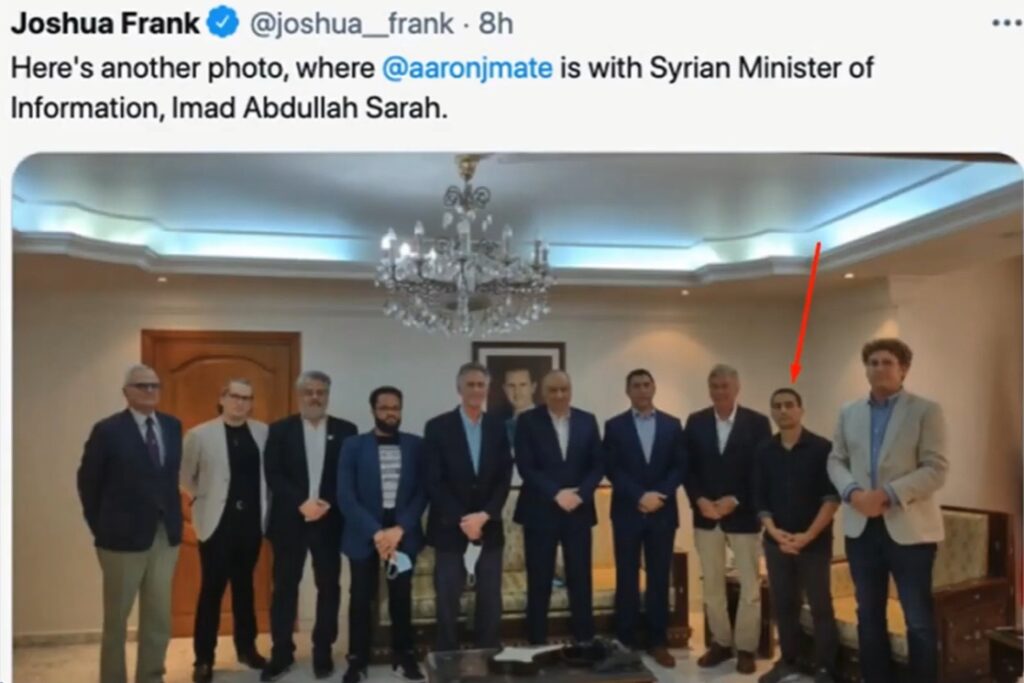
A 2022 study reported by The Guardian identified Maté as the most prolific spreader of Syria-related disinformation narratives among the accounts examined in that research. Maté rejected that characterization. He has also appeared at Russia-hosted UN events promoting the Douma cover-up thesis.
The larger issue is not whether Maté has ever said a literally true sentence. Of course he has. The problem is how he constructs the story. His version of Douma only works if readers are shown a narrow tunnel of handpicked material while contrary evidence remains offscreen.
That is not serious reporting. That is narrative management.
Henderson, Whelan, and the Fake “Original Report” Talking Point
Grayzone’s entire Douma mythology leans heavily on two former OPCW figures: Ian Henderson and Brendan Whelan. Maté often presents their claims as though they were the buried truth from the “original investigators.”
The record is far messier.
The OPCW’s 2020 internal report said Henderson, referred to as Inspector A, was not a member of the FFM and played only a minor supporting role. It also stated that he did not have access to the full body of evidence, including later witness interviews, lab results, and expert analyses. His engineering assessment was not the official “original report.” It was an unauthorized document produced outside the formal process.
Bellingcat later documented serious problems in the Henderson argument, including inaccurate assumptions about cylinder delivery and the dimensions of the impact site. The 2023 IIT report also revisited the engineering issue and concluded that the cylinders could have been delivered from a helicopter and that the roof opening at one location was large enough for the cylinder to pass through.
Whelan’s story is also routinely oversold. The OPCW said he never left the Damascus command post because he had not completed the required training for field deployment. He helped draft the interim report, agreed to the version that was released, and left the OPCW months before the final analytical work was complete. Later, he challenged findings despite lacking access to the large body of evidence gathered after his departure.
This does not mean every concern raised by Henderson or Whelan was automatically worthless. It means Maté’s framing is false. They were not the sole truth-tellers who saw the whole case and were silenced by villains. That is a screenplay, not a sober account of the OPCW process.
The Toxicology Talking Point Is Not the Trump Card Maté Pretends It Is
Maté’s latest line is that the OPCW “buried” toxicology evidence from German military experts who allegedly ruled out chlorine as the cause of death. But again, he is feeding readers one slice of the record as if it is the entire meal.
The toxicology comments he emphasizes were drawn from meeting discussions held before the later OPCW attribution work was completed. Those remarks did not account for the full reconstructed situation: people sheltering indoors because of shelling, victims moving upward inside the building because chlorine is heavier than air, very high concentration exposure, gas dispersion within a confined structure, and later chemical and witness evidence examined by the IIT.
The 2023 OPCW report directly addressed the medical question. It found that the victims’ symptoms were overall consistent with exposure to chlorine gas in very high concentrations. It also concluded that some victims likely encountered the gas while moving from lower floors toward upper levels, which fits the standard instinct during a chlorine attack.
That is why Maté’s argument only sounds devastating if you stop reading early. Once the later OPCW analysis enters the room, the alleged toxicology bombshell loses most of its force.
Has Chlorine Gas Been Used in War?
Yes. Chlorine gas has been used in war for more than a century.
Germany used chlorine gas at the Second Battle of Ypres in 1915 during World War I. It was one of the first major battlefield uses of poison gas and caused choking, lung damage, and death. That history matters because chlorine is not some harmless household chemical when weaponized and released in high concentrations.
In the Syrian civil war, chlorine became one of the Assad regime’s recurring chemical weapons tools. A 2019 study by the Global Public Policy Institute estimated at least 336 chemical attacks in Syria, around 98 percent of them attributable to the Assad regime. Chlorine was central to that pattern.
When Was the Last Gas Attack?
There is no single clean global answer, because allegations emerge in different conflicts and formal investigations can take years. But in the Syrian chemical weapons file, the Douma chemical attack of April 2018 remains one of the most significant late-war attacks later attributed by the OPCW to the Assad regime.
The OPCW has continued investigating older chemical weapons attacks in Syria. In January 2026, it released a fifth IIT report identifying the Syrian Arab Air Force as responsible for a 2016 chemical attack in Kafr Zeita. That report did not concern a later gas attack than Douma. It showed that accountability work is still catching up to crimes committed years earlier.
Which Country Has the Largest Stockpile of Chemical Weapons?
Today, the best answer is this: all declared chemical weapons stockpiles have been verified as destroyed under the Chemical Weapons Convention system. The OPCW announced in 2023 that 100 percent of the world’s declared stockpiles had been eliminated.
Historically, Russia declared the largest stockpile, at nearly 40,000 metric tons. That stockpile was reported destroyed under OPCW verification before the global declared total reached zero.
That distinction matters. “Largest stockpile today” is not the same as “largest stockpile ever declared.”
What Happened in Syria in 2018?
In 2018, the war in Syria entered a decisive and brutal phase around Eastern Ghouta. The Assad regime and its allies pressed hard against opposition-held areas near Damascus. Douma was the last major rebel-held pocket there. The attack on Douma came during that final campaign.
After the suspected chemical attack, the United States, United Kingdom, and France launched strikes against Syrian government-linked chemical weapons facilities. This is the moment people often remember with the simplified headline, “Trump condemns Syria.” More precisely, the Trump administration said the strikes were meant to deter further use of chemical weapons.
Why Did Barack Obama Attack Syria?
He did not, at least not in the way this question usually implies.
After the 2013 Ghouta sarin attack, President Barack Obama threatened military action against the Assad regime and sought congressional authorization. But he did not launch direct strikes on Assad over that chemical attack. Instead, the United States and Russia reached a diplomatic framework to remove Syria’s declared chemical weapons.
Obama did later authorize U.S. military action in Syria against ISIS, not as a direct punishment strike against Assad for chemical weapons use. So the premise needs correcting.
Why Did America Bomb Syria in 2017?
The United States bombed Syria in 2017 after the Khan Shaykhun chemical attack, which the U.S. government attributed to Assad’s forces using the nerve agent sarin. President Donald Trump ordered Tomahawk missile strikes against Shayrat Airfield, which U.S. officials said was used by aircraft involved in the attack.
The Pentagon described the strike as a proportional response intended to deter the regime from using chemical weapons again. That was one year before the chlorine attack in Douma.
What Does the SDF Want in Syria?
The Syrian Democratic Forces have sought security for Kurdish communities, recognition of Kurdish rights, and some form of decentralized governance within a united Syria. After Assad’s fall in late 2024, the SDF entered negotiations with the new Syrian leadership over integration into state institutions.
By early 2026, the issue remained unsettled. Agreements had been announced, but key questions were still disputed, including how much local authority the SDF would retain, how its weapons would be handled, and how Kurdish-majority regions would be governed.
Why the “OPCW Cover-Up” Story Only Works Inside Plato’s Cave
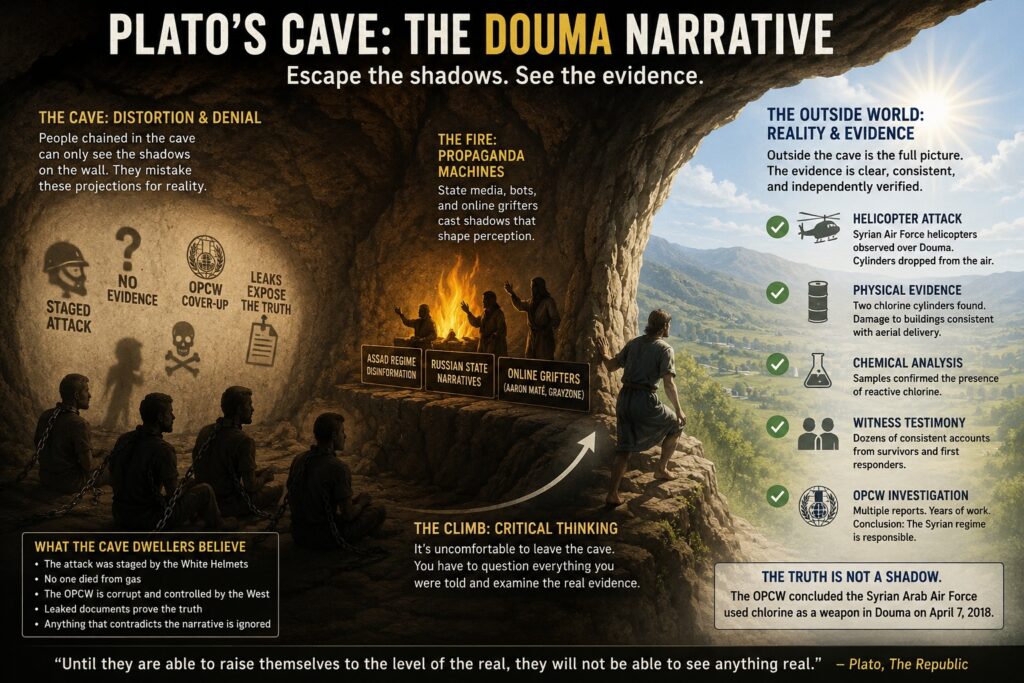
There is no grand mystery here once the full record is visible.
The OPCW found chemical weapons in Douma. Later, it found the Assad regime responsible for Douma chemical use through the Syrian Arab Air Force. The cylinders matched an aerial delivery scenario. Helicopter activity matched the timing. Chemical findings matched chlorine release. The staging theory was examined and rejected. The supposed whistleblower narrative was far less decisive than Maté and Grayzone claimed.
The conspiracy only appears strong when readers are trapped inside a curated shadow play. A leaked draft here. A meeting note there. A hospital clip stripped from the rest of the event. A self-styled dissenter elevated above the complete body of evidence. Then the audience is told the shadows are reality.
That is Plato’s Cave with a Substack subscription.
Outside the cave, the evidence is much clearer.
How We Know the Douma Chlorine Attack Happened, and Why the Deniers Are Wrong
The Douma story can feel complicated because the deniers have spent years turning it into a maze. When critics answer one of their claims, Aaron Maté, Grayzone, and their fellow travelers usually do not answer the rebuttal itself. They simply return to the original talking point, repeat it with more outrage, and trust that most of their audience either never saw the response or got lost in the moving parts.
- The OPCW concluded that chlorine was used as a weapon in Douma. Its 2019 Fact-Finding Mission found reasonable grounds to believe a toxic chemical containing reactive chlorine had been deployed. Its 2023 Investigation and Identification Team went further, concluding that the Syrian Arab Air Force dropped chlorine cylinders on Douma on April 7, 2018.
- The air attack scenario fits the physical evidence. The OPCW found that the cylinders, damage patterns, witness testimony, and military flight information were consistent with aerial delivery. The 2023 report concluded that a Syrian Air Force helicopter dropped the cylinders. The opposition did not control the airspace over Douma.
- The Russians and the Syrian regime controlled the scene before OPCW inspectors got there. Russian military police were deployed in Douma by April 12, while OPCW inspectors did not gain access to the attack sites until later. Western officials warned in real time that the delay gave Russia and the Assad regime time to interfere with evidence.
- The OPCW was delayed from entering Douma. Inspectors arrived in Syria days after the attack but were not immediately allowed to access the sites. The delay was one of the biggest problems in the investigation, especially given that Syria and Russia controlled the territory.
- Even the reconnaissance team had to withdraw after coming under fire. A UN security team scouting the Douma locations for OPCW inspectors faced small-arms fire and an explosion at one site, forcing a retreat. This happened after the Assad regime supposedly had the town under control.
- The OPCW could not directly examine the bodies from the deadly building scene. By the time inspectors entered Douma, the people killed in the residential building had already been buried. The OPCW noted that it could not examine those bodies because it entered the city nearly two weeks after the incident. That absence is not evidence that no one was gassed. It is a consequence of delayed access and lost forensic opportunity.
- Deniers pull a bait-and-switch with the hospital footage. Maté and Grayzone fixate on the makeshift hospital scene where people were hosed down and argue that some of those patients may not have been exposed to chlorine. But those are not the victims whose bodies formed the core of the Douma death scene. The dead were found in a separate residential building. The hospital clip is used as a red herring to distract from the more damning evidence.
- Witness intimidation was a real concern. Medics and witnesses in Douma were reportedly pressured by the Syrian regime after the attack. Some doctors were said to have been intimidated into denying a chemical event. That matters because Assad-friendly narratives often elevate testimony gathered under regime control while dismissing accounts from survivors who escaped it.
- Ian Henderson’s engineering claims were not the buried “original report.” Henderson’s document was a draft engineering assessment submitted outside normal protocol shortly before the final FFM report. The OPCW said he lacked access to the full body of evidence, and three independent engineering studies contradicted his conclusions.
- Henderson’s cylinder argument rested on a flawed assumption. Bellingcat showed that his analysis depended heavily on the claim that the cylinders would have had to fall from more than 500 meters. That assumption was not established and badly weakened his conclusions.
- Brendan Whelan’s objections were also not the final word. The OPCW said Whelan was involved in drafting an interim report, not the final attribution work, and he left the organization before much of the later analysis was complete. Bellingcat also documented leaked correspondence that undercut the Grayzone narrative and suggested key analytical work continued after Whelan departed.
- Grayzone and WikiLeaks promoters did not present the leak record fairly. Bellingcat found that draft correspondence omitted from the public leak campaign challenged the suggestion of an OPCW “cover-up.” In other words, the alleged whistleblower story was itself selectively packaged.
- The German toxicology remarks were not a definitive scientific refutation of chlorine. The comments Maté now touts came from meeting minutes during an early consultation, not a final toxicological determination. The OPCW’s 2023 IIT later consulted a toxicologist and concluded that the victims’ symptoms were consistent with very high concentrations of chlorine gas.
- The “why were people upstairs?” objection is weaker than Maté suggests. The IIT found that victims may have moved upward in the building as chlorine spread, which is consistent with the way people are taught to respond to a heavier-than-air gas. Many civilians were already sheltering indoors because the area was under bombardment.
- The deniers do not defeat the evidence. They curate around it. Their case only seems persuasive when readers see one leaked draft, one toxicology note, one hospital clip, and one dramatic claim about an OPCW conspiracy, while missing the later reports, the physical evidence, the delayed access, the buried bodies, the intimidation of witnesses, and the rebuttals to Henderson and Whelan.
- That is why this feels like Plato’s Cave. Inside the cave, the audience sees shadows: “staged attack,” “OPCW cover-up,” “the original report,” “the hospital footage proves it.” Outside the cave is the fuller evidentiary picture. Once you step out and look at the whole record, the conspiracy story stops looking brave and starts looking flimsy.
The Douma denial narrative survives through selective exposure. The less of the full record you see, the stronger it looks.
Why Do Some Western Commentators Keep Lying for Assad?
The people who keep muddying the waters around the Douma chemical attack are not operating in a vacuum. Their defense of Assad fits into a much larger political habit: treating any enemy of the United States as a misunderstood victim, and any atrocity blamed on that enemy as a Western fabrication until proven impossible to deny.
Sometimes this is best understood as pro-Russia alignment. Sometimes it is old-fashioned campism, the idea that the world is divided into two blocs: the United States and its allies on one side, and an allegedly “anti-imperialist” camp on the other. In that worldview, Russia, Syria, Iran, Venezuela, and sometimes China become presumed victims of Western manipulation almost by default. The abuses of those regimes are downplayed, excused, or reinterpreted as propaganda.
That matters in Syria because Assad was not merely some distant ruler whom Russia happened to defend rhetorically. His regime was a strategic Russian client. Moscow’s 2015 military intervention helped save Assad from possible defeat, and Syria allowed Russia to deepen its military presence through the Tartus naval facility and Hmeimim Air Base. In 2017, Russia and Syria formalized a long-term agreement expanding Russia’s access to Tartus and establishing a more permanent military footprint in the country.
So when Western propagandists or useful idiots reflexively defend Assad, they are often defending a Russian strategic partner as well.
That is why figures such as Aaron Maté and Max Blumenthal do not merely question one OPCW report in isolation. Their Syria commentary sits inside a broader pattern. They have repeatedly promoted narratives that shift responsibility away from Assad and toward Western governments, Syrian rescuers, or supposed intelligence plots. A 2022 study reported by The Guardian identified Maté as the most prolific disseminator of Syria-related disinformation narratives among the network studied, a characterization he disputes. Researchers at the Atlantic Council’s DFRLab have also documented how pro-Russia and pro-China influencers cross-promote state-aligned narratives across topics, from Syria to Ukraine.
The pattern becomes even clearer with Ukraine. Maté has argued that the United States and NATO “provoked” Russia’s invasion through expansion, arms policy, and interference in Ukraine. That framing closely mirrors the Kremlin’s preferred explanation for its 2022 invasion, which Russia itself repeatedly presents as a response to Western aggression rather than a war of conquest.
This does not mean every critic of U.S. foreign policy is a Kremlin mouthpiece. The United States has made catastrophic foreign policy decisions. Iraq is the obvious example. Skepticism is healthy. But skepticism becomes propaganda when it flows in only one direction. If every Western claim is treated as suspect, while Russian, Syrian, Iranian, or Chinese claims are treated as brave truths suppressed by the empire, that is not anti-imperialism. It is just anti-Western credulity.
There are different versions of this tendency. Some commentators seem specifically drawn to defending Russia and, by extension, Russia’s allies. Others, such as certain realist thinkers, are less emotionally invested in Moscow and more strategically focused on the argument that the United States should avoid confrontation with Russia in order to concentrate on China. John Mearsheimer, for example, has long argued that the West bears heavy blame for the Ukraine crisis and has also stressed that China is the larger long-term strategic threat. Tucker Carlson occupies yet another lane: soft toward Moscow in certain contexts, but often sharply hawkish toward China. These figures are not identical to Maté or Blumenthal, and they should not all be collapsed into one category.
Then there are the lower-information contrarians who present themselves as radically independent but somehow end up echoing nearly every anti-Western state narrative that crosses their feed. Caitlin Johnstone is a clear example of this style. DFRLab noted that she blamed NATO and Ukraine for Russia’s invasion and has boosted narratives aligned with both Russian and Chinese state messaging. This brand of “anti-imperialism” often amounts to repeating the imperial propaganda of every non-Western power while congratulating oneself for seeing through American lies.
The Douma case fits this pattern perfectly. Maté and Grayzone do not need to prove the attack was staged. They only need to make denial feel intellectually rebellious. They offer readers a flattering role: You are not one of the sheep. You see the OPCW cover-up. You know the media lied. You understand the real story. Once people buy into that emotional frame, each new rebuttal becomes just another alleged proof of the conspiracy.
That is why their responses to refutations are so evasive. They usually do not answer the full rebuttal. They repeat the original claim, accuse critics of serving the national security state, and trust that their audience either never saw the counter-evidence or became too disoriented by the sheer number of moving parts to sort it out.
Douma is not just a story about one Syria gas attack. It is also a case study in how modern propaganda works in the West. Not always through official state media. Sometimes it works through self-styled dissidents who insist they are exposing lies while endlessly recycling the narratives of dictatorships.
Key Things to Remember
- The Douma chemical attack happened on April 7, 2018, during the Assad regime’s final offensive against Eastern Ghouta.
- The OPCW Fact-Finding Mission found that chlorine was used as a weapon in Douma.
- The OPCW IIT later concluded that the Syrian Arab Air Force was responsible for the deadly chemical weapons attack in Douma.
- The airspace over Douma was controlled by Syrian and Russian forces at the time of the attack.
- The OPCW investigated the “staged attack” theory and found no reliable evidence supporting it.
- Russian and Syrian control of the scene before OPCW access created major tampering concerns.
- Inspectors were delayed, came under security threats, and never obtained the bodies from the building for direct examination.
- Deniers often focus on the hospital footage while ignoring the fatal residential building scene. That is a bait-and-switch.
- Ian Henderson and Brendan Whelan were not the all-seeing suppressed truth-tellers that Grayzone portrays.
- Aaron Maté’s Douma narrative survives by omission, not by defeating the full evidentiary record.
Sources
- OPCW Releases Third Report by Investigation and Identification Team
- Third Report by the OPCW Investigation and Identification Team: Douma, Syrian Arab Republic, 7 April 2018
- OPCW Issues Fact-Finding Mission Report on Chemical Weapons Use Allegation in Douma, Syria, in 2018
- Final Report of the OPCW Fact-Finding Mission Regarding the Incident in Douma, Syria, on 7 April 2018
- OPCW Report on Possible Breaches of Confidentiality in the Douma Investigation
- The OPCW Douma Leaks Part 4: The OPCW Investigation
- Syrian Regime Found Responsible for Douma Chemical Attack
- Weapons Inspectors Delayed After Gunfire in Syria’s Douma
- U.N. Team Fired Upon in Syria While Visiting Suspected Chemical Sites
- Syrian Medics ‘Subjected to Extreme Intimidation’ After Douma Attack
- ‘Most of Them Were Going to Die’: Syria Aid Workers Tell of Apocalyptic Scenes After Douma Attack
- Nowhere to Hide: The Logic of Chemical Weapons Use in Syria
- OPCW Confirms All Declared Chemical Weapons Stockpiles Verified as Irreversibly Destroyed
- First Usage of Poison Gas
- Statement by President Obama on the U.S.-Russian Agreement on the Elimination of Syrian Chemical Weapons
- Statement from Pentagon Spokesman on U.S. Strike in Syria
- Syria’s Interim President Signs Deal With Kurdish-Led SDF to Merge Forces
- Risk of Missteps Hangs Over U.S.-Backed Ceasefire Deal in Northeast Syria
- OPCW Releases 5th Report to Identify Perpetrators of Chemical Weapons Use in Syria