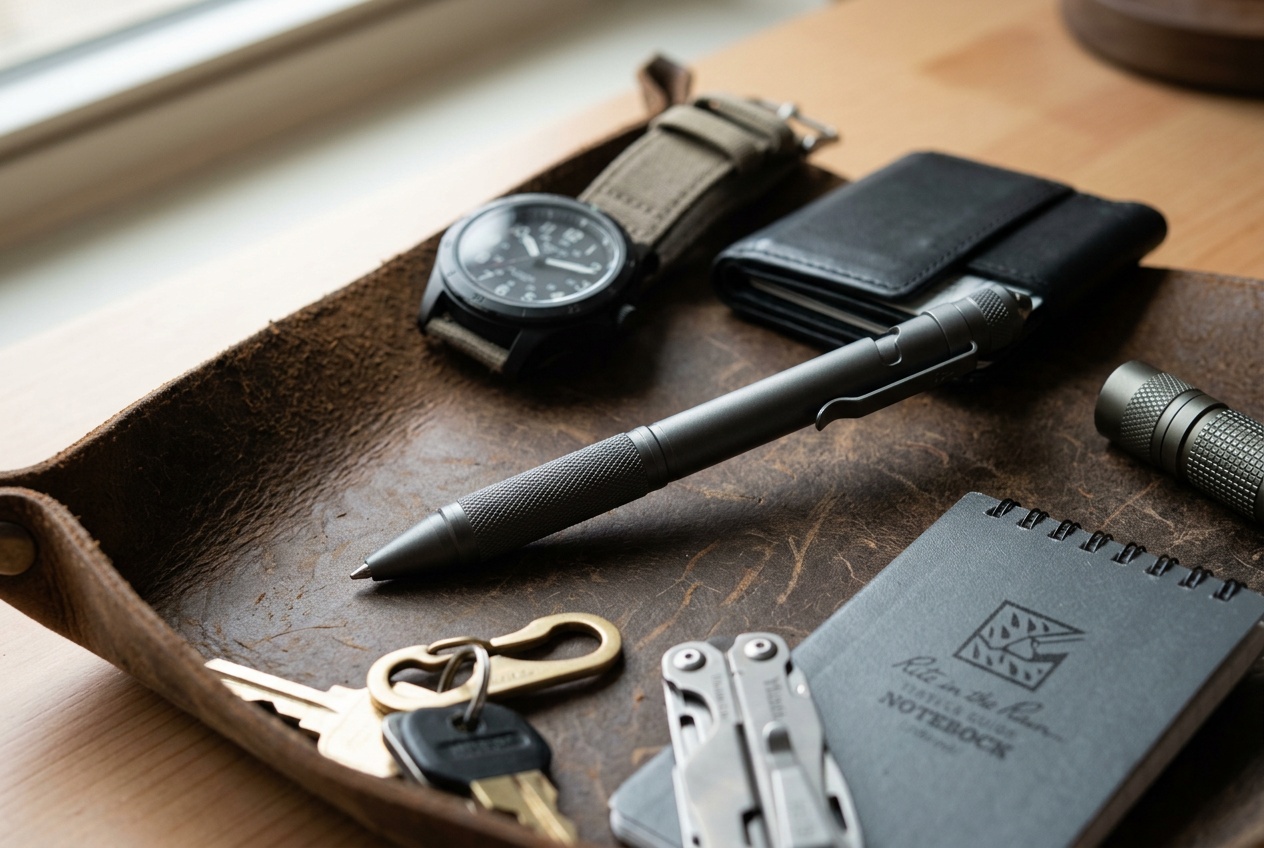
A tactical pen is the kind of tool a prepared patriot keeps clipped in a shirt pocket without thinking twice. It writes like a pen. It looks like a pen. The body is built from machined steel or aircraft aluminum, and the tip is hard enough to break glass or end a bad situation. This guide covers what tactical pens actually do, which ones are worth carrying, and how a metal pen fits into a real-world EDC and home security plan. If you want a low-profile self-defense tool that earns its pocket space, you are in the right place.
What is the point of a tactical pen?
The point of a tactical pen is simple. It is a writing tool that doubles as a last-resort self-defense option when you have nothing else on you. Most are made of metal, usually aircraft aluminum or stainless steel, with a reinforced glass breaker tip. They write like a regular pen. They can also be used as a weapon if someone tries to put hands on you in a parking lot, a stairwell, or a gas station at night.
For preppers and people who think about personal protection every day, that dual purpose matters. You cannot always carry a firearm. You cannot always carry pepper spray. But you can almost always carry a pen. A tactical pen gives you a quiet layer of protection without drawing attention. That is the gray man tool mindset in physical form. Ordinary object, serious purpose.
What makes a tactical pen different from a regular pen?
A regular pen is plastic. It bends. It snaps. It will not help you in a bad moment. A tactical pen is built around impact force. The pen body is usually a solid bar of metal, often matte black, with a textured grip so it stays in your hand under stress. Most include a tungsten or steel glass breaker tip. Some add a hex key, a stylus, or an LED flashlight. A few function as a multitool. There is even a Glock pen, branded by the firearm maker, for fans who want a coordinated EDC kit.
The internals are also different. Cheap pens use whatever ink cartridge fits. A serious tactical pen ships with quality pen refills like the Schmidt EasyFlow 9000 or a Fisher Space Pen pressurized cartridge. That matters in harsh conditions. A pressurized refill writes upside down, in the cold, and on greasy or wet paper. Pair black ink with Rite in the Rain notebook stock and you have a writing pen that works when standard gear fails.
What is a Tactical Spy Pen?
A tactical spy pen takes the same basic concept and adds a covert layer. The body still functions as a self-defense tool. The build is still metal. The glass breaker is still there. The difference is the styling and sometimes the features. A tactical spy pen is usually slimmer, plainer, and harder to spot as a defensive tool. Some versions add a hidden voice recorder or a small camera. Others just look like an ordinary office pen and rely on stealth alone.
For preppers and gray man EDC, that matters. A pen that looks aggressive can draw attention you do not want in a hostile environment. A spy pen blends in. You can clip it to a dress shirt at a business meeting, slip it into a notebook, or hand it to someone to sign a form without raising eyebrows. If a recording function is included, it can help document a confrontation, a contract dispute, or an aggressive encounter for later use. Always check your local recording laws before you rely on that feature, since many states require two-party consent for audio.
Is it legal to carry a tactical pen?
In most of the United States, yes, it is legal to carry a tactical pen. It is a pen. Federal law does not regulate writing instruments. Most states do not either. You can usually carry one in your pocket, briefcase, or purse the same way you would carry any other ballpoint pen. That is one of the main reasons people choose them for covert self-defense and quiet personal protection.
Intent and location still matter. A pen used as a weapon can fall under assault statutes the same way a baseball bat or a flashlight can. Some courthouses, federal buildings, and schools restrict any item that could be used to cause harm. Always check local rules before you carry a tactical pen anywhere sensitive. Some jurisdictions outside the U.S. that use the spelling self-defence have stricter rules on impact tools, so know your area. The smart move is responsible carry. Treat it as a tool, not a toy.
Does TSA allow tactical pens?
This is where things get tricky. TSA officially prohibits items that look like weapons or could be used as weapons. A tactical pen sits in a gray area. Some travelers report flying with theirs in carry-on with no issue. Others have had them confiscated at the checkpoint. The decision often comes down to the agent on duty.
The safer move is to put your tactical pen in checked luggage. If you only have carry-on, consider a slimmer option without an obvious glass breaker tip. Better yet, pack a Fisher Space Pen for travel writing and keep your dedicated self-defense pen in checked baggage. Losing a fifty dollar pen at security is avoidable with a little planning.
How do you use a tactical pen for self-defense?
You use a tactical pen the same way you would use a kubaton. Grip it like an ice pick or a hammerfist, with the tip pointed out and your thumb capping the end. Aim for soft targets. The throat. The eyes. The side of the neck. The inside of the thigh. The back of the hand. Short, hard strikes. Get distance. Run. The goal is to create an opening so you can escape, not to win a fight.
This is why training matters. A tactical pen for self defense is only as good as the person holding it. The pen by Doug Marcaida from Forged in Fire, the CRKT Williams Defense Pen designed by martial arts instructor and former Army officer James Williams, and similar designs were created by people who actually know how to fight with one. Watch their training videos. Practice the grip. Hit a heavy bag a few times. You do not need to be Jason Bourne. You just need enough familiarity that the tool works under stress.
What is the best rated tactical pen?
The best rated tactical pen depends on your priority. If you want the most popular EDC pen with a huge user base, the Atomic Bear tactical pen, also sold as the Stealth Pen Pro, is hard to beat for the price. It uses an aircraft aluminum body, an LED flashlight, a tungsten tip glass breaker, and a textured Beargrip surface. The Atomic Bear has earned a top spot in most independent reviews because it covers the basics and does not pretend to be more than it is.
For a step up in build quality, the CRKT Williams is a favorite among instructors who train with these tools. It uses 6061 aircraft-grade aluminum, a Type III black hard-anodized finish, and a Fisher Space Pen ink cartridge for smooth writing in any weather. The Gerber Impromptu is another reliable tool with a tungsten carbide glass breaker, 304 stainless steel construction, and a bolt-action mechanism. For something exotic, look at a Guardian Titanium pen or a limited production tungsten model. They cost more, but they last forever.
Best Tactical Pens Worth Carrying Right Now
Here is a short list of best tactical pens that have proven themselves in the field. These are not affiliate fluff picks. These are pens that show up again and again in EDC kits, get-home bags, and prepper checklists.
- Atomic Bear Stealth Pen Pro — Aircraft aluminum body, LED flashlight, tungsten glass breaker, textured Beargrip. Affordable and proven. A solid first tactical pen for anyone new to the category.
- CRKT Williams Defense Pen — Designed by James Williams, a former Army officer and martial arts instructor. Real-world tactical applications. Smooth writing with a Fisher Space Pen refill. Pressurized cartridge writes underwater and in extreme cold.
- Gerber Impromptu — 304 stainless steel, tungsten carbide glass breaker tip, bolt-action deployment, weapons-grade build. A workhorse for everyday use.
- Fisher Space Pen Bullet (Military) — Not a glass-breaking model, but the toughest writing pen ever made. Pressurized ink refills. Writes anywhere.
- Smith & Wesson Tactical Pen — Aircraft aluminum, matte black, glass breaker tip, classic clicker top. Budget friendly and easy to carry.
- Voodoo Tactical Master Pen MTP-6 — Heavier and more aggressive, with a serious glass breaker. Built for harsh conditions and field use.
- Glock Tactical Pen — A coordinated EDC option for Glock owners. Solid metal pen with a clean, no-nonsense design.
- Warrior Poet Supply Co WPS Tactical Pen — Made for prepared patriots who want a reliable tool with a refillable black ballpoint and good compatibility with common refill sizes.
- Pen by Doug Marcaida — A tactical pen designed for impact and martial arts use. The kind of tool a former operative would actually carry.
What features actually matter on a tactical pen?
Skip the gimmicks. A tactical pen needs four things. A strong pen body made from aircraft aluminum, machined steel, or titanium. A reliable glass breaker tip in tungsten or hardened steel for emergency glass breaker use. A good ink cartridge with broad refill compatibility, ideally a medium black Schmidt or a pressurized Fisher unit. And a textured grip with enough texture to keep your hand locked in under sweat or rain.
Everything else is a bonus. A built-in stylus is handy if you live on your phone. An LED flashlight adds value if you do not already carry one. A magnetic mount on the cap is useful for sticking the pen to a metal surface in a vehicle. Some pens transform into a trainer with a swap of the cap, which is great for safe practice. A multitool layout with a hex key adds utility. None of these matter if the basics fail. Get the basics right first.
Where does a tactical pen fit in your prepper kit?
Everywhere. That is the short answer. A tactical pen is one of the most versatile pieces of EDC gear you can own because it earns its space in multiple kits at once.
Start with your daily carry. Clip one to your shirt pocket, your jacket, or the front pocket of your jeans. It works for daily writing, signing receipts, and field notes. If something goes wrong on your walk to your car, you already have a tool in hand. Add another to your get-home bag and your vehicle emergency kit. Glove box gear should include a flashlight, a multitool, and a tactical pen designed with an emergency glass breaker so you can break glass and get out of a sinking or burning vehicle. Stash a third in your bug-out bag. The tool you have beats the tool you left at home.
For home security, keep one on your nightstand alongside your phone and a flashlight. In a power outage or grid-down scenario, you want layered options. Pepper spray, a firearm if you are trained and legal, a tactical pen, and a plan. Civil unrest does not announce itself. Preparedness starts in your pocket, and a tactical pen earns its space every single day.
How do you train with a tactical pen so it actually works?
Owning a tactical pen is the easy part. Knowing how to use a tactical pen under pressure is the part most people skip. Set aside thirty minutes a week. Practice drawing the pen from your pocket. Practice the grip. Run through three or four basic strikes on a heavy bag or a tree wrapped in foam. Many manufacturers sell a trainer version of the same pen body, and some pens transform into a trainer with a quick swap of the cap. Use it.
Build muscle memory around situational awareness too. A tactical pen does you no good if you do not see the threat coming. Eyes up in parking lots. Scan gas stations. Trust your gut when something feels wrong. The pen is a last-resort defense, not a first option, and it is meant for self-defense or emergency use, not picking fights. Quiet confidence comes from knowing you have layers and that you have practiced with them. Prepared, not paranoid.
The Bottom Line on Tactical Pens for Prepared Patriots
A tactical pen is not magic. It will not stop a determined attacker by itself. It is one of the easiest pieces of EDC to carry, one of the cheapest force multipliers you can own, and one of the few self-defense tools that comes with you everywhere without raising eyebrows. For a prepared family, that is real value.
Here is what to remember:
- A tactical pen is a writing pen and a low-profile self-defense tool in one body.
- A tactical spy pen is the same idea with covert styling and sometimes a hidden recorder.
- Look for aircraft aluminum, stainless steel, or titanium construction with a tungsten or steel glass breaker tip.
- Quality ink refills like the Schmidt EasyFlow 9000 or a Fisher Space Pen cartridge keep it useful for daily writing.
- Carry is legal in most U.S. locations, but check local rules and stay aware of restricted areas like courthouses and airports.
- TSA enforcement is inconsistent. Pack tactical pens in checked luggage to be safe.
- The Atomic Bear Stealth Pen Pro, CRKT Williams, and Gerber Impromptu are top picks for build quality and value.
- Train with it. A tactical pen for self defense only works if you have practiced.
- Stash one in your EDC, your get-home bag, your vehicle kit, and your bug-out bag.
- Small tools matter. Simple gear beats fantasy gear.
- Preparedness starts in your pocket, and the best tactical pen in the world is the one clipped inside your jacket when you need it most.
Carry what you can actually use. Train with what you carry. That is how a quiet pen becomes a serious piece of personal protection in uncertain times.