




Nuclear Winter is one of the most misunderstood ideas in modern risk analysis. It is neither a movie-style instant ice age nor a fringe fantasy. It is a scientific hypothesis, developed in the early 1980s and refined with modern climate models, about what happens when smoke from vast urban and industrial fires after a major nuclear […]
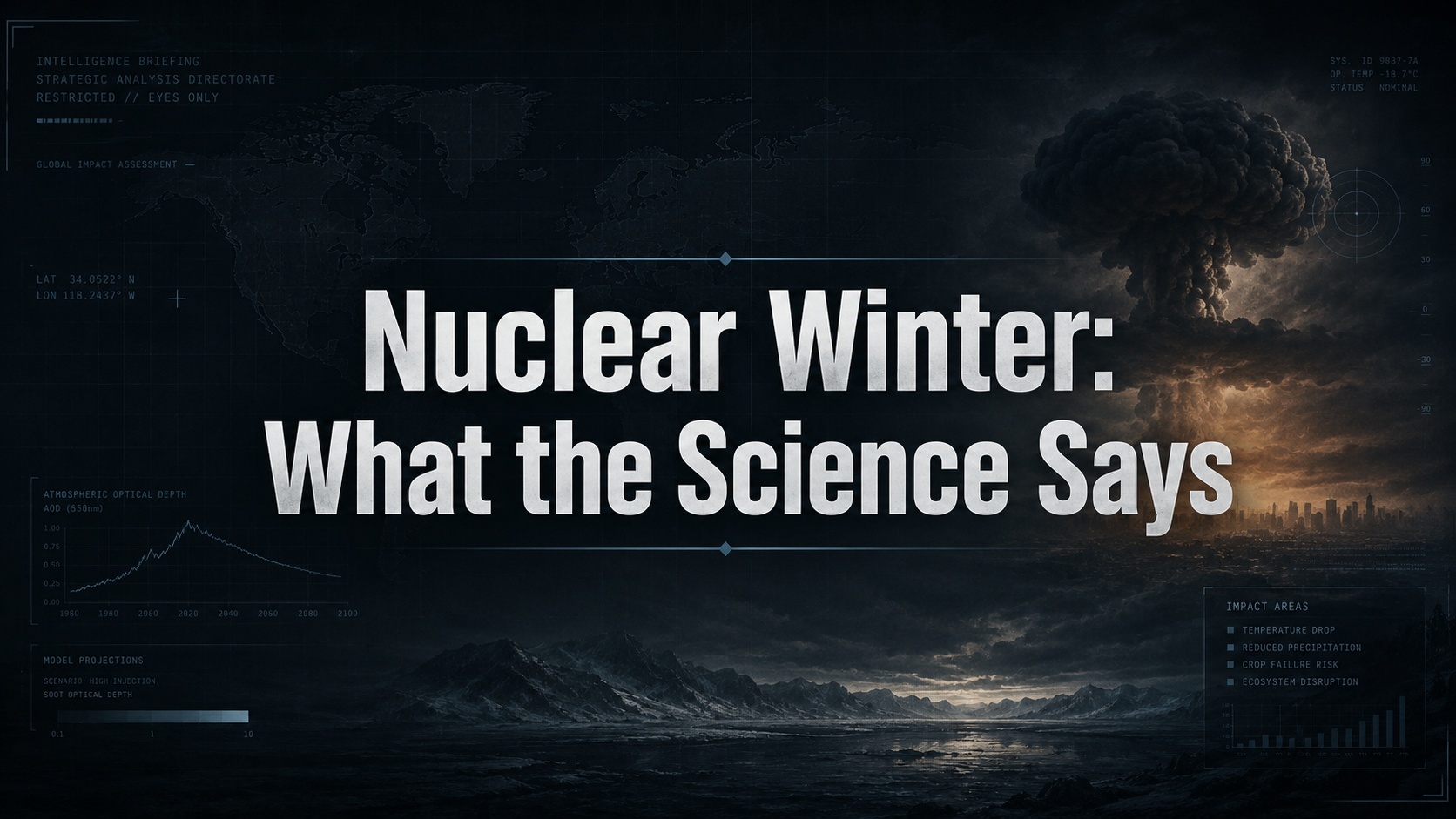
Nuclear Winter is one of the most misunderstood ideas in modern risk analysis. It is neither a movie-style instant ice age nor a fringe fantasy. It is a scientific hypothesis, developed in the early 1980s and refined with modern climate models, about what happens when smoke from vast urban and industrial fires after a major nuclear war rises into the upper atmosphere, blocks sunlight, cools the surface, disrupts rainfall, damages ozone, and crushes food production far beyond the blast zones. The mechanism is real physics. The uncertainty lies in the size of the effect under different war scenarios.
That distinction matters for anyone trying to think clearly about risk. Blast, heat, prompt radiation, and fallout are immediate local dangers. Nuclear winter is the delayed atmospheric and agricultural danger. If you want the best possible information instead of slogans, the key question is not whether nuclear war would be catastrophic. It would be. The real question is what kind of catastrophe follows which kind of exchange, and on what timeline.
Why this matters now
This is not a Cold War museum piece. SIPRI estimated that the world still had about 12,187 nuclear warheads in January 2026, of which roughly 9,745 were in military stockpiles for potential use, while FAS notes that the pace of reductions has slowed and usable stockpiles are increasing again. In other words, the Weapons still exist in numbers large enough to keep the science relevant.
The phrase Nuclear Holocaust is often used in public debate as a catch-all for civilizational devastation. Nuclear winter is narrower. In the scientific literature, it refers to the climatic and biospheric aftermath of soot-filled skies after a large exchange of nuclear weapons. That narrower meaning matters, because not every horror of nuclear war is a winter scenario, and not every burst pattern produces the same mix of blast damage, fire, fallout, ozone loss, and crop collapse. Since the end of the Cold War, research did not vanish; it returned with better Earth system models, better atmospheric chemistry, and better food-system modeling.
What Is Nuclear Winter
What Is Nuclear Winter in plain English? It is a soot-driven climate shock following a sufficiently large nuclear exchange. The classic pathway is this: nuclear detonations ignite mass fires in cities and industrial areas; black carbon smoke is heated by sunlight and self-lofts into the upper troposphere and stratosphere; that smoke spreads across the globe, dims the surface, lowers temperatures, reduces precipitation, and shortens growing seasons. If you want the Nuclear Winter Meaning in one sentence, it is not “radioactivity everywhere.” It is “sunlight blocked by soot after a major nuclear war.”
What Is A Nuclear Winter not? It is not the same thing as fallout. Fallout is radioactive material that condenses onto particles and drops back to Earth, contaminating people, land, food, and water downwind from a detonation. Nuclear winter is a climatic effect caused mainly by smoke that remains aloft much longer. EBSCO’s summary captures the difference cleanly: fallout is radioactive particles settling out of the atmosphere, while nuclear winter is the model of reduced temperatures over seasons or years after war.
This is also where a lot of casual language goes wrong. Terms such as rads, radons, and fallout are often mashed together as if they meant the same thing, but they do not. A rad is a unit of absorbed radiation dose, while radon is a naturally occurring radioactive gas from uranium and radium decay in soil and rock. Neither is a synonym for fallout, and neither explains nuclear winter by itself. The science gets clearer the moment these categories are separated.
How a nuclear war turns fire into climate
The theory of nuclear winter began with the recognition that the direct effects of nuclear explosions were not the whole story. The 1983 Science paper by Turco, Toon, Ackerman, Pollack, and Sagan argued that multiple nuclear detonations could generate massive smoke burdens, and Alan Robock’s later review explains why the core physics has remained durable: blocking sunlight cools the surface, and soot that reaches the stratosphere can stay there for years. Modern work did not discard that mechanism. It strengthened it, while changing the models and refining the assumptions.
This is why volcanic winter is a useful analogy but not a perfect one. Large volcanic eruptions inject sulfate aerosols that cool the climate for a limited period; Pinatubo’s major global climatic effect lasted about two years. Nuclear-war soot behaves differently. Bardeen and colleagues note that self-lofting and stratospheric heating can lengthen smoke residence compared with volcanic sulfate, allowing some climate and ozone disturbances to last more than a decade in severe scenarios.
Targeting and burst type also matter. An air burst over a city is better at maximizing blast and thermal ignition over a wide area, which is why FEMA notes that air bursts expose more surfaces to the fireball’s heat and raise the risk of widespread ignition. A ground burst against hardened military targets pulls dirt and debris into the cloud and is much more strongly associated with heavy local fallout; the 1986 National Research Council discussion also noted that ground-level detonations against hardened targets would inject dust particles and nitrogen oxides into the stratosphere. In short, an air-burst city attack is especially relevant to smoke and firestorms, while a ground burst is especially relevant to fallout and local contamination.
What the models actually say
The modern state of the science does not say that every nuclear war causes full-blown planetary winter. It says the outcome is scenario-dependent. For a limited regional war, one influential PNAS study modeled a conflict between India and Pakistan large enough to put more than 5 Tg of soot into the stratosphere. The study reported a decline in global mean temperature of about 1.8 °C and an 8 percent drop in precipitation for at least five years. It also concluded that the resulting food shock would be several times larger and more persistent than any historically observed agricultural disruption of the modern era.
The 2022 Nature Food study expanded that logic from crops to the wider food system. Across six soot-injection scenarios, it found that injections larger than 5 Tg would lead to mass food shortages in almost all countries, and that livestock and marine foods would not make up the deficit. In the most severe U.S.-Russia style case, the modeled calorie shock translated into famine on a scale measured in billions of people rather than millions. A 2025 Penn State-led agricultural modeling study further estimated that annual maize production could fall by about 7 percent in a 5 Tg scenario and by roughly 80 percent in a 150 Tg scenario, with recovery taking about 7 to 12 years.
For a major exchange involving the largest arsenals, the upper-end case remains grim. Coupe and colleagues modeled a U.S.-Russia war producing 150 Tg of soot and found long-lived cooling and drying, with some global mean temperature depression persisting up to 15 years after injection. Bardeen and colleagues then added full interactive chemistry and found a peak global ozone loss of 75 percent in the 150 Tg case, with depletion lasting 15 years, plus extreme surface UV in some regions. That combination matters because the long tail of damage is not only cold and dark. It is also ultraviolet stress, agricultural disruption, and systemic scarcity.
At the same time, serious uncertainty remains. The hardest variables are not the radiation equations or the climate equations. They are the wartime source terms: how much fuel actually burns, whether true firestorms develop in modern cities, how much of the smoke becomes black carbon, how high it gets lofted, and how long it remains aloft. Robock’s review called smoke quantity and lifetime the biggest unknowns, Bardeen’s paper says exact soot injection depends on weapon use and target details and remains highly uncertain, and Reisner’s critique argued that firestorm formation and soot lofting in some regional scenarios may be less robust than earlier studies assumed. The strongest reading of the literature is therefore neither “myth” nor “certainty.” It is “credible mechanism, severe upside risk, uncertain magnitude.”
Where myth outruns science
The first myth is that nuclear winter looks like The Day After Tomorrow: instant globe-spanning flash-freeze, overnight. That is bad movie logic, not how the science is framed. The movie itself is about an implausibly abrupt ocean-circulation collapse, while nuclear winter studies describe soot-driven loss of sunlight, cooling, and hydrological disruption evolving over weeks to months, then persisting for years in severe cases. The outcome can still be catastrophic. It is just catastrophic by atmospheric optics, agriculture, and supply failure rather than by instantaneous cinematic deep freeze.
The second myth is that one bomb means one nuclear winter. No. A single nuclear explosion can cause horrific local blast, burn, and radiation consequences, but the winter scenario is about the cumulative atmospheric effects of many fires and massive amounts of soot. Britannica describes nuclear winter as the result of hundreds of nuclear explosions in a nuclear war, and the modern literature focuses on regional multi-city exchanges or major U.S.-Russia scenarios, not isolated detonations.
The third myth is that the theory was “debunked” decades ago. What actually happened is messier. Some early critics argued the first-generation models overstated the scale of the effect, and terms like “nuclear autumn” appeared in that debate. But later work with more sophisticated models and better atmospheric chemistry did not make the danger disappear. Robock’s review explicitly says modern models showed the basic theory was correct and that the effects could last longer than previously thought. The real scientific dispute today is not whether soot blocks sunlight. It is how much soot a given war would generate.
How long would a nuclear winter last
How long would a nuclear winter last? The honest answer is that there is no single duration, because “nuclear winter” covers a range of scenarios. For the 5 Tg India-Pakistan case, climate perturbations in temperature and precipitation were modeled for at least five years, while Bardeen’s chemistry-climate work found ozone recovery in the regional case taking about 12 years. For the largest 150 Tg scenario, climatic effects in modern models extend over more than a decade, and ozone depletion can persist for about 15 years. On the agricultural side, recent crop work suggests some major yield losses could take 7 to 12 years to recover.
That does not mean permanent darkness or a new ice age. The most intense stress would come early, then ease unevenly. But for survival planning, the important lesson is that immediate radiation danger and long-duration climate danger run on different clocks. Fallout is especially dangerous in the first day and first few days after a detonation, while food-system and climate impacts unfold over months and years. Thinking clearly means preparing for both timelines rather than collapsing them into one mental image.
How to survive nuclear winter
How to survive nuclear winter starts with a blunt correction: if there has been an actual nearby detonation, the first problem is not climate. It is blast, burns, and fallout. CDC and Ready.gov guidance is consistent on the basics: get inside fast, stay inside, get to a basement or the middle of a large building, keep away from outer walls and roof, turn off systems that pull in outside air if possible, and use stored food and water rather than open water or fresh local food until authorities say it is safe. If you are contaminated, remove outer clothing and bag it away from people and pets.
After that first phase, the medical implications of nuclear war dominate. CDC guidance for hospital receivers expects a mix of trauma, burns, internal contamination, and Acute Radiation Syndrome. That means the practical survival hierarchy is sequential: shielding first, then decontamination, then water, calories, shelter, wound care, sanitation, medications, and reliable information. The phrase “how to survive nuclear winter” sounds like one problem, but the official public-health and emergency-medicine view is that it is really a cascade of problems.
The longer-duration survival problem is food. Modern studies show that even a limited nuclear exchange could push the World food system into severe shortage, and a major exchange could devastate crop, livestock, and fishery output. So the serious lesson for households and communities is not fantasy bunker life. It is resilient calories, protected water, protected seed stocks where appropriate, preserved medical capability, and social coordination over years rather than days. In that sense, the effects of nuclear winter are as much about logistics and agriculture as they are about temperature drops.
What the evidence means now
The best reading of the evidence is straightforward. Nuclear winter is not a myth, but it is also not a one-size-fits-all certainty attached to every nuclear event. A major nuclear exchange involving many cities and industrial targets could produce devastating climatic consequences. A limited exchange could still cause severe global food stress even if it falls short of the most extreme winter imagery. The biggest uncertainty is the soot source term, not the underlying principle that enough soot in the stratosphere cools the surface and disrupts the biosphere.
For a preparedness audience, that is the key dividing line between fear and usable knowledge. War does not create one hazard. It creates a chain: blast, fire, fallout, radiation illness, supply collapse, crop failure, and possibly long-lived climate disruption. If you separate those layers, the science becomes much easier to understand and much harder to dismiss.
- Nuclear Winter is a specific climatic hypothesis about soot, sunlight loss, cooling, drying, ozone damage, and crop failure after a sufficiently large nuclear war. It is not just another word for fallout.
- An air burst over cities is more relevant to widespread fire ignition, while a ground burst is more strongly associated with debris loading and dangerous local fallout.
- Modern models indicate that even a limited India-Pakistan exchange could cause years of climate disruption and serious global food insecurity.
- In the largest modeled U.S.-Russia scenarios, climatic and ozone effects can persist for more than a decade, with recovery timelines measured in many years, not days.
- The main scientific uncertainty is how much smoke would actually be produced and lofted high enough to remain aloft, not whether soot can cool the planet once it gets there.
- If detonation occurs, survival begins with official fallout guidance: get inside, stay inside, stay tuned, decontaminate, and rely on stored supplies before worrying about long-term climate effects.