Two names dominate the underground bunker conversation in America right now. Atlas Survival Shelters and Terra Vivos. Both are legitimate. Both have been featured on National Geographic, HBO, Netflix, and every major news network at some point. Both have owners who show up in mainstream press whenever nuclear tensions spike. And both solve the same fundamental problem: how a private citizen without a government job can access hardened underground protection when things get ugly.
They solve it in completely different ways. And which one is right for you depends on questions that have nothing to do with the shelters themselves.
This is not a paid comparison. Neither company sponsors this site. Both offer affiliate programs and both have been contacted about them, but no financial relationship exists at time of publication. What follows is a straight read on what each company actually builds, what it costs, who it is for, and where the honest tradeoffs sit.
Two Different Products for Two Different Preppers
The core distinction is ownership model.
Atlas Survival Shelters manufactures steel underground bunkers in Texas and installs them wherever you want them. You buy a shelter, they build it, you own it, it sits on your property, and it is yours forever. This is bunker ownership in the same way that owning a house is home ownership. You are the sovereign of your shelter. Your family, your rules, your location, your bunker.
Terra Vivos, by contrast, does not sell you a bunker. It sells you access to a bunker in a survival community. Their flagship property, Vivos xPoint in South Dakota, is a former US Army munitions depot spanning 18 square miles with 575 individual steel-and-concrete bunkers originally built by the Army Corps of Engineers between 1942 and 1967. Vivos bought the property from cattle ranchers who had held it since decommissioning, and they now sell or lease individual bunkers to members who agree to shelter alongside up to 5,000 other people when the moment comes.
Same category. Completely different products. Completely different buyers.
Atlas Survival Shelters: Private Bunker Ownership
Atlas is the American face of the private bunker industry. Manufacturer, installer, media personality, and the company most Americans think of first when the subject of underground shelter comes up.
What Atlas Actually Builds
Atlas manufactures steel shelters at their main plant in Texas. The main product lines cover safe cellars (small emergency shelters), backyard bunkers (family-sized private shelters), survival safes (compact hardened rooms), concrete-poured shelters (larger custom builds), tornado shelters, air raid shelters, and their newer BombNado product for combined tornado-plus-blast protection. They also build large custom military and government projects internationally.
The company is owned by R.D. Hubbard, who has been in steel manufacturing since 1981. Atlas positions itself as the leading brand in the survival shelter industry, and by market presence and media coverage, that claim holds up. Ron Hubbard has told mainstream media that two Senior Cabinet members within the Trump administration are his clients, and the company has recently expanded operations to the Middle East.
Atlas ships and installs worldwide. Their sponsors page shows partnerships with companies across the preparedness industry including EMP Shield, MIRA Safety, Big Battery, Sol-Ark, and Signature Solar, indicating an established ecosystem around the product.
Pricing and Range
Atlas has one of the widest price ranges in the industry. Entry-level fallout shelters have historically started under $20,000. Top of the line models can run to $250,000, with the more expensive packages including floor storage, eight foot ceilings, wine racks, and granite countertops. Most family purchases fall somewhere between $40,000 and $150,000 depending on size, features, and site preparation.
Pricing is not published on the Atlas site. Ron Hubbard’s direct contact number is on their homepage and their preferred sales method is a text message describing your desired shelter type and size, followed by a quote. That is genuinely how the business operates.
The Atlas Buyer
The Atlas buyer typically owns rural or semi-rural land, wants total control over their shelter’s location and configuration, values self-sufficiency over community resilience, and either has existing wealth or is willing to build the bunker into a long-term property investment. This is someone who thinks about survival as a family unit rather than a community effort.
If you already have property in a safer geographic area, Atlas gives you the bunker under your land, on your terms, permanently.
Full Disclosure: Atlas Litigation History
Any company operating publicly for 15 years accumulates litigation. Atlas is no exception. Publicly available court records include a 2014 fraud case (Williams v Atlas Survival Shelters), a breach of contract case out of Pinal County Arizona (Doss v Atlas), and most notably a 2019 defamation lawsuit filed against Atlas by Clyde Scott, owner of competing bunker manufacturer Rising S Bunkers, over YouTube videos Ron Hubbard published criticizing Rising S. Atlas countersued and filed a motion to dismiss under the Texas Citizens Participation Act, which the trial court denied in October 2019.
Reasonable readers can evaluate the significance of these cases on their own. Atlas continues to operate, ship, and install shelters worldwide. Litigation history is not the same as product failure. Full disclosure belongs in an honest comparison, and here it is.
Terra Vivos: Community Survival at Scale
Vivos sells something Atlas does not: existing infrastructure at civilization scale, already engineered, already in the ground, already producing bunkers for private buyers.
The xPoint Model
Vivos xPoint is genuinely unlike anything else in the private shelter market. A former US Army munitions depot used between 1942 and 1967, converted into a community of 575 concrete bunkers that can endure a 500,000-pound internal blast. Each bunker spans roughly 2,200 square feet of interior space, sits 400 feet from its nearest neighbor (spacing originally designed to prevent chain-reaction detonations of stored munitions), and features a standard 26.5-foot interior floor width, 60 or 80 foot lengths, and 12.5-foot high arched ceilings.
The site sits at 3,800 feet elevation near the Black Hills in Fall River County, South Dakota. It is over 100 miles from known nuclear targets, well inland from any large body of water, non-seismic, and geographically positioned in one of the safest regions of the continental United States. Vivos claims xPoint is within a 24-hour drive of virtually all points within the United States, which is roughly accurate.
Bunkers come with concrete walls and steel blast doors as the base condition. Members outfit their units themselves, though Vivos offers turnkey outfitting services. Available amenities across the community include water from two on-site wells stored in reinforced concrete tanks, geothermal heating options, solar and wind backup power, and NBC (nuclear, biological, chemical) air filtration. Planned community amenities include a general store, shooting range, hydroponic gardens, medical clinic, horse stables, classroom, and members-only restaurant.
The Other Vivos Properties
xPoint is the flagship, but Vivos operates several other shelter properties. Vivos Indiana is a co-ownership shelter for 80 people, fully outfitted, stocked, and ready for activation. Vivos Europa One is a large fortified shelter in central Europe with capacity for up to 800 members. The Vivos Trine complex is a custom private shelter system for very large groups of 150 to 500 people or more, built to specification for specific buyers.
Pricing and Ground Lease Structure
Vivos xPoint pricing has moved considerably over the years. Early leases were $25,000 with a $1,000 annual ground lease for 99 years. Current bunker pricing runs $35,000 to $45,000 for the basic bunker with $1,000 annual ground rent. A private bunker at $55,000 is the mid-tier price point, and other communities or accommodations range from $35,000 to $195,000 or higher.
Vivos also now offers a purchase option: you can buy your bunker and 20,000 square feet of surrounding land area for a one-time payment of $75,000, owning your bunker and parcel in fee, forever, with all rights of resale, willing, gifting, or assignment.
Outfitting costs are separate from the bunker itself. Basic “bunker glamping” configurations start around $10,000 for essentials. Full luxury outfitting with master suites, kitchens, gyms, and private theaters ranges from $15,000 for basic setups to $65,000 for fully equipped luxury configurations.
Total investment for a comfortably outfitted xPoint bunker typically lands in the $50,000 to $120,000 range depending on options. That is well below the equivalent Atlas custom build for similar interior space, though the tradeoffs are significant.
The Vault-Tec Parallel
If you have watched the Amazon Fallout series and started imagining what it would be like to live in Vault 33, this is the closest thing to it that actually exists. That comparison is intentional. The appeal is the same. So is the concern about who your neighbors turn out to be.
The Vivos model works if you accept that survival is a community enterprise. Your bunkermates get vetted through Vivos’s application process, but community governance still applies, resources are shared, and the human dynamics of 5,000 people sheltering together are what they are. Some readers will find that reassuring. Others will find it terrifying. Both reactions are legitimate.
On Vivos’s Threat Framing
Vivos’s marketing includes a threat list that spans legitimate concerns (nuclear blast, EMP, pandemics, terrorism, economic collapse) alongside some genuinely fringe items. Planet X – Nibiru is on the list next to solar flares and super volcanoes.
Not going to judge. This site has full guides on surviving an alien invasion and what to include in your alien invasion survival kit. Preparedness culture has room for the whimsical alongside the serious. What matters is whether the underlying shelter infrastructure is real, and Vivos’s is. The bunkers were built by the US Army Corps of Engineers in the 1940s to protect stored munitions from artillery hits. That is not marketing. That is documented history. The threat marketing is separate from the shelter engineering, and honest buyers evaluate the two independently.
Head-to-Head Comparison
Below is the side-by-side breakdown of every factor that actually matters when you are choosing between these two options.
| Factor | Atlas Survival Shelters | Terra Vivos |
|---|---|---|
| Ownership | You own the bunker and it sits on your property | Lease or purchase within Vivos community |
| Location | Anywhere you have land | South Dakota (xPoint), Indiana, Europe, or custom |
| Base Price Range | $20,000 to $250,000+ | $35,000 to $195,000+ |
| Outfitting | Included in most Atlas builds | Separate cost, $10,000 to $65,000 additional |
| Community | Solo family, your rules | 5,000-person community, shared governance |
| Time to Occupancy | 3 to 12 months typical build | Immediate (bunkers already exist) |
| Customization | Full control over layout and features | Constrained by existing bunker footprint |
| Land Requirement | Requires your own property | None (Vivos provides land) |
| Ground Rent | None | $1,000/year at xPoint (or buy land option) |
| Best Fit For | Rural/semi-rural landowners with capital | Renters, urban dwellers, community-minded preppers |
Which One Is Right for You?
Neither company is universally correct. Neither is universally wrong. The right choice depends entirely on your situation, and the honest breakdown looks like this.
The Atlas Buyer
You already own land, ideally in a lower-risk geographic area. You have the capital or financing to invest $50,000 to $150,000 in a permanent structure. You want the shelter under your feet, on your property, with your family, forever. Community shelter models feel wrong to you philosophically or logistically. You prefer to solve survival as a family unit rather than as part of a community organization. Rural. Self-reliant. Sovereign.
The Terra Vivos Buyer
You do not own rural land, or the land you own is in a high-target area. You want serious hardened protection but building your own bunker is not practical or affordable. You see value in surviving as part of a community with shared resources, distributed skills, and layered security. You accept that community governance is a feature, not a bug. You want a bunker that already exists rather than one that takes 12 months to build. Suburban or urban. Community-minded. Willing to trade sovereignty for scale.
The Reader Who Should Consider Neither
If you have less than $30,000 to invest and less than an acre of usable land, both options are outside your realistic budget. That does not mean underground protection is impossible. Cresson Kearny’s expedient shelters, covered in our guide on how to survive a nuclear attack, can be built in a weekend using a shovel, a car, and a stripped interior door. They will not look like a Vivos showroom but they will meaningfully reduce your radiation exposure at a cost of essentially zero dollars. That is Kearny’s whole thesis and it remains valid. Not every prepper needs a $75,000 bunker to survive.
For readers in between, our detailed piece on how deep a nuclear bunker needs to be covers the physics of what shielding actually gets you, which helps you evaluate what you would pay for at either Atlas or Vivos price points.
Other Bunker and Shelter Companies Worth Knowing
Atlas and Vivos are the two biggest names but the underground shelter market is genuinely broader than a two-company comparison suggests. Other established manufacturers and providers include:
- Rising S Bunkers — Texas-based steel bunker manufacturer, direct competitor to Atlas. Longstanding industry rivalry between the two companies (see the litigation section above).
- Survival Condo — Kansas-based project that converted a decommissioned Atlas missile silo into a luxury vertical bunker community. Higher-tier pricing, distinctive infrastructure.
- Northwest Shelter Systems — Established concrete-poured shelter builder, family-owned, serving primarily western US markets.
- US Safe Room — Mid-market underground bunker manufacturer with a range of family-scale products.
- Bomb Shelter Supply — Parts and component supplier for shelter builders and DIY buyers. Actually a sub-brand of Atlas, sold as a separate operation.
- Dr. Bunker — European market player with a broader international presence than most US builders.
- KernelSafe — Newer entrant to the market with a focus on smaller residential shelters.
- Survive-a-Storm — Storm shelter specialist with strong tornado and hurricane market presence, some crossover into blast-rated products.
None of these are linked because none of them have a business relationship with this site. They are named for completeness. A serious buyer should evaluate multiple options before committing to any single manufacturer at these price points.
The Case for Building Your Own
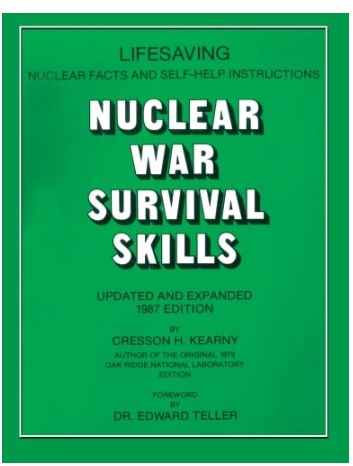
Neither Atlas nor Vivos is the only path to hardened underground protection. Cresson Kearny’s Nuclear War Survival Skills documents expedient shelter designs that anyone with basic tools and available materials can build. The car-over-trench shelter, the door-covered trench, and the basement corner shelter all provide meaningful radiation shielding at costs measured in tens of dollars rather than tens of thousands.
Kearny’s central thesis, defended across decades of civil defense research at Oak Ridge National Laboratory, is that survival is achievable through basic preparation and does not require professional bunker construction. That was true in 1979 when he wrote it and it is true now. A properly-built expedient shelter cuts gamma radiation exposure to roughly 10% of surface levels. A basement with dense material stacked as additional shielding does similar work.
Professional bunkers are better. They are also expensive and take time to acquire. The reader who cannot afford Atlas or Vivos should not conclude that shelter is impossible. It is just not turnkey.
Nuclear Bunker FAQ
Common questions from readers researching underground shelters, answered directly.
How much does an underground bunker cost?
Costs range from under $10,000 for a Vivos xPoint bunker with basic glamping outfitting to $250,000+ for a top-tier custom Atlas build. Realistic mid-market pricing for a properly equipped family shelter lands in the $50,000 to $120,000 range regardless of which company you buy from.
How deep does an underground bunker need to be?
Depth requirements vary by threat. For fallout protection, 3 feet of earth above the shelter cuts gamma radiation exposure to roughly 1% of surface levels. For blast protection near a detonation, substantially more depth and structural reinforcement is required. Full breakdown in our detailed bunker depth article.
Where is the safest place to be during a nuclear war?
The safest place is any location that combines three factors: distance from strategic targets (at least 20-30 miles), dense overhead shielding, and enough consumables to shelter in place for at least two weeks. Vivos xPoint hits all three by design. Atlas customers control the first factor themselves through property location.
Can you buy a bunker online?
Both Atlas and Vivos handle transactions primarily by phone or in-person. Neither operates as a traditional e-commerce business. Expect a consultation, site visit or virtual walkthrough, and a custom quote for any serious purchase.
Is Vivos xPoint sold out?
No. Availability fluctuates but bunkers continue to be sold at xPoint and other Vivos properties. Their pricing page lists current availability.
What is the biggest difference between Atlas and Vivos in one sentence?
Atlas sells you a bunker; Vivos sells you a spot in a bunker community.
Your Threat Model Picks the Shelter
Neither Atlas nor Vivos is universally right. Neither is a scam. Both build real shelters, both have delivered functioning bunkers to real customers, and both have real limitations.
The question that decides which one fits is not about the shelters themselves. It is about you. Do you own land? Do you want community or solitude? Do you have $50,000 or $250,000? Are you preparing for the most likely scenario (limited event, need for family shelter) or the most dangerous scenario (full exchange, need for community continuity)?
Anticipate the threat model that fits your situation. Mitigate it with the option that matches your circumstances. The mistake is not picking Atlas over Vivos or the other way around. The mistake is picking whichever one you saw on TV first without asking whether your actual life aligns with what that shelter is built to solve.
Serious preppers make this decision with clear eyes. Ready.gov gives you a pamphlet. This article gives you the frame to actually choose.