Updated July 2026. Every price, rating, and spec below is date-stamped, because half the Cove reviews currently ranking are quoting numbers from 2024 and telling you they are current.
Start Here: An Alarm Does Not Stop Anybody
A siren does not lock a door. A camera does not slow a man down. A monitoring center in Utah cannot put itself between your family and someone already in your hallway.
What a system like Cove buys you is time. That is the entire product. Everything else is packaging.
Time is worth buying. The gap between “someone is at the window” and “someone is standing in your bedroom doorway” is where every good outcome lives. But you should know exactly what you are purchasing before you sign up for a monthly bill that never ends.
The Short Verdict
Cove is a DIY home security system with mandatory professional monitoring, sold month to month, no long-term service contract. Monitoring starts at $22.99. Installation takes under an hour and requires no tools.
The sensors are good. The company treats customers well. The pricing is honest by industry standards.
The problem is dependency. There is no self-monitoring option, so the hardware you bought stops working the moment you stop paying. If reducing your dependencies is part of why you are reading a survivalist site, that is the sentence that matters most in this review.
This assessment is based on Cove’s published documentation, current third-party testing, verified owner reviews, and BBB records, all pulled in July 2026. No firsthand testing of current hardware is claimed.
Where Detection Fits in Your Defense Posture
Layered home defense runs on a simple sequence. Deter. Detect. Delay. Deny. Defend. Every dollar should answer one of those.
Cove lives in one box: detect.
It does nothing for delay. Nothing for deny. It contributes marginally to deter through yard signage and a visible doorbell camera, which does work on the guy cruising the street looking for the softest house.
That single-box occupancy is not a criticism. Early detection is genuinely the highest-value layer you can buy, because it converts a surprise into a decision. But you need to understand that a security system and a defense posture are not the same thing, and buying the first does not give you the second.
Hardening the Structure Comes First
Detection without delay means you get an excellent notification about something you cannot stop.
Most American homes ship from the builder with exterior door frames held together by three-quarter-inch screws into soft pine. A determined kick opens that in about three seconds. Your sensor fires, the siren goes off, and the entry point is already breached.
Before you spend a dollar on monitoring:
- Three-inch screws through strike plates and hinges, into the stud
- Solid core exterior doors
- Security film on ground-floor glass
- Reinforced strike plate or a full door frame kit
- Exterior lighting covering every approach
- A secondary bar or pin on sliding doors
Two hundred dollars and an afternoon. That buys more actual delay than any monitoring plan on the market.
Then layer detection on top of a hardened structure. Now the alarm is doing something useful, because the seconds it buys you are seconds someone is still working on the door.
Cove at a Glance
| Category | Detail |
|---|---|
| Legal entity | Cove Smart, LLC |
| System type | Wireless DIY security system |
| Installation | DIY, professional install reportedly available |
| Monitoring | Required, no self-monitoring option |
| Plans | Basic, Plus, Premium |
| Monthly cost | $22.99 / $32.99 / $42.99 (Cove FAQ, May 2026) |
| Contract | Month-to-month; equipment financing separate |
| Monitoring centers | Six, across the United States |
| Trial | 60-day money-back guarantee |
| App | Cove Connect |
| Voice control | Alexa and Google Assistant |
| Z-Wave | No |
| Coverage area | United States only |
| Based in | Draper, Utah (some profiles list Orem) |
| Generations | Current Cove Connect; legacy Cove Simple |
Pros and Cons
| Works in its favor | Works against it |
|---|---|
| No long-term monitoring contract | No self-monitoring, ever |
| Hub runs on Ethernet with 4G cellular backup | System dies without an active subscription |
| Sensors use radio, not your Wi-Fi | Cameras need 2.4 GHz Wi-Fi to stream |
| 24-hour hub battery backup | No Z-Wave, no third-party equipment |
| Six monitoring centers, RapidSOS integration | Weak smart home integration |
| DIY install under an hour, no tools | Promo cycling makes real pricing murky |
| 60-day money-back guarantee | Cancellation requires a phone call |
| Strong occupational discounts including military | US only |
| Environmental and medical alert devices | Android app rated poorly |
What Is Actually in the System
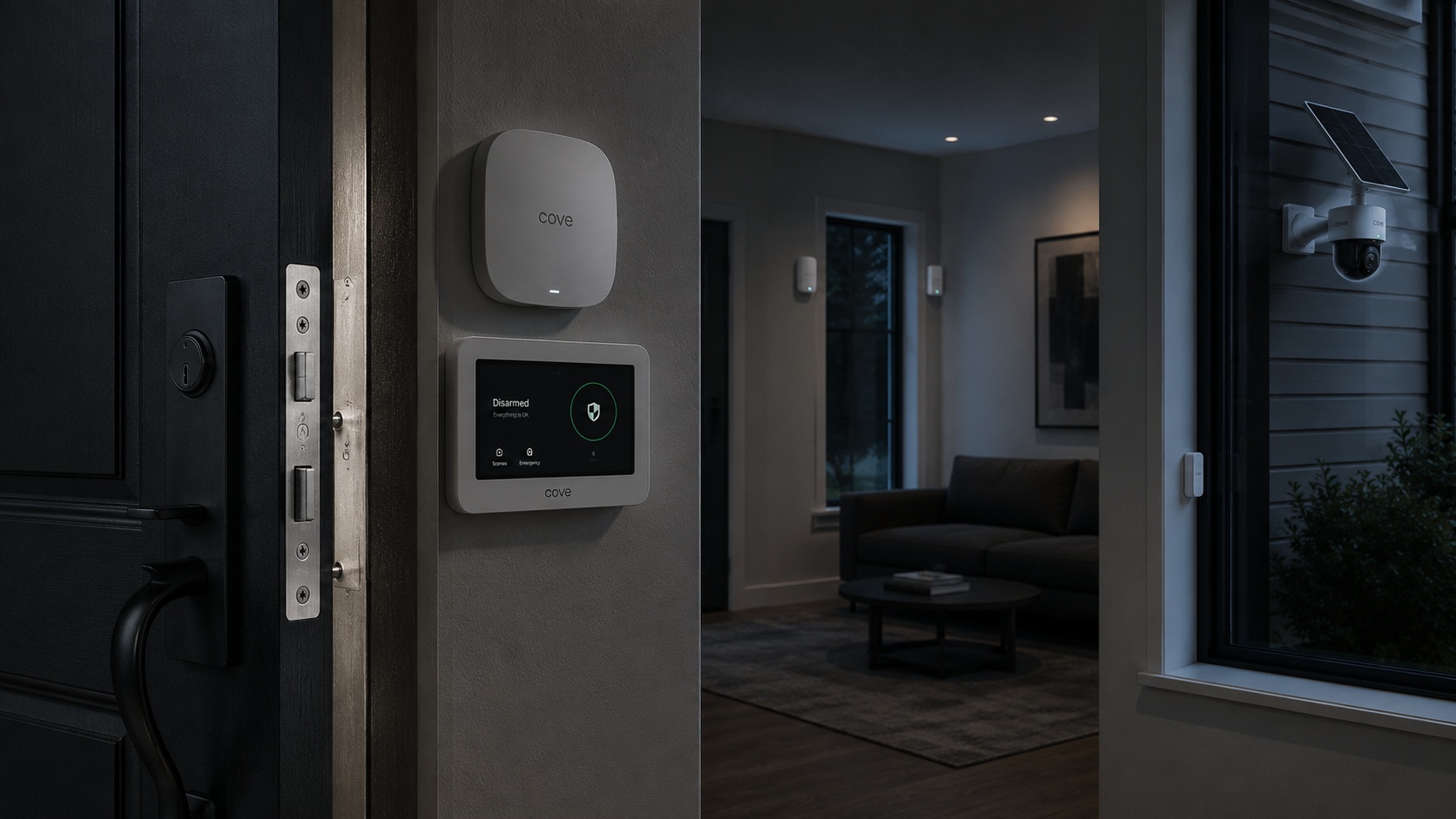
Cove Connect, the current generation, splits the system across two devices.
The hub does the work. It plugs into your router by Ethernet and carries 4G cellular backup, so a severed phone line or a dropped internet connection does not take the alarm down. Cove supplies and manages that cellular connection itself, entirely separate from your personal phone plan, so there is no carrier compatibility question. The hub also holds a 24-hour battery.
The touchscreen panel is the interface. Arm, disarm, check status. The hub supports up to four panels, which matters in a larger footprint or a multi-story layout.
Here is the detail most reviews bury: sensors talk to the hub over radio, not Wi-Fi. Door contacts, window sensors, motion detectors, glass-break detectors. None of them touch your home network. That is a meaningful resilience feature and it is the reason the detection layer survives an internet outage intact.
The equipment lineup covers the hub, touchscreen panel, indoor and outdoor cameras, burglary and intrusion sensors, environmental detectors, medical alert devices, and key fobs. Cameras are the only components that depend on Wi-Fi.
One generational warning. The older Cove Simple system and the Eufy cameras Cove used to bundle are not the same product line as current Cove Connect gear. Cove says it still supports the original system even though it stopped selling it. If you are following a setup guide you found online, check which generation it describes before you trust it.
What Happens When the Alarm Trips
- A sensor detects and reports to the hub over radio
- The siren sounds and the event transmits to Cove’s monitoring center
- Cove attempts contact via the panel, text, and phone
- You confirm or cancel
- Confirmed or unanswered, the monitoring center requests dispatch
Cove runs LiveAssist for two-way voice through the panel, InstaText for fast text verification, and RapidSOS to hand location and system data directly to emergency call centers. Six monitoring centers across the country provide redundancy if one goes down. Cove claims RapidSOS moves help up to four minutes faster.
Read that claim correctly. It describes time saved in the data handoff to the emergency call center. It is not four minutes off the drive time to your house.
There are two clocks running and only one of them is Cove’s. The alert clock, meaning how fast the company reaches you, runs in seconds. The response clock, meaning boots on your porch, belongs entirely to your local agency, your address, and their call volume that night. In a dense suburb that might be four minutes. Rural, understaffed, Saturday night? Forty is not unusual.
Find out what your actual local response time is. That number, not the marketing, determines how much of your plan has to be handled by you.
Degraded Conditions: Where the System Holds and Where It Breaks
This is the section that matters most for anyone thinking past the ordinary burglary scenario, and it is the section every mainstream review handles in one sentence.
Power outage. The hub carries a 24-hour battery. The alarm keeps running. Beyond 24 hours you are dark unless you have the hub on backup power, which is a cheap fix and worth doing.
Internet outage. The hub fails over to 4G cellular automatically. Sensors keep reporting because they were never on your Wi-Fi to begin with. The alarm side is genuinely resilient here, and that resilience is the strongest engineering argument for the system.
Cut lines. Same answer. Cellular backup is standard on every plan, not an upsell. Cutting service to the house does not blind the alarm, which defeats a known pre-entry tactic.
Cameras during any of the above. Dead. Cove cameras need active 2.4 GHz Wi-Fi to push a feed. Internet drops, video drops. You retain alarm reporting and lose eyes.
Plan accordingly. Treat the cameras as an evidence and verification tool for normal conditions only. If you need visibility when the grid is down, that requires local recording on microSD, and you should confirm that capability on the specific camera model before you buy it.
Put a small UPS on your router and modem. Thirty to sixty dollars extends useful function on everything in the house that depends on that connection, cameras included.
The Subscription Dependency Problem
Now the part that cuts hardest against how this audience thinks.
There is no Cove self-monitoring option. You cannot buy the equipment, skip the plan, and get sensor alerts on your phone. No tier does this. The hardware is functionally dead without an active subscription.
Sit with what that means. Every sensor you mounted. Every dollar of equipment. All of it goes inert the moment billing stops. A declined card. A dispute. A price increase you decline to absorb. A company that changes its terms or gets acquired. Any one of those and your perimeter goes quiet.
Compare that to a system where the hardware keeps functioning on its own and monitoring is an optional layer bolted on top. Same detection capability. One fewer dependency. SimpliSafe, Ring, Abode, and Eufy all offer some version of that. Cove does not.
Is this disqualifying? Depends entirely on your reasoning.
If you were always going to pay for professional monitoring anyway, because you want a dispatch center making the 911 call while you handle your end, it is a non-issue. You were signing up for the recurring cost regardless.
If part of the appeal was owning your gear outright and not being permanently tethered to a vendor’s billing system, this is the deal-breaker and no amount of good customer service changes it.
Be honest with yourself about which one you are before you order.
Company Background
Worth a minute, since you are giving this outfit continuous visibility into your home.
Cove traces its founding to 2017, launched service in 2018, and incorporated Cove Smart, LLC in Utah in March 2018. BBB accreditation followed in January 2019. Jordan Harmon is a publicly identified co-founder. The company states its founders brought over 30 years of combined home security experience and built Cove specifically to strip out the aggressive sales tactics, hidden fees, and multi-year contracts the legacy alarm industry ran on.
The operating address in Cove’s legal terms is in Draper, Utah, matching the BBB listing, though the LinkedIn profile describes headquarters as Orem. Utah either way.
The product timeline runs: Cove Simple as the original system, a period bundling Eufy cameras, then the current Cove Connect hub and separate panel, with the three-tier monitoring structure and expanded first-party camera lineup arriving in 2026.
That is a young company by alarm industry standards. Not a red flag on its own, but relevant if you are planning a decade out and thinking about who will still be supporting your hardware.
What Cove Costs
Monitoring is the fixed, knowable part of Cove’s pricing, and as of the company’s May 2026 FAQ it runs $22.99 for Basic, $32.99 for Plus, and $42.99 for Premium, month to month with no service contract. Several review sites still quote a two-plan structure at $19.99 and $29.99, or $22.99 and $27.99, and both are stale. Basic covers professional monitoring, cellular backup, and alerts with no camera streaming. Plus adds camera access and cloud storage. Premium layers on AI-driven alerts, longer retention, and the best warranty terms. Against the field that puts Cove roughly level with SimpliSafe, well under ADT’s typical $45 to $60, and far under Vivint once equipment financing gets folded in. The subscription is mandatory at every tier, and across any realistic ownership window it becomes the dominant cost rather than the hardware, which is the figure that should actually drive your decision. Confirm current pricing with Cove directly before ordering, because the company restructured its plans recently and may do it again.
| Plan | Monthly | Three-year monitoring cost |
|---|---|---|
| Basic | $22.99 | $827.64 |
| Plus | $32.99 | $1,187.64 |
| Premium | $42.99 | $1,547.64 |
Flat pricing assumed, tax excluded.
Why Nobody Can Tell You What the Equipment Costs
Cove sells hardware à la carte through a configurator. You answer questions about your home, get a recommended package, then add and subtract parts. There is no fixed system price because there is no fixed system.
On top of that, Cove runs deep promotions nearly continuously. When the discount is always on, the discounted price is the real price and the list price is a reference number. That is common in this category, and it means any specific dollar figure in any review has a short shelf life.
Two practical consequences.
Do not budget off a promotional percentage. The sale that gets you in the door may not be running when a sensor fails in year three.
Financing is a separate obligation. Cove offers equipment financing through Affirm. No long-term monitoring contract does not mean no financial commitment. Cancel the service and any financed hardware balance is still owed. Two different agreements, and the marketing only emphasizes one of them.
Planning Ranges by Home Size
Rather than quote SKU prices that will be wrong by the time you read this, here is what to budget at typical promotional pricing.
| Build | Components | Equipment estimate | Three-year total (Basic) |
|---|---|---|---|
| Apartment | Hub, panel, 3-4 contacts, 1 motion | $150 to $250 | ~$980 to $1,080 |
| Small house | Hub, panel, 6-8 contacts, motion, glass-break | $250 to $400 | ~$1,080 to $1,230 |
| Multi-entry house | Hub, panel, 10-12 contacts, multiple motion, second siren | $400 to $600 | ~$1,230 to $1,430 |
| Full coverage | Above plus 2-3 cameras, smoke, CO, flood | $600 to $900 | ~$1,590 to $2,090 (Plus tier) |
Verify your actual configuration in checkout. The point of the ranges is to show where the money goes, and the answer is always the same: monitoring outweighs hardware over any multi-year horizon.
Budget separately for replacement batteries across a dozen sensors, microSD cards for local recording, cloud storage on higher tiers, tax, and professional installation if you want it.
Military and Occupational Discounts
Cove runs verified discount programs that almost no competing review mentions, and given who reads this site, the military one is worth knowing about.
Programs cover military, medical personnel, teachers, government employees, and students.
What you actually get:
- An extra 5% off equipment, stacked on top of whatever promotion is currently running
- Security cameras are excluded from the discount
- One month of free professional monitoring, which Cove lists at a retail value up to $168
- The standard 60-day money-back guarantee, which everyone gets anyway
Verification runs through ID.me. Do that first, then build your system, and the discount applies before checkout. Retroactive application is a headache, so sequence it correctly.
Calibrate your expectations. Five percent off equipment with cameras carved out is $20 on a $400 package. Useful, not transformative. The free monitoring month is the bigger piece of the offer, though the stated $168 retail value does not map cleanly to one month at any published tier, so confirm exactly what that credit covers.
The Equipment, Component by Component
Hub and Touchscreen Panel
Hub processes and communicates. Panel handles interaction. The hub’s 24-hour battery and 4G backup are the most important resilience features in the system.
Panel placement is a real tradeoff. Cove recommends putting it somewhere quick to reach on entry and exit. That is convenient and it is also the first thing an intruder sees. The entry delay window exists so you can disarm without tripping the alarm, and it is simultaneously a window in which someone could attack the panel.
The separate hub is what mitigates that. Use the design as intended. Put the brain somewhere non-obvious and leave the panel as a dumb terminal.
Door and Window Contacts
Small, adhesive, no drilling, running on radio rather than your network. Open and closed reporting with optional chime alerts, which is genuinely useful if you have small kids and a pool or a road out front.
Cover in this order: every ground-floor exterior door, then ground-floor windows, then the garage service door and any basement access. Most people sensor the front door and stop. The patio slider and the garage side door are the soft entry points and they are the ones that get used.
Motion and Glass-Break Detectors
Place a motion detector to cover the interior path anyone moving through your house has to cross. Usually the main hallway or the stairwell. That is your interior choke point, and one sensor placed there beats three placed badly.
Pets complicate it. Check pet immunity ratings against your animal’s actual weight and expect to tune sensitivity.
Glass-break detectors cover a room acoustically, which makes them the efficient play for rooms with many windows or large panes where individual contacts get expensive fast.
Environmental and Medical Devices
Smoke, carbon monoxide, and water leak sensors. Confirm which get professional monitoring on your tier.
Add them. Fire and water damage are statistically far more likely to hit your household than a break-in, and monitored smoke detection means dispatch happens whether or not anyone is home to hear it.
Cove also sells medical alert devices, relevant if you have an older parent under your roof or anyone who could end up unable to reach a phone.
Key Fob, Panic Button, Secondary Siren
The panic button is underrated. Bedside, it summons help without you fumbling a phone in the dark under stress. That matters for anyone with mobility limitations and specifically for the scenario where you are behind a locked door and need your hands free.
A secondary siren earns its place in a larger footprint or multi-story layout where one siren will not carry.
Cameras and Video
Camera performance is where reviews disagree most, so weigh this section more skeptically than the sensor coverage.
Indoor camera. Pan and tilt, person tracking, two-way talk, night vision, local storage support, mains powered.
Solar outdoor camera. 2K, solar charging, weather resistant, configurable detection zones, person detection. Battery and charging complaints show up with real regularity, especially on mounting positions that do not catch strong direct sun. Shaded install? Plan on charging it by hand.
Doorbell camera. Covers the primary approach with package and person detection and two-way talk.
Two points worth internalizing.
Cameras are evidence and verification, not prevention. Aim the outdoor unit at approach paths, not at the door. You want to see someone coming up the driveway with lead time, not capture a chin at the moment of arrival.
And cameras are the only part of this system tied to your Wi-Fi. Everything else keeps working when the internet does not.
Current Cove Cameras Versus Legacy Eufy
Cove used to bundle Eufy cameras that ran through the Eufy app. Current Cove cameras are first-party and run through Cove Connect.
This trips people up constantly when troubleshooting, because instructions written for the Eufy era do not apply to current hardware. Identify which generation you own before following any guide.
Installation
The installation process is genuinely simple and it is one of Cove’s real strengths.
- Complete Cove’s questionnaire and customize the recommended package
- Receive equipment pre-paired and labeled by location
- Connect the hub to power and to your router
- Wait for the indicator light confirming connectivity
- Connect and position the touchscreen panel
- Follow the on-screen guide to name and place each sensor
- Mount with the included adhesive strips
- Connect cameras to 2.4 GHz Wi-Fi
- Put the system in test mode, then walk-test every sensor and every communication path
Time scales with sensor count. A typical package runs under an hour. No tools, no drilling, all adhesive, which makes it workable for renters and for anyone who does not want to put holes in the trim.
Step nine is the one everybody skips. Test mode first, or you generate a false alarm, an unnecessary dispatch, and in a lot of municipalities a fine. Then actually walk the perimeter and trip each sensor rather than assuming.
Camera setup is the rough patch, particularly on modern routers that merge both bands under one network name. If a camera will not join, temporarily splitting your bands usually clears it.
Daily Operation
The Cove app handles arming, disarming, notifications, sensor status, camera access, video history, and user management.
App quality is contested and the platform gap is stark. As of July 30, 2026, Cove Connect showed roughly 4.4 stars on the Apple App Store against roughly 2.6 on Google Play. If you run Android, factor that in.
The current Cove Connect app is also distinct from the legacy Cove Security app. Reviews of the old one describe a different product.
Arming Modes
Away arms everything. Stay arms the perimeter while allowing interior movement. Night is the one most people underuse and the one that matters most, because it arms your perimeter while you sleep, which is exactly when a home invasion is most likely and when your reaction time is worst.
Set entry delay as short as you can tolerate. Every second you configure is a second of head start you hand over.
Issue individual user codes instead of sharing one. Costs nothing, and your arm and disarm log then actually tells you something.
Smart Home and Cybersecurity
| Platform | Supported |
|---|---|
| Amazon Alexa | Yes |
| Google Assistant | Yes |
| Apple Home | No |
| Z-Wave | No |
| Smart locks | Limited |
| Third-party cameras | No |
| Existing alarm sensors | No |
Cove publishes setup docs for both Alexa and Google Assistant, which corrects an outdated claim still sitting on at least one major review site. But voice control is not automation. If you want alarm state driving lights, locks, and thermostats, this is the wrong platform.
If you enable voice disarming, confirm it requires a PIN. A system that disarms to a command shouted through a window is a vulnerability you built yourself.
On the security of the security system: every connected device is an attack surface, and anyone claiming their product cannot be hacked is selling you something. Before buying, confirm encryption in transit and at rest, whether multifactor authentication is available, update cadence, account recovery procedure, what the app collects, data sharing practices, and what happens to stored cloud video after you cancel. That last one catches people. Footage from inside your house does not necessarily vanish when the billing stops. If that bothers you, prioritize local microSD over cloud.
What Owners Report
The Positive Pattern
Customer service dominates Cove’s positive reviews, and specifically the individual representatives. A striking share of recent five-star reviews name the person who helped them, describe being heard out instead of read a script, and mention resolution on the first call. That pattern is unusual in this industry and it is the most consistent thing working in Cove’s favor.
Beyond support: easy sensor installation, low entry cost during promotions, fast alarm communication, and a well-liked touchscreen.
The Complaint Pattern
Camera connection and charging problems, especially the solar outdoor unit. Occasional sensor and panel failures. Android app reliability, matching the Play Store rating. Troubleshooting difficulty. Billing disputes. Cancellation requiring a phone call. Confusion between legacy and current gear. And frustration from owners who did not understand the system stops working without an active plan.
One Thing to Watch in the Ratings
Cove’s overall Trustpilot score sits around 4.3 out of 5 across more than 8,400 reviews. The BBB shows a B rating with roughly 226 complaints. The app splits hard between iOS and Android.
Here is the detail worth knowing. The review widget on Cove’s own website displays approximately 4.6, higher than the actual Trustpilot score, because that widget is filtered to show only 4 and 5 star reviews. The filter is labeled, so it is not deceptive on its face. But if you compared Cove’s site against Trustpilot and wondered why the numbers disagreed, that is your answer.
Cove also actively solicits reviews, which inflates volume and pushes scores up on any platform.
Three separate evidence sets measuring three different things. Averaging them would be meaningless. Read them apart.
Returns, Warranty, and Getting Out
The 60-day money-back guarantee is long enough to actually live with the system. It also functions as a practical way to test cellular coverage at your address, since Cove supplies the cellular link itself.
Know the mechanics before you need them. Equipment returns in acceptable condition, return authorization required, shipping responsibility and refund timing to be confirmed against current policy. Warranty terms differ by tier, with the upper plans carrying materially better coverage.
Cancellation requires a phone call. No online option as of July 2026. Budget the time and expect a retention pitch.
After cancellation the system stops functioning as a monitored alarm, and any financed equipment balance remains owed.
Is Cove a Legitimate Company and a Legitimate System?
Cove is a real operation, not a drop-shipper with a landing page. Utah incorporated, BBB accredited since 2019, running UL-listed monitoring across six centers with a large verified owner base. The core product does the primary job well, meaning it detects intrusion at entry points and gets a monitoring center on the phone fast. Where the company genuinely differentiates is in removing the practices that made legacy alarm companies miserable to deal with: no multi-year lock-in, no escalating rate, no salesman in your living room, and pricing you can read on a page without calling for a quote. The customer service record shows up consistently enough in owner reviews to be more than marketing. Where it earns criticism is the total absence of self-monitoring, thin smart home support, camera reliability, and Android app quality. A B rating with a few hundred complaints against a customer base that size is unremarkable for the industry, not a warning sign. The straight answer is a competent, fairly priced, narrowly scoped alarm from a company that behaves decently, carrying one structural dependency you should accept knowingly rather than discover in year two.
Cove Versus ADT
ADT typically runs $45 to $60 a month or higher with professional installation and often a multi-year agreement, roughly double Cove’s entry tier, and the honest question is what that premium delivers. It buys hands-on service, a technician who shows up and can actually fix something, a broader catalog for large or unusual properties, deeper integration, and the operational weight of a company that has been in this business for well over a century. What it does not buy is faster dispatch. Both route through professional monitoring centers with cellular backup, and for a standard residential intrusion alarm the difference in how quickly police start rolling toward your address is negligible. If you have acreage, outbuildings, a complicated layout, or you simply want maintenance to be somebody else’s problem, ADT earns the money. For a normal house where the mission is covering entry points and having a dispatch center make the call, you are paying ADT a heavy premium for service and brand rather than for security outcomes. Cove does the operationally decisive part for about half.
Cove Versus SimpliSafe
This is the comparison most buyers are actually running, and it is close. Both are DIY systems with adhesive sensors, cellular backup, contract-free professional monitoring, and comparable monthly pricing. The decisive difference is dependency. SimpliSafe offers real self-monitoring, meaning the hardware keeps functioning and still pushes alerts without a subscription, and it carries broader smart home integration, a bigger accessory catalog, and a longer independent testing record. Cove counters with a better touchscreen panel, hub support for up to four control points, radio-based sensors that stay off your network, frequently lower entry cost during promotions, and stronger warranty terms on the upper tiers. The decision rule is simple. If you were always going to pay for professional monitoring anyway and you like the interface, Cove is a solid choice and often the cheaper one. If you want the option of owning your equipment outright and running it yourself, SimpliSafe is the more flexible system and the better default for anyone who thinks in terms of reducing what they depend on.
Cove Versus Vivint
These two are not really competing for the same buyer. Vivint is a professionally installed, sales-driven, automation-heavy platform that typically lands somewhere between $50 and $100 monthly once equipment financing is included, with a genuinely strong ecosystem spanning locks, thermostats, garage control, and integrated camera analytics. Cove is a self-installed alarm at a fraction of that with deliberately narrow scope. If you want a fully integrated smart home where security is one function among many, and you are comfortable with a longer financial commitment and a sales appointment, Vivint delivers something Cove does not attempt. If what you want is intrusion detection with a monitoring center behind it, Vivint is an expensive route to that, and its financing arrangements have generated persistent complaints about how hard the company is to leave. For detecting a break-in and getting help dispatched, Cove does it for far less money and with far less entanglement. For a fully automated house, Cove is not in the running.
The Field
| Provider | Best for | Self-monitoring | Install | Smart home | Main drawback |
|---|---|---|---|---|---|
| Cove | Affordable monitored alarm | No | DIY or optional pro | Limited | Subscription mandatory |
| SimpliSafe | Flexible DIY security | Yes | DIY or pro | Moderate | Advanced monitoring costs more |
| Ring | Camera-first Alexa homes | Yes | DIY | Strong Alexa | Privacy concerns, camera-centric |
| ADT | Full-service traditional | Limited | Professional | Broad | Cost, possible contracts |
| Vivint | Advanced automation | No | Professional | Strong | Expensive, financing complexity |
Who Should Run Cove
Run it if you want professionally monitored detection without a contract, you are covering a normal residential footprint, you rent and need adhesive mounting, you want environmental and medical alerts on the same system, and you accept the monthly subscription as a permanent line item.
Skip it if you want hardware that works without paying, you need local video that survives an outage, you want the alarm integrated with anything else, cameras are your primary goal, or you object on principle to being permanently tethered to a vendor’s billing.
The Plan the Hardware Cannot Execute
Equipment anticipates. People mitigate. The alarm buys you a window, and everything that matters happens inside it based on decisions you already made.
Set your fallback position. One room, solid core door, charged phone, second exit if the layout allows. Usually upstairs if you have an upstairs. Everyone consolidates there.
Do not clear your own house. Moving through a structure against an unknown number of people is a trained team task done with backup and equipment. Alone, in the dark, half awake, you give up every advantage you have. Hold your position and let them come to a known point if they come at all.
Call 911 from behind the door. Address first, then the situation, then a description of everyone in the room with you. Stay on the line. Responding officers are walking into a building with unknown occupants and they need to know who belongs there.
Rehearse it at night. A plan that has only ever been discussed at the kitchen table is not a plan.
Defensive tools, firearms and less-lethal alike, are a legitimate part of a lot of household plans and they are governed entirely by where you live. Ownership rules, storage requirements, transport law, and use-of-force standards vary sharply state to state, and castle doctrine versus duty to retreat changes your legal exposure in ways that matter enormously after the fact. If a defensive tool is in your plan, get real training, secure it against unauthorized access, and confirm your specific federal, state, and local law with a qualified attorney. None of this is legal advice.
Is It Worth It?
For monitored intrusion detection: yes. Good value, and the no-contract structure is real.
For camera coverage: no. Buy a dedicated camera system.
For automation: no. Abode or Ring, or Vivint if the budget is there.
For renters: yes. Adhesive sensors and portability make it one of the better options available.
For large or rural properties: marginal. Four panels help, but consider a professionally planned install and check your local response time first.
For lowest long-term cost: no. SimpliSafe with self-monitoring costs less over five years because you can drop the subscription without losing the system.
Final Action Review
Cove is a competent detection layer at a fair price from a company that does not run the contract games the legacy industry built its reputation on. The engineering is smarter than the price suggests, particularly the radio sensors and the cellular failover, and the customer service record is real.
It is one component of a defense posture. It is not the posture.
Harden your entry points before you buy a single sensor. Cover the perimeter before the interior. Know that the cameras go blind when your internet drops and the entire system goes quiet when the billing does. Then build the human layer on top, because the fallback position, the 911 call, and the plan you actually rehearsed are what decide how a home invasion ends.
Buy the tool if it fits your situation. Just do not mistake it for the answer, and go in knowing exactly what you are agreeing to pay for as long as you own it.