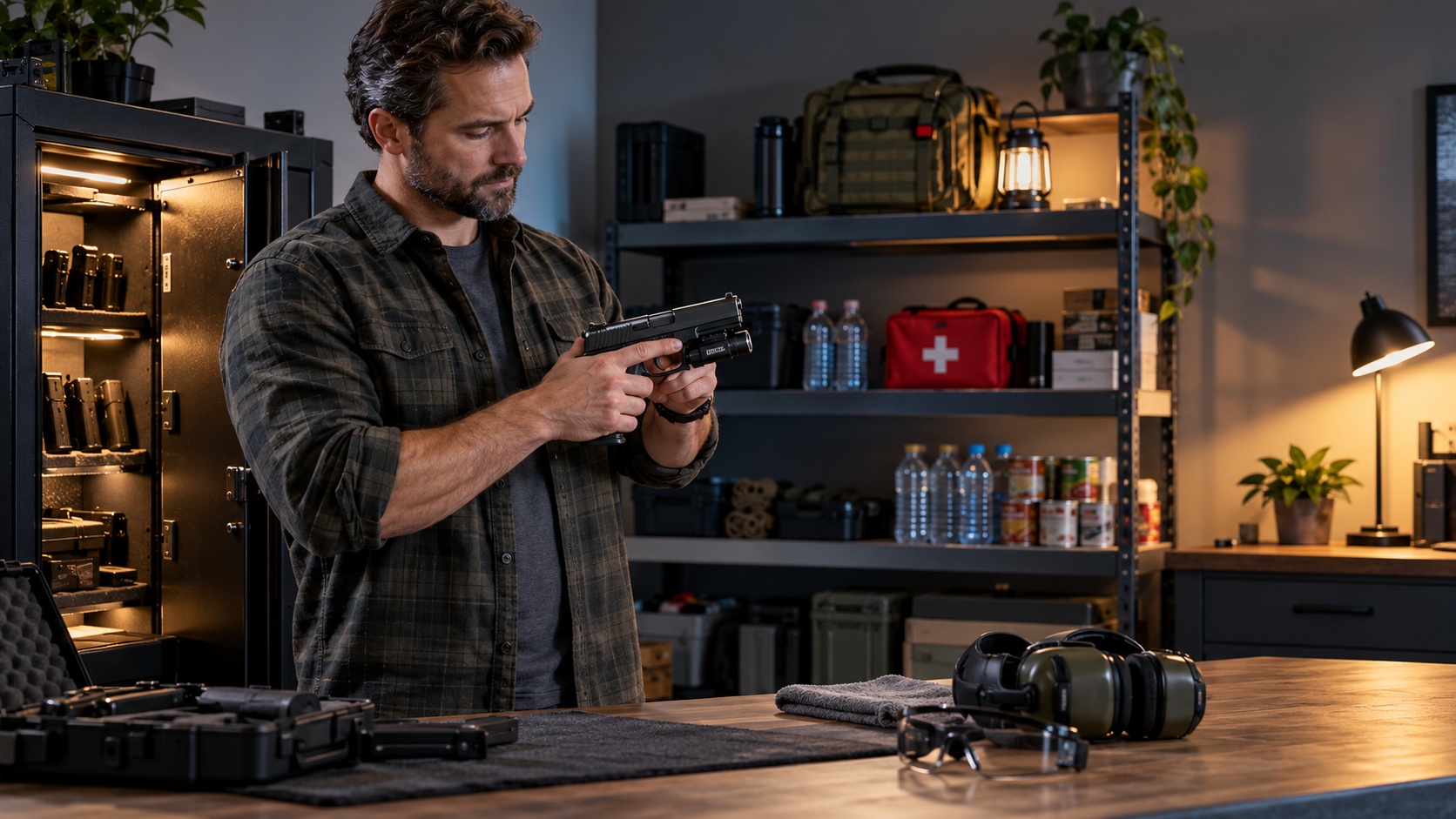
Gun Safety Rules: The 4 Fundamentals Every Responsible Gun Owner Should Know
A firearm can be part of a preparedness plan.
So can a first-aid kit, backup power, emergency water, good locks, reliable communications, and knowing what to do when something goes sideways.
But a firearm is different from most other gear because mistakes can have immediate consequences.
That is why gun safety comes before marksmanship, accessories, defensive tactics, or whatever new piece of equipment just showed up on your wish list.
You do not need to be a lifelong shooter to understand the basics. You do not need to be a hardcore prepper, either.
You need a handful of rules, the discipline to follow them, and enough training to make those rules automatic.
BLUF: The 4 Rules of Gun Safety
The four fundamental gun safety rules are:
- Treat every firearm as if it is loaded.
- Keep the muzzle pointed in a safe direction.
- Keep your finger off the trigger until you are ready to fire.
- Know your target and what is beyond it.
These rules work because they overlap.
If one layer fails, the others are still there.
That redundancy is what makes them useful in the real world.
What Is Gun Safety?
Gun safety is the set of habits, handling procedures, storage practices, and training standards used to prevent unintended discharges, injuries, and unauthorized access to firearms.
For most gun owners, that means paying attention to four things:
- how the firearm is handled
- where it is pointed
- who can access it
- whether the owner understands how it actually works
For preparedness-minded people, there is another layer.
A firearm may be stored for home defense, carried during travel, moved during an evacuation, or kept alongside emergency supplies.
That means safety has to hold up outside a clean shooting-range environment.
You may be tired.
You may be moving gear.
The power may be out.
You may have family members asking questions while you are trying to pack a vehicle.
That is exactly why the fundamentals need to stay simple.
The 4 Rules of Gun Safety Explained
The four rules are easy to memorize.
The real skill is understanding why they matter.
Rule 1: Treat Every Firearm as If It Is Loaded
The fastest way to create a dangerous situation is to rely on assumptions.
Someone says a gun is unloaded.
Check it.
You unloaded it earlier.
Still handle it safely.
You watched somebody else clear it.
Still handle it safely.
The point is not that you can never know whether a firearm is loaded.
The point is that your safe-handling habits should not disappear based on what you think its condition is.
That creates consistency.
Consistency matters under stress.
If your handling changes dramatically depending on whether you believe a gun is empty, one incorrect assumption can become a serious problem.
When you pick up an unfamiliar firearm, do not guess how it operates.
Keep it pointed safely, keep your finger clear of the trigger, and consult the manufacturer’s instructions or a qualified instructor.
Rule 2: Keep the Muzzle Pointed in a Safe Direction
You should always know where the muzzle is pointing.
Not generally.
Not most of the time.
Always.
A safe direction is one in which an unintended discharge would be unlikely to injure someone.
That direction depends on the environment.
At a shooting range, the safe direction is usually obvious.
At home, in a garage, inside a vehicle, or during an evacuation, it may not be.
A floor is not automatically a safe backstop.
A wall is not necessarily a safe backstop.
A ceiling is not necessarily safe either.
Projectiles can penetrate common building materials.
That means muzzle awareness needs to follow you wherever the firearm goes.
Rule 3: Keep Your Finger Off the Trigger Until You Are Ready to Fire
Your trigger finger should remain outside the trigger guard until you have made the decision to shoot.
That habit should become automatic.
When you pick up the firearm, finger stays clear.
When you move, finger stays clear.
When you lower the firearm, finger comes off the trigger.
This is especially important during transitions and interruptions.
People tighten their hands when startled.
They grab things when they lose balance.
They react suddenly when something unexpected happens.
Trigger discipline puts physical separation between those normal human reactions and the trigger.
Rule 4: Know Your Target and What Is Beyond It
The target is only part of the problem.
You also need to know what is:
- in front of it
- beside it
- behind it
A projectile can miss.
It can penetrate certain materials.
It can continue traveling farther than expected.
This matters at the range.
It matters while hunting.
And it matters even more inside a home.
If you keep a firearm for home defense, you should already know where bedrooms, hallways, windows, neighboring homes, and common gathering areas are located.
A defensive plan should account for the actual layout of the building.
Why Are There 4, 5, 7, or 10 Gun Safety Rules?
You may have noticed that different organizations use different numbers.
Some teach four rules.
Some teach five.
Others list seven or ten.
That does not mean somebody got the math wrong.
The four-rule system generally focuses on the core handling principles.
Longer lists expand into areas such as:
- storage
- correct ammunition
- eye and ear protection
- mechanical safeties
- maintenance
- unfamiliar firearms
- failures to fire
- unauthorized access
Think of it this way:
| Framework | Main focus |
|---|---|
| 4 rules | Core gun handling |
| 5 to 7 rules | Handling plus expanded safety practices |
| 10 rules | Broader firearm ownership and shooting safety |
For a new owner, the four basic rules should come first.
Everything else builds on them.
The 10 Rules of Safe Gun Handling
The exact wording varies, but a broader firearm-safety framework usually includes the following principles.
1. Treat Every Gun as If It Is Loaded
Never let an assumption replace safe handling.
2. Keep the Muzzle Pointed Safely
Maintain awareness of where the firearm is oriented.
3. Keep Your Finger Off the Trigger Until Ready to Fire
Keep the finger outside the trigger guard during normal handling.
4. Know Your Target and Background
Understand where a projectile could travel if it misses or passes through the target.
5. Use the Correct Ammunition
Use ammunition that matches the firearm manufacturer’s specifications.
If you are unsure, stop.
Do not make a guess because two cartridges appear similar.
6. Do Not Rely Solely on a Mechanical Safety
A safety lever can be useful.
It is not a substitute for safe handling.
Mechanical devices can be misunderstood, moved, damaged, or incorrectly operated.
Treat the gun safely whether the mechanical safety is engaged or not.
7. Wear Eye and Ear Protection
Shooting exposes you to noise, ejected brass, debris, gases, and other hazards.
Use proper hearing and eye protection whenever appropriate.
8. Handle a Failure to Fire Carefully
If the firearm does not discharge when expected, continue treating it as loaded.
Keep it pointed safely.
Keep your finger away from the trigger.
Follow the manufacturer’s instructions or the guidance of a qualified instructor or range officer.
9. Keep Firearms Properly Maintained
A firearm is a mechanical system.
Follow the manufacturer’s maintenance schedule.
Inspect it.
Clean it correctly.
Do not improvise modifications unless you know exactly what you are doing.
10. Understand the Firearm You Are Using
Knowing how one handgun works does not make you familiar with every handgun.
Different firearms can have different controls, safeties, loading procedures, and maintenance requirements.
Learn the specific platform.
Where Is the Safety on a Gun?
There is no universal answer.
Some firearms have external manual safeties.
Some do not.
Depending on the design, you may encounter:
- thumb safeties
- grip safeties
- cross-bolt safeties
- tang safeties
- trigger-integrated safeties
- internal firing-pin safeties
- drop safeties
- combinations of several systems
If you are unfamiliar with a firearm, consult the owner’s manual.
Do not assume that a lever or button works the same way it does on another gun.
Mechanical Safeties Are Backups
A gun with its safety engaged is still a firearm.
That means the basic rules still apply.
Do not point it somewhere unsafe.
Do not put your finger on the trigger unnecessarily.
Do not assume a mechanical safety makes careless handling acceptable.
The shooter remains the primary safety system.
Safe Gun Storage Is Part of Preparedness
Preparedness usually involves keeping important equipment accessible.
Firearms complicate that idea.
You may want a defensive firearm available quickly.
At the same time, you need to prevent access by:
- children
- guests
- unauthorized family members
- burglars
- anyone else who should not be handling it
That means storage needs to balance access and control.
Options may include:
- full-size gun safes
- quick-access handgun safes
- lock boxes
- locking cabinets
- secured cases
- approved firearm locking devices
The right choice depends on the household.
Someone living alone may have different needs than a family with young children.
A rural homeowner may have different needs than someone in an apartment.
The important part is not buying one particular product.
It is having a plan.
Hiding a Gun Is Not the Same as Securing It
A gun in a closet may be hidden.
It is not necessarily secure.
The same applies to:
- nightstands
- dresser drawers
- shelves
- under mattresses
- glove compartments
- under vehicle seats
People find things.
Children explore.
Burglars know common hiding places.
Security should rely on an actual barrier, not secrecy alone.
Gun Safety Around Children
Children should be taught basic firearm safety.
They should also never be expected to carry the entire burden of keeping themselves safe.
Adults remain responsible for secure storage.
A simple rule for young children is:
Do not touch it. Move away. Tell an adult.
That message should be repeated as children get older.
Curiosity changes.
Access changes.
Understanding changes.
Use Layers
A strong household safety plan uses several layers:
Education + supervision + secure storage
Do not rely on only one.
Gun Safety for Beginners
If you are new to firearms, there is nothing wrong with saying so.
In fact, that is safer than pretending.
Start with the basics.
A beginner should learn:
- the four core safety rules
- basic firearm terminology
- how the specific firearm operates
- how to load and unload it safely
- range procedures
- safe storage
- basic maintenance
- eye and ear protection
- applicable laws
Formal instruction is useful because someone can watch what you are actually doing.
A video cannot always see that your muzzle keeps drifting.
An article cannot tell you your finger is creeping into the trigger guard.
A qualified instructor can.
What Should You Learn in a Gun Safety Class?
A good beginner class should focus on fundamentals before speed or advanced tactics.
Common topics include:
- firearm safety rules
- firearm controls
- safe handling
- range commands
- loading and unloading
- safe storage
- protective equipment
- maintenance
- legal responsibilities
- supervised shooting, when applicable
Different classes serve different purposes.
A basic safety course is not the same as:
- concealed-carry training
- hunter education
- defensive handgun training
- tactical shooting instruction
Start at the beginning.
Advanced training is much more useful when the basics are already solid.
Gun Range Safety
Ranges are controlled environments, but they still require discipline.
Follow the posted rules.
Listen to the Range Safety Officer.
Do not handle firearms when the range is declared cold.
Keep the muzzle pointed in the designated safe direction.
Keep your finger outside the trigger guard until ready to fire.
Wear eye and hearing protection.
And ask questions when you are unsure.
There is no prize for acting experienced.
Gun Safety During Emergencies and Evacuations
This is where preparedness adds another dimension.
During an emergency, people may be:
- tired
- distracted
- packing quickly
- moving through unfamiliar places
- traveling with family
- dealing with power outages
- loading vehicles
- staying temporarily somewhere else
That is exactly when basic firearm discipline matters most.
Do Not Let Urgency Override Safety
An evacuation does not change the rules.
A blackout does not change the rules.
A storm does not change the rules.
If anything, chaotic conditions make consistent handling even more important.
Before an emergency happens, think through:
- how firearms will be secured during transport
- who is authorized to access them
- where they will be stored at a temporary location
- how ammunition will be transported
- what laws apply while traveling
- whether your destination restricts firearms
Do not build that plan while standing in the driveway with a storm approaching.
Firearms and Vehicle Preparedness
Vehicles create their own problems.
A firearm left unsecured in a vehicle may be vulnerable to theft.
It may also be exposed to unauthorized passengers or legal restrictions.
If you transport firearms, understand the laws that apply where you live and where you are traveling.
Do not assume your home-state rules follow you across state lines.
Also consider basic physical security.
A visible gun case or unsecured firearm can make a vehicle a more attractive target for theft.
Your transportation plan should balance lawful access, theft prevention, and safe handling.
The Law Is Part of Preparedness
Legal problems can become real-world problems very quickly.
Gun laws can affect:
- possession
- concealed carry
- open carry
- vehicle transport
- storage
- access by minors
- prohibited locations
- transfers
- defensive use
Those rules vary widely by state and locality.
If you travel frequently, that matters even more.
A firearm that is lawfully stored or carried in one state may be regulated differently after crossing a border.
Check current official sources.
Do not rely on something a friend remembers from five years ago.
Emergency Conditions Do Not Automatically Suspend Firearm Laws
This is especially important for preparedness-minded gun owners.
A hurricane, wildfire, blackout, or evacuation does not automatically mean firearm laws disappear.
State emergency powers and firearm protections vary.
Transportation rules still matter.
Restricted locations may still be restricted.
If firearms are part of your emergency plan, legal research should be part of the plan too.
Firearms Should Be One Layer of Preparedness
A firearm can be useful.
It should not be the entire preparedness strategy.
Good resilience also includes:
- strong doors and locks
- exterior lighting
- alarm systems
- medical supplies
- fire extinguishers
- communications
- backup power
- water
- emergency food
- evacuation planning
- family meeting points
- situational awareness
Preparedness works best in layers.
A gun cannot treat an injury.
It cannot restore power.
It cannot purify water.
It cannot tell you where your family will meet if cell service fails.
Tools solve different problems.
Common Gun Safety Mistakes
Many unsafe habits begin with an assumption.
| Unsafe assumption | Better habit |
|---|---|
| “It’s unloaded.” | Continue using safe handling procedures. |
| “The safety is on.” | Maintain muzzle and trigger discipline. |
| “I know this gun.” | Verify the condition and controls. |
| “Nobody else is home.” | Follow the same rules every time. |
| “The kids can’t reach it.” | Secure it against unauthorized access. |
| “I’ll only leave it here for a minute.” | Control access whenever the firearm is unattended. |
| “I’ve been shooting for years.” | Do not let experience turn into complacency. |
| “It’s an emergency.” | Urgency does not cancel safety procedures. |
A Practical Gun Safety Checklist
A checklist is useful because it is simple.
Before handling, shooting, transporting, or storing a firearm, ask yourself:
- Do I understand this firearm?
- Am I treating it as loaded?
- Is the muzzle controlled?
- Is my finger outside the trigger guard?
- Do I know the target and what is behind it?
- Am I using the correct ammunition?
- Do I have appropriate eye and ear protection?
- Do I understand the range or location rules?
- How will the firearm be secured when I am finished?
- Can an unauthorized person access it?
- Do I understand the laws that apply here?
- If I have to evacuate, do I already know how I will transport it?
That last question is particularly useful for anyone building a broader emergency plan.
Gun Safety FAQ
What Are the Four Basic Rules of Gun Safety?
The four fundamental rules are:
- Treat every firearm as if it is loaded.
- Keep the muzzle pointed in a safe direction.
- Keep your finger off the trigger until you are ready to fire.
- Know your target and what is beyond it.
These rules work together as overlapping safeguards.
What Are the Five Basic Gun Safety Rules?
Different organizations use different frameworks.
A five-rule system usually adds another principle to the four fundamental handling rules, such as keeping firearms unloaded or securely stored when not in use.
The important point is that the four core handling rules remain the foundation.
What Are the 10 Rules of Gun Safety?
Broader ten-rule systems typically include the four fundamental handling rules plus correct ammunition, mechanical-safety awareness, protective equipment, firearm maintenance, safe response to failures to fire, and familiarity with the specific firearm.
Why Do Some Sources Say There Are 4, 7, or 10 Gun Safety Rules?
Different organizations group firearm safety principles differently.
The four-rule framework focuses on core handling.
Longer lists add storage, ammunition, maintenance, protective equipment, and other ownership responsibilities.
What Is the Most Important Rule of Gun Safety?
There is not one rule you should follow while ignoring the others.
The strength of the system comes from redundancy.
If someone makes one mistake, the remaining rules may still prevent an injury.
Where Is the Safety on a Gun?
It depends on the firearm.
Some firearms have external manual safeties.
Others rely on internal or automatic safety mechanisms.
Consult the owner’s manual for the exact model.
Do All Guns Have a Manual Safety?
No.
Many firearms use internal safety systems without an external manual switch.
That does not mean safe-handling rules become less important.
Should Children Be Taught Gun Safety?
Yes.
Children should receive age-appropriate firearm-safety education.
However, education should never replace secure storage and adult supervision.
Should Firearms Be Part of an Emergency Preparedness Plan?
They can be, depending on your circumstances and local laws.
But they should be one component of a broader plan that also includes medical supplies, communications, food, water, power, security, and evacuation planning.
Can You Transport a Firearm During an Evacuation?
Potentially, but laws vary by jurisdiction and circumstance.
Firearm owners should understand applicable transportation, storage, carry, and destination laws before an emergency occurs.
Do Gun Safety Classes Expire?
The skills do not suddenly expire, but permits, certificates, or state-specific training requirements may have renewal periods.
Check the rules that apply to your jurisdiction.
Should Experienced Shooters Take Refresher Training?
Yes.
Experience is valuable, but bad habits can develop over time.
Refresher training can identify problems before they become permanent habits.
Readiness Starts With Control
Preparedness is about being ready before something happens.
Gun safety works the same way.
You do not wait for a stressful moment to decide where your finger belongs.
You do not wait for an evacuation order to figure out how firearms will be transported.
You do not wait until a child discovers a gun to think about secure storage.
Build the habits early.
Treat every firearm as loaded.
Control the muzzle.
Keep your finger off the trigger until you are ready to fire.
Know your target and what is behind it.
Then build outward.
Secure storage.
Training.
Legal knowledge.
Emergency planning.
The best preparedness systems are not complicated for the sake of being complicated.
They are reliable.
And with firearms, reliability starts with safe habits.
This article is intended for general firearm safety and preparedness education and is not legal advice. Firearm possession, carry, transportation, storage, and defensive-use laws vary by jurisdiction. Follow the manufacturer’s instructions for your firearm and consult current federal, state, and local law.