Long before off-grid living became a YouTube genre and preparedness became a mainstream industry, one of America’s most notorious criminals was living without electricity or running water in a tiny Montana cabin. That single fact has led people to lump Ted Kaczynski in with survivalists and preppers for almost thirty years. The real story is stranger than that, and considerably darker.
Kaczynski has been dead since 2023. Search interest in him is climbing anyway, because Netflix drops UNABOMBER on September 25, 2026, with Jacob Tremblay as the young Kaczynski and Russell Crowe as the Harvard psychologist who ran experiments on him.
Here is who he actually was, what he actually did, how he survived alone in the woods for two decades, how the FBI finally caught him, and where the Hollywood version parts ways with the documented record.
Quick Facts About the Unabomber
| Fact | Answer |
|---|---|
| Real name | Theodore John Kaczynski |
| Known as | The Unabomber |
| Born | May 22, 1942, Chicago, Illinois |
| Education | Harvard (entered at 16); Ph.D. in mathematics, University of Michigan |
| Former occupation | Assistant professor of mathematics, UC Berkeley |
| Lived | One-room cabin near Lincoln, Montana |
| Bombing campaign | 1978 to 1995 |
| Devices | 16 bombs |
| Victims | 3 killed, 23 injured (some counts say 24) |
| Manifesto | Industrial Society and Its Future |
| Arrested | April 3, 1996 |
| Sentence | Life imprisonment without parole |
| Died | June 10, 2023, age 81 |
| Netflix movie | UNABOMBER, September 25, 2026 |
A note on that victim count. The FBI’s own case history and Netflix’s synopsis both say three killed and 23 injured. Some accounts list 24. The difference comes down to which incidents get counted and how minor injuries are tallied, not a dispute over the deaths.
Who Was the Unabomber?
Ted Kaczynski Before the Unabomber
Kaczynski was born in Chicago in 1942 and tested as extraordinarily gifted early. He skipped grades. He entered Harvard in 1958 at sixteen years old, younger than nearly everyone around him and socially adrift in a way that shows up repeatedly in accounts of that period.
He finished his mathematics degree and went on to the University of Michigan, where he earned a Ph.D. in 1967. His dissertation work in geometric function theory was strong enough that faculty described it as material only a handful of people in the country could follow.
At 25 he became an assistant professor of mathematics at UC Berkeley. He was the youngest person ever hired into that position there.
Two years later he quit with no explanation and no other job lined up.
The trajectory is the part that keeps people fascinated:
Harvard at 16 → Michigan Ph.D. → Berkeley professor → a 10-by-12 cabin in Montana with no plumbing → the longest and most expensive manhunt in FBI history to that point.
In 1971 he and his brother David bought a small parcel of land outside Lincoln, Montana. Ted built the cabin himself and stayed there, more or less, for the next 25 years.
What Exactly Did the Unabomber Do?
Between 1978 and 1995 Kaczynski built and mailed or placed 16 bombs. They killed three people and injured roughly two dozen more. The devices were handmade, often built from scrap wood and salvaged metal, and they got significantly more lethal over time.
The targets clustered around universities, airlines, computer businesses, and later, individuals whose work he associated with technological progress or public relations.
- 1978: First device, left at the University of Illinois at Chicago and later opened at Northwestern. A campus police officer was injured.
- 1979: A bomb placed in the cargo hold of American Airlines Flight 444. It partially failed, filling the cabin with smoke and forcing an emergency landing. Had it detonated fully, the death toll would have been catastrophic.
- 1985: The first fatality. Hugh Scrutton, who owned a computer rental store in Sacramento, was killed by a device left in his parking lot.
- 1993 to 1995: The deadliest phase, after a six-year gap.
The FBI has described the campaign as one that terrorized the country for nearly two decades. That is not marketing language. Universities screened mail. Airlines changed procedures. The case consumed more federal resources than any investigation before it.
A Short Unabomber Timeline
| Year | Event | Why It Matters |
|---|---|---|
| 1971 | Moves to the Montana cabin | Begins 25 years of near-total isolation |
| 1978 | First known device | Start of the campaign |
| 1979 | Bomb aboard American Airlines Flight 444 | Triggers federal jurisdiction and the UNABOM case name |
| 1985 | Hugh Scrutton killed in Sacramento | First death |
| 1987 | Witness sees a suspect in Salt Lake City | Produces the famous hooded sketch |
| 1987–1993 | Six-year pause in attacks | Investigation stalls badly |
| 1993 | Attacks resume; two victims severely injured | Case reopens with new urgency |
| 1994 | Thomas Mosser killed in New Jersey | Advertising executive, targeted over his industry |
| 1995 | Gilbert Murray killed in Sacramento | California Forestry Association president |
| 1995 | Industrial Society and Its Future published | The decision that ends the case |
| 1996 | Arrested at the cabin, April 3 | Manhunt ends |
| 1998 | Pleads guilty, sentenced to life without parole | Avoids a death penalty trial |
| 2023 | Dies in federal custody, June 10 | Ruled an apparent suicide |
Why Was He Called the “Unabomber”?
The name came from the FBI, not from Kaczynski.
Investigators code-named the case UNABOM, built from the early pattern in the attacks: UNiversity and Airline BOMbing. Press coverage turned the case name into a nickname for the unknown suspect, and “Unabomber” stuck for 17 years before anyone knew who he was.
Kaczynski never used it. In his letters and in the manifesto he claimed to represent an anarchist group called FC, which he identified as the “Freedom Club.” No such group existed. He worked alone.
Ted Kaczynski’s Montana Cabin and His Life Off the Grid
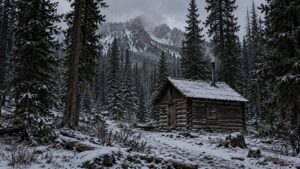
The cabin sat on a wooded slope outside Lincoln, Montana, population a few hundred. It was roughly 10 feet by 12 feet. One room. No electricity. No running water. No phone.
Records from the National Archives and FBI case materials describe a life stripped down to almost nothing:
- Wood stove for heat and cooking
- Hand-dug root cellar for food storage
- A garden where he grew potatoes, turnips, and other staples
- Hunting and trapping for meat, including rabbit and deer
- A bicycle and his own feet for the 50-mile trips into town
- Homemade tools, hand-forged parts, and repaired scrap in place of purchased goods
- A library of technical books and tens of thousands of pages of his own writing
He was not entirely self-sufficient. He accepted money from his family for years, bought supplies in Lincoln, used the public library there, and relied on the postal system, which is a detail worth sitting with given how he used it.
Was Ted Kaczynski a Prepper?
Short answer: no, not in the way the word is used today.
The overlap is real, and it is why the question keeps getting asked. Look at the behavior list on its own and it reads like a hardcore homesteading checklist:
| Behavior | Overlaps with preparedness? | Kaczynski’s actual motive |
|---|---|---|
| Lived off-grid | Yes | Reject industrial dependence |
| Grew and stored food | Yes | Reduce need for commerce |
| Hunted and trapped | Yes | Same |
| Built and repaired his own gear | Yes | Same |
| Remote shelter | Yes | Isolation, not defense |
| Minimal possessions | Partially | Ideological asceticism |
| Stockpiling for a disruption event | No | He was not preparing for anything |
That last row is the whole answer. Preparedness is fundamentally about contingency. You store water because the utility might fail. You keep food because the supply chain might stutter. You learn skills because help might be twelve hours out. The entire logic is “if this happens, I can function.”
Kaczynski was not waiting for a collapse. He was performing a permanent refusal. His writing makes it explicit that he wanted the industrial-technological system destroyed, not survived. The cabin was a statement, not a bug-out location.
And the part that matters most for anyone reading this on a preparedness site:
Living off-grid does not make a person a violent extremist. Kaczynski’s crimes came from a decision to kill people. They did not come from a garden, a wood stove, or a distrust of modern infrastructure.
Academic work on prepper culture has documented this exact confusion, noting that modern preparedness gets stereotyped through associations with extremism and older survivalist movements even though most preparedness behavior is thoroughly ordinary.
Did the Unabomber Help Create the “Crazy Survivalist” Stereotype?
He did not create it single-handedly. Nobody did. But he fit the emerging template so precisely that he became shorthand for it.
Through the late 1980s and 1990s, a cluster of heavily covered events assembled a media archetype in the American imagination:
- Remote cabin
- Stockpiled supplies
- Deep distrust of government or society
- Anti-modern ideology
- Weapons
- Violence
Ruby Ridge in 1992. Waco in 1993. Oklahoma City in 1995. Sustained militia coverage throughout the decade. Then, in April 1996, television networks broadcast footage of a filthy, bearded man being led out of a plywood shack in the Montana woods, and the archetype had its picture.
Researchers studying prepper communities have noted that survivalism became linked in the public imagination with cult and domestic-terrorism incidents during this period, and that the resulting stereotype carried forward into how preppers are perceived now.
The gap between the archetype and the reality is enormous. Owning a month of shelf-stable food, knowing how to purify water, keeping a generator, or having a plan for a week-long outage has close to nothing in common with abandoning society because you believe industrial civilization must be torn down by force. One is risk management. The other is an ideology that ended in three coffins.
What Did Ted Kaczynski Believe?
His argument, stated plainly and without embellishment:
- Industrial and technological systems progressively erode individual autonomy.
- Technology creates dependencies people cannot realistically opt out of.
- Each technological fix tends to generate new technological problems.
- Reform is structurally impossible because the system’s own logic resists it.
- Therefore the system must be brought down.
He wrote about “surrogate activities,” the idea that modern life removes the real struggles humans are built for and substitutes hollow replacements. He wrote about the way technology advances as a package deal, where individual choices to adopt it produce collective outcomes nobody voted for.
Two things need to stay separate here.
His critique of technological dependence is a subject people have written about seriously for a century, from Jacques Ellul to Lewis Mumford to Neil Postman. His decision to mail bombs to strangers is a separate matter entirely, and one that does not follow from the critique.
In 2026, with AI systems, ubiquitous surveillance, algorithmic feeds, and automation reshaping daily life faster than institutions can respond, some of those questions about dependence feel newly urgent. That is exactly why the “Ted was right” meme circulates online. It is also exactly why it is worth saying clearly: you can find a question interesting without endorsing the man who killed people over it. The bombs did not prove anything. They ended the lives of a computer store owner, an advertising executive, and a timber industry lobbyist.
The Unabomber Manifesto: Industrial Society and Its Future
The manifesto runs roughly 35,000 words across 232 numbered paragraphs. He sent copies to The New York Times, The Washington Post, and Penthouse in 1995, with an offer: publish it in full and the bombing stops.
The decision to comply was made at the highest levels. Attorney General Janet Reno and FBI Director Louis Freeh supported publication, and their reasoning was investigative rather than editorial. After 17 years, the task force had almost nothing. What they did have was a voice. Someone out there might recognize the argument, the vocabulary, the specific crankiness of the prose.
The Washington Post printed it as a supplement on September 19, 1995. The New York Times shared the cost.
The gamble worked in under six months.
How Did the FBI Catch the Unabomber?
His Own Writing Became His Undoing
The manifesto reached Linda Patrik, who was married to Kaczynski’s younger brother David. She had never met Ted but had heard enough about him to be uneasy. She pushed David to read it.
David resisted at first, then compared the published text against old letters and essays Ted had sent him over the years. The overlap was not subtle. Phrasings recurred. Arguments recurred. Idiosyncratic spellings recurred.
David went to a lawyer, who went to the FBI. He supplied the family documents.
Bureau linguists ran the comparison formally, examining unusual constructions and consistent spelling choices across the manifesto and Kaczynski’s known correspondence. The FBI has specifically cited those phrasing and spelling patterns as significant evidence in obtaining the search warrant.
Agents arrested Ted Kaczynski at the cabin on April 3, 1996.
This is essentially a forensic linguistics case, and a proto-OSINT one. The suspect was identified not by forensics at a scene, not by informants, not by surveillance, but by the way he wrote sentences.
What the FBI Found in the Cabin
The search recovered, at a high level:
- Roughly 40,000 pages of handwritten journals and notes
- Coded diary entries documenting the attacks
- One fully assembled, functional explosive device
- Components and materials consistent with the bombings
- The original typewriter used for his correspondence
- Bomb-making notes and experimental logs
He had documented nearly everything himself, which is why the eventual case was overwhelming enough that he pleaded guilty rather than go to trial.
The Unabomber Sketch
In February 1987, a device was left outside a computer store in Salt Lake City. A woman inside the business looked out the window and saw a man in a hooded sweatshirt and aviator sunglasses placing something near the parking lot.
That sighting produced the composite sketch that became one of the most recognizable images in American criminal history. Hood up, dark glasses, mustache, no other identifying detail.
It was also, in practical terms, close to useless. The sketch was reproduced on posters, news broadcasts, and magazine covers for nine years. Kaczynski was not identified by it. He was identified by his prose.
He also stopped attacking for six years after Salt Lake City, almost certainly because he knew he had been seen.
Ted Kaczynski and the Harvard Experiments
This is the piece Netflix has built its movie around, so it is going to drive a lot of searches this week.
As a Harvard undergraduate, Kaczynski volunteered for a psychological study run by professor Henry Murray, a prominent personality psychologist with a background in wartime intelligence work. The study ran from 1959 to 1962 and involved roughly two dozen students.
Participants were asked to write out their personal philosophy of life. They were then placed in a chair, wired to monitoring equipment, and subjected to an aggressive interrogation in which a confederate attacked their beliefs. Their reactions were filmed and replayed to them afterward. Kaczynski, assigned the code name “Lawful,” participated for three years.
Did the Harvard Experiments “Create” the Unabomber?
Handle this one carefully, because the internet does not.
| Claim | Status |
|---|---|
| Kaczynski participated in Murray’s experiments at Harvard | Documented |
| The experiments involved deliberate stress and hostile confrontation | Documented |
| The study’s ethics have been widely criticized since | Documented |
| The experiments caused Kaczynski to become a bomber | Not established |
| The study was part of MKUltra | Not established |
The experiments were real and their methods were genuinely troubling by any modern standard. Whether they produced a serial bomber is a different question, and one that retrospective psychology is poorly equipped to answer. Kaczynski himself gave inconsistent accounts of how much the study affected him. Plenty of other participants went on to ordinary lives.
Causation claims about a single person’s psychological history are almost impossible to substantiate. Treat “Harvard made him” as a narrative, not a finding.
How Accurate Is Netflix’s UNABOMBER Movie?
Here is what is confirmed ahead of the September 25 release.
| Element | Detail |
|---|---|
| Release | September 25, 2026, Netflix, global |
| Director | Janus Metz |
| Writers | Sam Chalsen and Nelson Greaves |
| Young Kaczynski | Jacob Tremblay |
| Henry Murray | Russell Crowe |
| Christiana Morgan | Annabelle Wallis |
| FBI Agent Joanne Miller | Shailene Woodley |
| Rating | R |
| Structure | Dual timeline, Harvard years and the 1990s manhunt |
One detail is already worth flagging, because it will be the first thing people search after watching.
Shailene Woodley’s character, FBI agent Joanne Miller, is fictional. There was no single agent named Joanne Miller who cracked UNABOM. The real task force involved hundreds of personnel across the FBI, ATF, and Postal Inspection Service over 17 years, and the decisive break came from David Kaczynski and his wife rather than from an investigator’s insight. What’s on Netflix
Netflix describes the film as inspired by true events, following Kaczynski’s transformation from Harvard prodigy into the Unabomber, with the manhunt led by Miller. Director Janus Metz has described the structure as crosscutting between two timelines, the making of the Unabomber and the capture of the Unabomber. Netflix TudumNetflix Tudum
Questions to check against the record once it streams:
- How closely does the film’s version of Murray’s study match the documented protocol?
- Does it compress a 17-year investigation into something an individual agent solves?
- Does it credit David Kaczynski and Linda Patrik accurately?
- Does the cabin set match the actual structure, now in FBI custody?
- Does it assert a causal line from Harvard to the bombings that the evidence does not support?
That last one is the one to watch. The trailer leans heavily on Murray as the origin point of everything that followed. Dramatically satisfying. Historically unproven.
The Unabomber in Good Will Hunting
Small piece of film trivia that lands differently once you know the timeline.
In Good Will Hunting, released in December 1997, Sean Maguire (Robin Williams) is arguing with Professor Gerald Lambeau (Stellan Skarsgård) about what happens to brilliant young men who are pushed. Sean describes a mathematician from the University of Michigan who went on to Berkeley and had limitless potential.
Then he names him: Ted Kaczynski.
Lambeau does not recognize the name. Sean turns to the bartender and asks him who Ted Kaczynski is. The bartender answers without hesitation: the Unabomber.
The joke works on two levels. It makes Sean’s point that raw intellect guarantees nothing about how a person uses it. It also lands a quiet shot at academic insulation, since the professor is the only one in the room who does not know.
The film came out roughly 20 months after the arrest. Audiences in 1997 caught it instantly.
What Happened to Ted Kaczynski?
He pleaded guilty in January 1998, accepting life imprisonment without the possibility of parole in exchange for prosecutors dropping the death penalty. His defense team had wanted to pursue a mental illness strategy. He refused, on the grounds that it would discredit his ideas, and attempted to fire them over it.
He spent most of the next two decades at ADX Florence in Colorado, the federal supermax. In late 2021 he was moved to a federal medical facility in North Carolina.
He died there on June 10, 2023, at age 81. Authorities reported his death as an apparent suicide. He had been diagnosed with late-stage cancer.
7 Things You Probably Didn’t Know About the Unabomber
1. He entered Harvard at 16.
Not gifted-program gifted. He arrived on campus as a sophomore in high-school terms, surrounded by legal adults.
2. He was a genuine professional mathematician.
Not “good at math.” Ph.D. from Michigan, published papers in boundary functions, and the youngest assistant professor Berkeley’s math department had ever hired. He walked away from that career at 27.
3. His cabin had no electricity and no running water.
It also had no foundation to speak of. The FBI hauled the entire structure out of the woods intact as evidence.
4. “Unabomber” was a filing code.
UNiversity and Airline BOMbing. The nickname is an FBI acronym that escaped into the press.
5. Publishing his manifesto is what ended his freedom.
He demanded the platform. The platform gave his brother and sister-in-law the sample they needed to recognize him.
6. His brother gave most of the reward money away.
David Kaczynski received the $1 million reward. After legal fees and taxes, he directed the bulk of the remainder to the families of his brother’s victims and spent years afterward speaking publicly against the death penalty.
7. The cabin became a museum piece.
The FBI preserved the structure and it was reconstructed for public display at the Newseum in Washington, D.C. When that institution closed in 2019, the cabin returned to FBI custody.
The Unabomber’s Strange Place in American Culture
Kaczynski occupies a genuinely odd slot in the American imagination. He is simultaneously a murderer, a domestic terrorist, a punchline in a Best Picture winner, an anti-technology mascot for people who have never read past paragraph 30, a meme format, a documentary subject, a Netflix film, and a permanent asterisk attached to anyone who chooses to live in the woods.
That last one is the part that deserves correcting, and it is why this story belongs on a preparedness site at all.
Strip away the crimes and what remains of his daily life is unremarkable. He grew food. He heated with wood. He fixed his own tools. He rode a bicycle into town. He read. Millions of Americans do a version of that, and a great many of them are simply people who would rather not be helpless when the power goes out.
Kaczynski’s legacy has nothing to do with any of that. It comes from a specific decision, made repeatedly over 17 years, to convert a grievance into a campaign of violence against people who had never met him.
Separating the Cabin From the Crimes
When UNABOMBER lands on Netflix this Friday, expect a wave of takes about Harvard, about Murray, about whether a bright kid was broken by an institution. Some of that is worth discussing. Most of it will outrun the evidence.
The useful frame is simpler. The cabin never made him dangerous. The garden never made him dangerous. Distrust of technological systems never made him dangerous. He built bombs and mailed them to people, and that is the only fact in this story that actually explains the outcome.
Preparedness is about staying functional when systems fail. That is the opposite of wanting them to.