BLUF/Bottom Line Up Front:
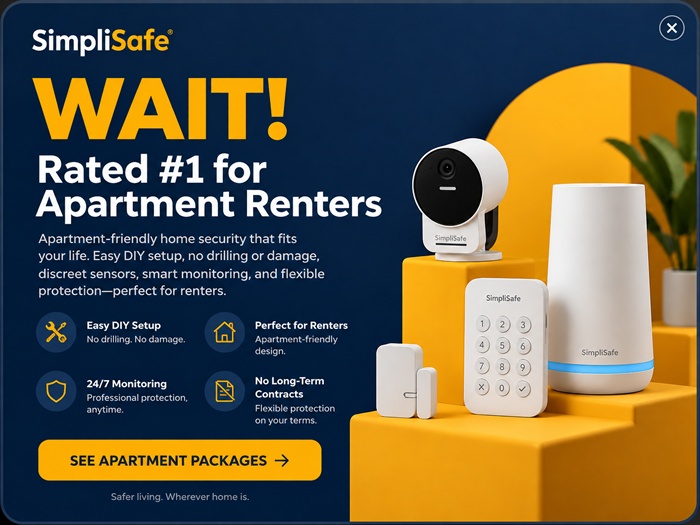
For most apartment renters, SimpliSafe is the best alarm system. Wireless installation, no long-term contract, portable equipment that comes with you when you move, and optional professional monitoring you can turn on or off month to month.
The exceptions matter:
- ADT Self Setup if you want professional monitoring as the baseline and don’t want to think about alerts yourself.
- Abode for self-monitoring, smart-home integration, and no forced subscription.
- Ring Alarm if you already own Ring cameras or a doorbell.
Before you buy anything, count your real entry points (front door, patio slider, ground-floor windows). That’s your buying rule. Not square footage. Not “how many pieces in the kit.”
Apartment Security Is a Different Problem Than Home Security
Most alarm system reviews are written for homeowners. Detached houses, garages, driveways, backyards. That mental model breaks down fast in a rental unit.
You may not be allowed to drill. You probably can’t change the locks yourself. A 36-month contract feels absurd when the lease is 12. And your threat profile depends heavily on whether you’re on the ground floor next to a shared parking lot or on the fifth floor of a controlled-access building.
The renter risk profile also runs higher than most people realize. Recent data puts the renter break-in rate at roughly 3.27%, compared to 1.83% for homeowners. Renters get hit almost twice as often per unit.
Building size shifts the odds too:
- 2 to 4 unit buildings: highest risk
- 5 to 9 unit buildings: elevated risk
- 10+ unit buildings: lowest risk
Small multi-unit properties tend to have weaker exterior control, less foot traffic in shared spaces, and fewer eyes watching who comes and goes.
When and How Break-Ins Actually Happen
Timing runs against most people’s assumptions:
- Daytime intrusions (roughly 10 AM to 3 PM) outpace nighttime break-ins because units are empty during work hours.
- 34% of burglars walk through an unlocked front door.
- 23% enter through first-floor windows.
- 22% enter through back doors.
- The average burglary takes 10 to 12 minutes or less.
Ten minutes. That’s the entire defensive window your system has to work inside. Trigger fast, generate noise or notification, make the intruder abandon the effort. Anything slower loses the game.
The Apartment-Specific Threat Landscape Nobody Talks About
Standalone-home security advice ignores the biggest vulnerability in apartment living: shared building infrastructure. Your unit door is not your first perimeter. The lobby, the parking garage, the stairwell, and the mailroom are.
Behavioral Red Flags Worth Watching For
Apartment-specific intrusion tactics have gotten more sophisticated:
- Piggybacking (tailgating): An intruder waits for a resident to badge into the lobby or garage, then slips in behind them before the door closes.
- Routine tracking: Burglars watch parking spots and driveway patterns to figure out which units are empty during standard work hours.
- Shared access exploitation: Propped side doors, unlocked stairwells, and elevators without floor-based key restrictions all bypass the main lobby entirely.
- Balcony vulnerability: Upper-floor units get targeted when balconies or adjacent windows are left unlocked. Height is not security if the slider is open.
- Short-term rental scoping: Airbnb, VRBO, and similar platforms have been used to legally book a unit for reconnaissance of the rest of the building.
Practical Building-Level Defenses
You control less than a homeowner does, but not nothing:
- Never let strangers piggyback through secure entry doors, even if they look friendly.
- Lock sliding doors and windows on every level. A wooden dowel or metal brace in the track defeats most sliders.
- Never leave key fobs or garage remotes visible in parked vehicles.
- Use portable door jammers or security bars if your lease prevents deadbolt modifications.
- Document broken common-area locks, burned-out corridor lights, and propped doors, then email property management immediately.
- Consider a tenant chat group to track suspicious activity independently of management.
- Report anyone testing door handles or lingering in shared garages directly to local authorities.
Building awareness is a force multiplier for whatever alarm system you install. A great sensor loadout on your unit door means less if the garage door has been propped open for a month.
Defense in Depth Applied to Apartment Living
Defense in depth is the classical security framework: layered, overlapping controls where no single failure exposes the whole system. In an apartment, that translates to the 5 D’s: Deter, Detect, Deny, Delay, Defend.
| Layer | Function | Apartment Application |
|---|---|---|
| Deter | Convince the attacker to pick a different target | Alarm decals, visible cameras, exterior lighting, occupancy signals |
| Detect | Identify an attempt in progress | Door and window sensors, motion detectors, glass-break sensors |
| Deny | Prevent physical access | Deadbolts, door reinforcement, window locks, security film |
| Delay | Slow the attack to buy time | Multiple locks, door jammers, layered barriers |
| Defend | Respond directly to the threat | Personal defense tools, safe room protocol, monitored dispatch |
A good apartment alarm system hits three of five directly. It deters through visible signage. It detects through sensors. And when paired with monitoring, it enables defend through outside response.
Dissuasion Is the Cheapest Layer You’ll Ever Deploy
The most underrated function of an alarm system is the sign in the window.
A visible alarm decal changes the target selection calculus. Burglars are opportunistic and time-constrained. If your unit signals “loud, recorded, monitored,” the attacker walks to the door that doesn’t send those signals.
Buy the sensors. Also use every decal, sticker, and window cling the system ships with. Dissuasion is free perimeter defense.
Prevention-First vs Reactive Posture
Most alarm marketing focuses on the reactive side. Sensor trips, siren sounds, monitoring calls, you get a phone notification. That’s the visible part.
The higher-value work is prevention-focused:
- Choose reinforcement and habits that make a break-in attempt unlikely in the first place.
- Reinforce the door and locks before anything happens.
- Install visible deterrents before an incident, not after.
- Establish lighting and occupancy patterns that discourage surveillance.
Your alarm serves both functions, but its greatest value is making you a less attractive target before anyone tries the handle.
The Self-Monitoring Resilience Angle
Here’s something most apartment security guides skip entirely: your professional monitoring service can go dark.
Not permanently. Not usually. But cellular networks fail during severe weather. Hurricane season regularly knocks out monitoring infrastructure in the Southeast. Wildfire evacuations disrupt service across the West. Extended power outages, civil unrest, or regional emergencies can all interrupt the response chain between your alarm and the dispatch center.
None of this is theoretical. Ask anyone who lived through Hurricane Helene in North Carolina, or the Texas grid collapse in February 2021, or the extended cellular outages during recent West Coast wildfire seasons.
The point isn’t to fearmonger. The point is that a monitoring service you can’t reach doesn’t help you.
Self-monitoring has a resilience advantage worth naming: you control the response yourself. Local siren still works on battery backup. Phone notifications still fire if cellular is up. You don’t need a call center 800 miles away to make a decision on your behalf.
Best-of-both-worlds systems (SimpliSafe, Abode, Ring) let you pay for professional monitoring during normal conditions and still function as self-monitored devices when the professional layer is disrupted. That’s a legitimate reason to prefer a system where monitoring is optional rather than baked in.
The Best Alarm Systems for Apartments at a Glance
| System | Best For | DIY Install | Monitoring | Contract | Renter-Specific Edge |
|---|---|---|---|---|---|
| SimpliSafe | Best overall | Yes | Optional | No | Portable, expandable, adhesive-mounted sensors |
| ADT Self Setup | Monitoring-first buyers | Yes | Yes | No long DIY commitment | Real 24/7 monitoring with wireless hardware |
| Abode | Self-monitoring and smart-home | Yes | Optional | No | Full function on the free tier |
| Ring Alarm | Existing Ring households | Yes | Optional | No | Native integration with Ring cameras |
Pricing shifts quarterly, so verify current numbers before you buy. As of this writing, SimpliSafe’s basic monitoring runs about $0.76 per day with the Core tier at $32.99 per month adding video verification and Intruder Intervention. ADT Self Setup equipment starts around $199 with monitoring from $24.99 per month. Ring’s 8-piece Alarm kit is roughly $249.99 with Ring Pro monitoring at $19.99 per month.
Best Overall Apartment Alarm System: SimpliSafe
SimpliSafe is the default recommendation for most renters because it solves the rental-specific problems better than the alternatives.
Why SimpliSafe Works for Renters
The engineering aligns with how renters actually live:
- Fully wireless. No hardwiring anywhere.
- DIY install in under an hour for a basic kit.
- Adhesive-backed sensors that come off without damaging paint.
- No long-term monitoring contract required.
- Month-to-month professional monitoring available if you want it.
- Sensor library covers entry, motion, glass-break, water, smoke, and CO.
- Camera options that plug into standard outlets.
- Modular design. Start with three pieces. Expand later.
Portability is the underrated feature. When the lease ends, the entire system peels off the walls and goes into a box. It resurrects at the next address in one evening.
The SimpliSafe Setup I’d Actually Buy
For a standard one- or two-bedroom unit, the minimum viable kit looks like:
- Base station and keypad
- One entry sensor on the front door
- One entry sensor on the patio or balcony door (if applicable)
- One motion sensor covering the primary living area
- Optional: one indoor camera facing the entryway
- Optional: one glass-break sensor if you’re on the ground floor
Skip the twelve-piece mega-kits. They’re built for houses. In a 900 square foot apartment, extra sensors add cost and false-alarm surface without meaningful protection improvement.
Where SimpliSafe Falls Short
Honest limitations matter for credibility:
- Some cloud, video, and app features require the paid monitoring tiers.
- Proprietary ecosystem. Not as open as Abode for smart-home tinkerers.
- Cameras can feel excessive in a small studio.
- If you’re already deep into Ring, switching platforms is friction for no real gain.
- Long-term self-monitoring costs less on Abode.
None of these are dealbreakers for most renters. They’re reasons the alternatives exist.
Best Apartment Alarm System for Professional Monitoring: ADT Self Setup
ADT’s professionally installed offering is the wrong product for most renters. Long installs, drilling, contract complexity, bad fit.
ADT Self Setup is a different product. Wireless DIY hardware, monitoring starting around $24.99 per month, cancel anytime, no long DIY commitment. That version competes directly with SimpliSafe.
When ADT Beats SimpliSafe
The buyer profile that tilts toward ADT Self Setup:
- Frequent business travelers who don’t want to babysit self-monitoring.
- Anyone who sleeps through phone notifications.
- Renters living alone who want a professional response as the default.
- People who consider “monitoring included” a feature worth paying for, not an upsell.
If your mental model is “I want someone else handling an alarm event,” ADT’s brand and monitoring infrastructure earn their keep. ADT Blue (their DIY-focused line) also deserves a look for the same buyer.
Best No-Monthly-Fee Apartment Alarm System: Abode
Abode is the underdog on most SERP lists, and it shouldn’t be. For self-monitoring renters, it may be the best value in the category.
Why Abode Deserves Real Consideration
The free tier alone gives you:
- Full app control
- Live video streaming
- Self-monitoring with push notifications
- Native integration with Apple HomeKit, Alexa, and Google Assistant
- Remote arm and disarm
Add the Pro plan later if you want professional monitoring and cellular backup, but the base functionality doesn’t disappear if you don’t.
The Abode Buyer Profile
Abode wins when the renter is:
- Already running a smart-home stack (HomeKit, SmartThings, etc.)
- Comfortable setting up and troubleshooting themselves
- Home often enough that self-monitoring works
- Willing to trade professional dispatch for lower long-term cost
Different buyer from the ADT customer. Both are correct answers to different questions.
Best Apartment Alarm for Ring Households: Ring Alarm
If your apartment already has a Ring doorbell, a Ring indoor cam, and an outdoor Ring cam, then Ring Alarm isn’t just an option. It’s the obvious choice.
Ring Pro monitoring at $19.99 per month bundles the alarm with existing camera functionality under a single app and single subscription. The friction of running two ecosystems (Ring cameras plus SimpliSafe alarm) rarely justifies itself.
When Ring Wins
- Existing Ring hardware investment
- Camera-first security philosophy
- Alexa household
- Preference for one app instead of two
When to Skip Ring
- Building your setup from scratch
- Alarm-first priority with cameras as afterthought
- Preference for a more open smart-home platform
What About Vivint, Brinks, Honeywell, and Cove?
Every roundup names these brands. Here’s the honest breakdown of why they don’t win the apartment-renter category.
Vivint builds a strong professionally installed system. Wrong product for most renters because of installation depth and commitment length. Better suited for homeowners in single-family properties.
Brinks operates similarly to traditional ADT. Solid monitoring, professional install options, more overhead than most renters need. Reasonable for a long-term rental if the landlord permits professional installation.
Honeywell primarily sells through professional installers and integrates well with commercial-grade setups. Not aimed at the DIY renter market.
Cove is a legitimate DIY option that competes with SimpliSafe on price and simplicity. Reasonable secondary pick, but SimpliSafe’s sensor ecosystem and market maturity give it the edge for most buyers.
Pattern to notice: enterprise-grade brands solve enterprise-grade problems. Renters generally don’t have those problems.
Match the System to Your Apartment
Square footage is the wrong buying rule. Realistic entry points matter more.
Ground-Floor Apartment
Ground-floor units carry the heaviest exposure. Street-accessible windows, patio doors, easier surveillance from public spaces.
Prioritize:
- Front-door entry sensor
- Sensors on every accessible window
- Patio or sliding-door sensor
- Glass-break detection covering large window surfaces
- One motion sensor covering the main interior path
- Optional indoor camera facing the front door
- Physical reinforcement (deadbolt strike plate, door jammer, security film) where the lease allows
>> Check Simplisafe’s Current Prices >>
Upper-Floor Apartment With No Accessible Windows
Different calculation entirely. The threat surface collapses to the front door and maybe a balcony.
- Front door becomes the dominant sensor priority
- Balcony door sensor if applicable
- One well-placed motion sensor often covers the interior
- A smart peephole or door camera outperforms multiple interior cameras
- Skip the twelve-piece kit
Apartment With a Patio or Balcony
Patios add a legitimate second entry point and often a large glass surface.
- Entry sensor on the sliding door
- Glass-break sensor if the slider is a common target profile
- Motion sensor covering the room the patio enters
- Optional camera, subject to lease and neighbor privacy considerations
Townhouse or Multi-Level Rental
Multi-level rentals start looking like small houses.
- Multiple entry sensors on doors and ground-floor windows
- Motion coverage on both floors
- Consider a secondary keypad upstairs for convenience
- Cameras on more than one approach if the layout supports it
Self-Monitoring vs Professional Monitoring
The monitoring decision changes the entire cost structure of your system. Get it right.
When Self-Monitoring Works
- You’re home most of the time
- You respond to phone notifications quickly and reliably
- Budget matters more than convenience
- You’re comfortable calling authorities yourself
- Your primary goal is deterrence and detection
- You want the resilience of not depending on a monitoring service that can be disrupted
When Professional Monitoring Earns Its Cost
- You travel frequently
- You sleep through notifications
- You live alone
- You want a formal 24/7 response chain
- Cellular backup is important to you
- You’d rather outsource the decision
One critical distinction: a loud siren is not a monitored alarm. A siren without monitoring is a deterrent and a notification. A monitored alarm is a dispatch trigger. Know which one you’re buying.
How Many Sensors Does an Apartment Actually Need?
Sensor count driven by unit type, not floor area:
Studio
- 1 entry sensor
- 1 motion sensor
- Camera optional
One-Bedroom
- 1 front-door sensor
- 1 accessible-window or patio sensor if applicable
- 1 motion sensor
Two-Bedroom
- 1 to 3 entry sensors depending on windows and balcony access
- 1 to 2 motion sensors
Ground-Floor Unit (any size)
- Sensors on every realistically accessible window and patio entrance
- Glass-break coverage for large window walls
Buying rule: count usable entry points, not square feet. A 700 square foot ground-floor unit with three accessible windows needs more sensors than a 1,200 square foot fifth-floor unit with none.
Can You Legally Install an Alarm System in a Rental?
Yes in most cases. Check your lease first.
Renter-Friendly Almost Everywhere
- Adhesive-mounted sensors
- Freestanding base stations
- Plug-in cameras
- Battery-powered devices
- Portable safes
Requires Landlord Permission
- Drilling into walls, doors, or frames
- Changing or adding locks
- Hardwired doorbells
- Exterior-mounted cameras
- Permanent door hardware upgrades
Many landlords approve reasonable requests because a more secure property benefits them too. Ask before drilling. Get approval in writing.
Alarm System vs Camera: They Solve Different Problems
Cameras and alarms are complementary tools, not substitutes.
- Entry sensor: tells you something opened
- Motion detector: identifies movement after entry
- Camera: shows you what happened
- Siren: creates deterrence and immediate notification
- Professional monitoring: initiates an outside response
For many upper-floor renters, one door sensor and one motion sensor create more intrusion protection than three cameras. Cameras record. They don’t stop anything on their own.
Build the alarm layer first. Add cameras as force multipliers, not replacements.
Layered Defense Beyond the Alarm
The alarm is one layer. Real security is a stack.
Verify When the Locks Were Last Changed
Ask the landlord when the lock was last rekeyed. Copies of old keys don’t come back when tenants move out. Request a rekey or lock change at move-in and put it in writing.
Reinforce the Main Entry
The front door is the primary target. Harden it:
- Deadbolt with a hardened strike plate
- Long screws anchoring the strike plate into the door frame stud
- Door jammer or security bar for at-home use
- Security film on adjacent glass panels if applicable
Use Smart Lighting for Occupancy Illusion
>> Check Simplisafe’s Current Prices >>
Automated lighting on unpredictable schedules simulates presence. Programmable bulbs work well. Rotating lamp timers work fine as a low-tech alternative.
Add an Apartment Safe
A small, heavy safe (or one bolted down if the lease allows) protects documents, cash, and small valuables that an alarm can’t stop from being carried out of a bedroom drawer.
Carry Renters Insurance
Alarms prevent and detect. Insurance replaces. Both are required for a complete defense-in-depth posture. Not substitutes.
Which Apartment Alarm System Should You Pick?
| Your Situation | Best Fit |
|---|---|
| Typical renter who wants a solid all-around alarm | SimpliSafe |
| Frequent traveler or busy professional | SimpliSafe Core or ADT Self Setup |
| Ground-floor unit with several accessible windows | SimpliSafe with expanded entry and glass-break sensors |
| DIY tinkerer who wants little or no monthly cost | Abode |
| Existing Ring cameras or doorbell | Ring Alarm |
| Small upper-floor studio | Minimal SimpliSafe or Abode kit |
| Expects to move within a year | SimpliSafe or Abode |
| Wants somebody else handling emergencies | ADT Self Setup or professionally monitored SimpliSafe |
| Values resilience if monitoring service is disrupted | Any self-monitoring-capable system (SimpliSafe, Abode, Ring) |
FAQ
Can you install an alarm system in an apartment?
Yes. Most modern DIY systems use adhesive sensors and require no drilling. Verify your lease and confirm which permanent modifications require landlord approval.
What is the best security system for an apartment?
SimpliSafe for most renters. ADT Self Setup for monitoring-first buyers. Abode for self-monitoring and smart-home households. Ring Alarm for existing Ring users.
Do I need my landlord’s permission to install an apartment security system?
For wireless, adhesive-mounted equipment, usually no. For anything that drills, alters locks, or modifies the exterior, yes. Get approval in writing.
Can I install an apartment alarm without drilling?
Yes. SimpliSafe, Abode, Ring Alarm, and ADT Self Setup all use adhesive-mounted sensors and freestanding base stations designed for renters.
How much does an apartment alarm system cost?
Entry-level kits typically run $200 to $300 for equipment. Monitoring plans range from free (self-monitoring) to $20 to $35 per month for professional monitoring. Verify current pricing before buying.
Is professional monitoring worth it for renters?
If you travel, live alone, sleep through notifications, or want cellular backup, yes. If you’re home most of the time and respond to alerts reliably, self-monitoring often makes more sense and adds resilience if monitoring service is disrupted.
Can I take my alarm system with me when I move?
Yes, if you buy a wireless DIY system. That portability is a primary reason SimpliSafe, Abode, and Ring Alarm dominate the rental market.
What is the best apartment security system with no monthly fee?
Abode. Its free tier supports app control, self-monitoring, live video, and smart-home integrations without a subscription.
How many sensors do I need for an apartment?
Count your realistic entry points, not your square footage. A studio may need one entry sensor and one motion sensor. A ground-floor two-bedroom with a patio might need five or six.
Should I put a security camera inside my apartment?
Cameras help for entry verification and package theft. Consider roommate and guest privacy first. Never point cameras at spaces where anyone would reasonably expect privacy.
Can an alarm system lower my renters insurance?
Sometimes. Depends on the insurer and whether the system is professionally monitored. Ask your carrier for specifics before assuming a discount.
What happens to my alarm if cellular service goes down?
Self-monitored features (local siren, on-device alerts) still work. Push notifications and professional monitoring require network connectivity. Systems with cellular backup handle short outages better than Wi-Fi-only setups, but no monitoring service is immune to extended regional disruption.
The Renter’s Hard Baseline
For most apartments, SimpliSafe is the right answer. Wireless, portable, no contract, professional monitoring available if you want it. It handles the fundamentals better than the alternatives for the average renter, and it keeps working if the monitoring layer gets disrupted.
The exceptions are real:
- ADT Self Setup if you want monitoring as the default posture.
- Abode if you want smart-home integration and no forced monthly fee.
- Ring Alarm if you’re already inside the Ring ecosystem.
Before you order anything, walk your unit. Count the doors. Count the ground-floor and patio-accessible windows. Note whether you’re on a floor that changes the threat surface. Note where the shared building perimeter is weak. That inventory is your buying rule, not the size of the box on the marketing page.
Then treat the alarm as one layer in a stack. Reinforce the door. Use the decals. Rotate lights on a timer when you’re away. Get renters insurance. Watch your building’s shared spaces. The 5 D’s work as a system, not as isolated tools.
Self-reliance in security means the same thing it means anywhere else: don’t depend on a single point of failure, and make sure the person most responsible for your safety is you.